
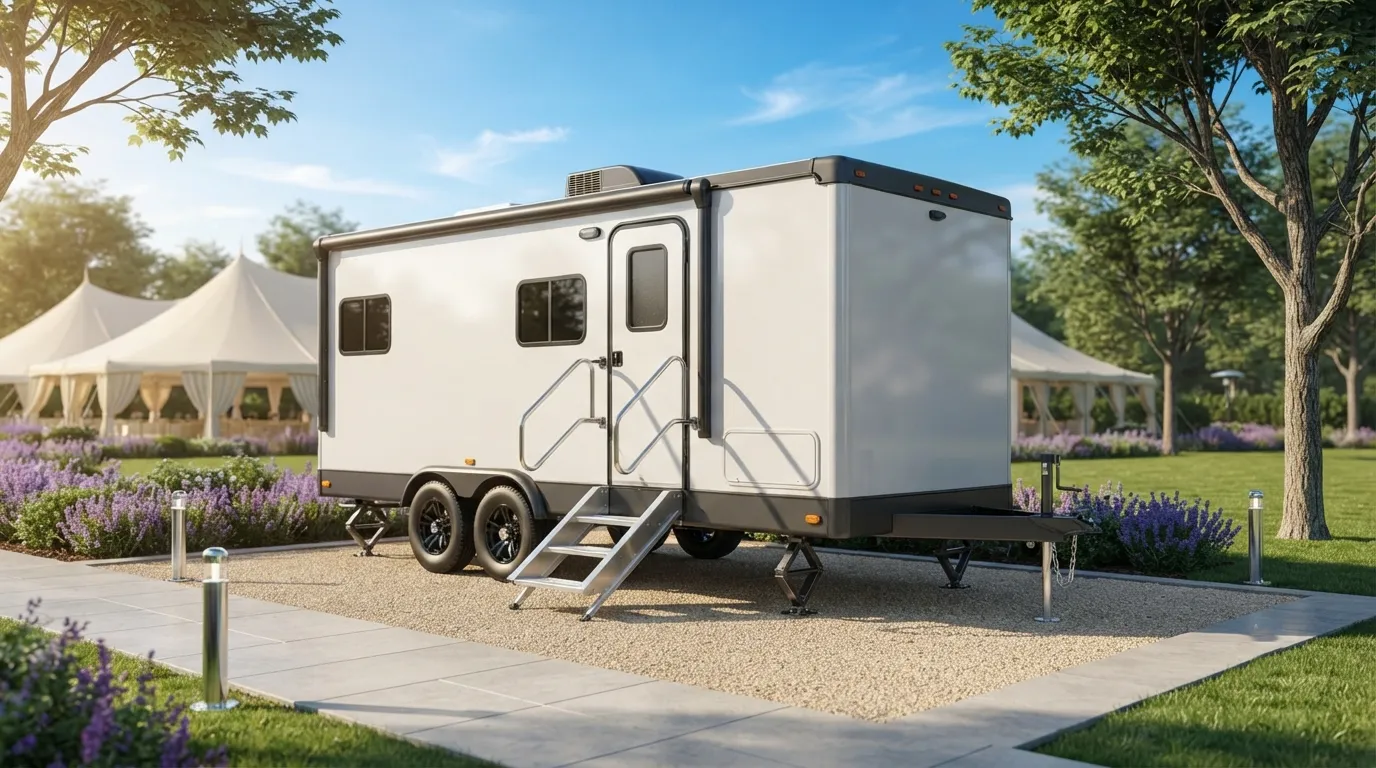
What is a restroom trailer, and how is it different from a porta potty?
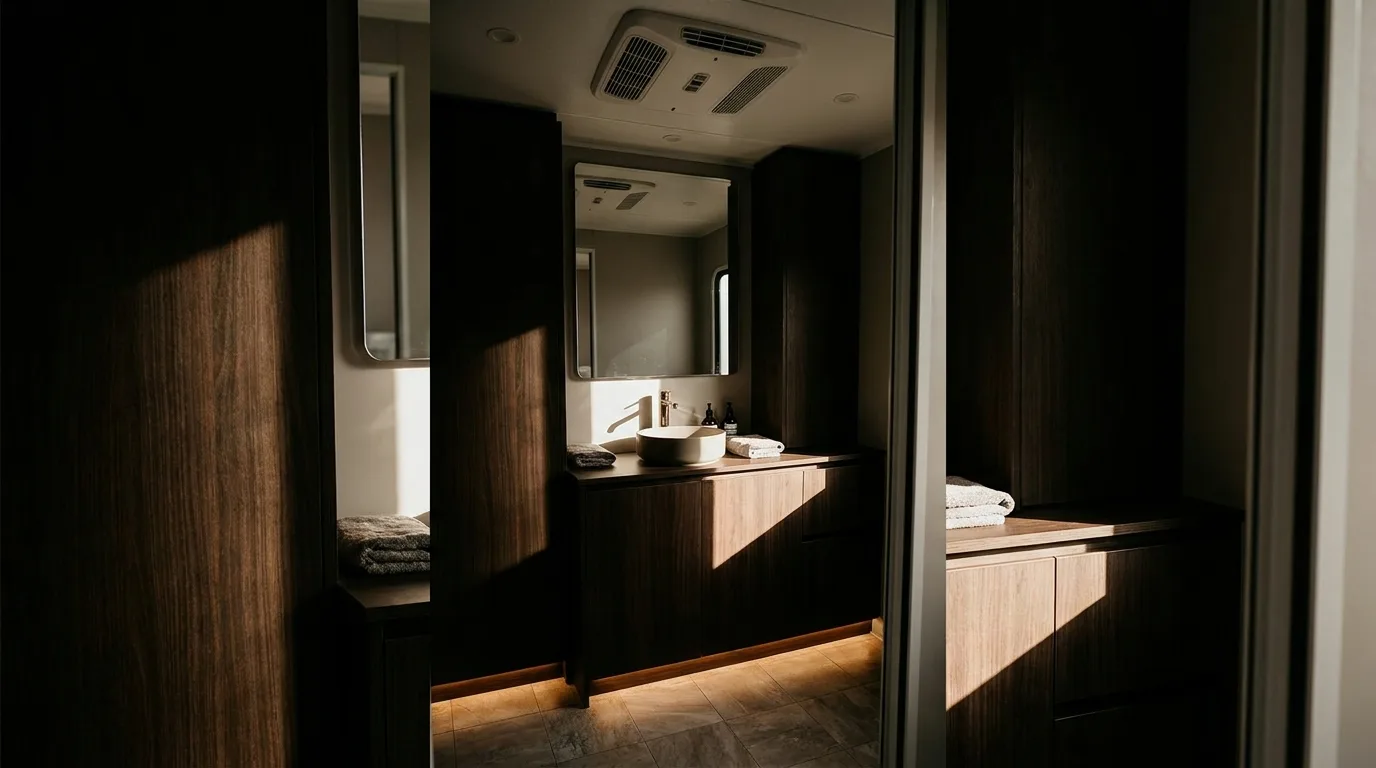
A restroom trailer is a towable unit with flushing toilets, running water, interior lighting and climate control, used where a standard portable toilet would not be good enough. Inside it reads as a small building bathroom: a bowl that flushes, a sink with a real tap, a mirror, a vanity light, a locking door and a hard floor you can walk on in heels.
The mechanical difference is the plumbing. A standard porta potty holds waste in a tank directly under the seat, and manufacturer specifications for the common units from PolyJohn and Satellite Industries put that tank at 60 to 70 gallons. A trailer splits the job in two: fresh water in one tank, waste in a much larger tank slung underneath, with a pump between them. That separation is why a trailer does not smell the way a hot unit does in August, and it is most of what you are paying for. The odour side of the standard units is covered on do porta potties smell, and the middle option, a deluxe flushable unit, sits between the two on both price and comfort. If you are still deciding between a trailer and a bank of portable toilets, the stall count and the guest list usually settle it.
Restroom trailer sizes, and what actually fits on a New York block
Trailers are sold by station count, meaning individual private rooms with a door, not by capacity. The figures below are typical manufacturer specification ranges for towable restroom trailers, and the last column is the constraint that matters more here than anywhere else in the country.
| Trailer | Body length | Waste tank | Comfortable for | Curb space needed |
|---|---|---|---|---|
| 2 station | 14 to 16 ft | 200 to 300 gal | Up to about 100 guests | One parking space plus tow vehicle |
| 3 station | 16 to 18 ft | 250 to 350 gal | About 150 guests | One and a half spaces |
| 4 station | 18 to 24 ft | 300 to 500 gal | About 250 guests | Two spaces |
| 6 station | 24 to 28 ft | 500 to 750 gal | About 400 guests | Two and a half spaces |
| 8 station | 28 to 34 ft | 750 to 1,250 gal | 500 guests and up | Three spaces, plus turning room |
Two-station units go places nothing else does. A Brooklyn backyard reached through a garage bay, a loading dock in the Garment District, a rooftop terrace with a service elevator to the roof deck: the short trailer is the one that gets in. At the other end, an eight-station unit is a 34 foot vehicle that has to be backed by a one-ton truck, and there are blocks in the West Village where that is simply not happening. Shower units are a separate build on the same chassis and are covered on the shower trailer page, and the higher-finish units with solid-surface counters and wood floors are on luxury restroom trailers.
What does a restroom trailer cost in New York City?
Typical market ranges for the five boroughs sit between $175 per day for a small two-station unit and $3,000 for a weekend with a large eight-station. These are market ranges reviewed July 2026, not a quote, and New York placements sit toward the top of every national band because of drive time, parking, permit work and night deliveries rather than the trailer itself.
| Trailer | Per day | Weekend | Per week | Per month |
|---|---|---|---|---|
| 2 station | $175 to $450 | $700 to $1,300 | $850 to $1,600 | $1,800 to $3,000 |
| 3 station | $275 to $600 | $850 to $1,600 | $1,100 to $2,000 | $2,300 to $3,800 |
| 4 station | $350 to $800 | $1,100 to $2,000 | $1,300 to $2,500 | $2,800 to $4,800 |
| 6 station | $550 to $1,200 | $1,500 to $2,500 | $1,800 to $3,200 | $3,800 to $6,000 |
| 8 station | $800 to $1,600 | $1,900 to $3,000 | $2,400 to $4,200 | $5,000 to $8,000 |
Published national weekend bands for restroom trailers run $900 to $3,000, with two-station units at the bottom and eight-station units at the top, which is exactly why a single average is misleading. Delivery in a per-week context typically adds $50 to $150 and weekly servicing $30 to $220. Every line is broken out on the restroom trailer cost page, and the standard unit comparison sits on what porta potty rental costs. For anything under three days, day-rate pricing is usually the cleaner way to buy.
Do you need a permit for a restroom trailer in New York City?
Yes, if any part of it sits on a street or a sidewalk. That placement needs a permit from the Department of Transportation, handled through the Bureau of Permit Management and Construction Control at 55 Water Street with the borough offices doing the approvals, and turnaround ranges from about a day to several weeks depending on the borough and the type of work. Call 311 for a straight answer on a specific address.
On private property, a parking lot, a driveway, a fenced site, a private plaza, none of that applies. The full walkthrough is on porta potty permit requirements, and if the same job needs a container, dumpster permits run on a separate track. Plan the permit before you plan the trailer. The approval clock drives more New York schedules than availability ever does.
Power, water and waste, and what the site has to supply
A restroom trailer is not a self-contained box. It wants electricity, it wants water, and it produces waste that has to go somewhere legal.
- Power. Most two and four station trailers run on a single 120 volt, 20 amp branch circuit, which under NFPA 70, the National Electrical Code, delivers about 2,400 watts. Larger units with air conditioning and water heaters want 30 or 50 amp service. If there is no outlet within reach, the answer is a generator, and a temporary power pole is the better long-term fix on a construction site.
- Water. A garden hose connection is enough. Where there is no tap, the fresh tank gets filled at delivery. Pulling water from a city hydrant is not a workaround: that needs a hydrant permit from the Department of Environmental Protection, which delivers roughly a billion gallons of drinking water a day and does not treat hydrants as a free tap.
- Waste. Water weighs 8.34 pounds per gallon, so a 1,000 gallon waste tank at capacity is carrying more than four tons before you count the trailer. That is why big units get pumped on site rather than towed out full. Waste goes to a Department of Environmental Protection wastewater resource recovery facility, of which the city operates 14, treating about 1.3 billion gallons a day.
Long jobs sometimes add a holding tank so the trailer can be pumped on a schedule instead of a panic, and septic pumping service covers the vacuum-truck side. Night work usually needs a light tower as well.
Getting a trailer onto a New York City block
Placement here is decided by pedestrian clearance before anything else. A trailer must never block a curb ramp, a building entrance, an emergency path or a work-zone route, and the 2010 ADA Standards require a minimum 36 inch clear width on a pedestrian access route in section 403.5.1. Beyond that, the list of things that kill a placement in this city is long and mostly local:
- Sidewalk sheds. The Department of Buildings Facade Inspection Safety Program keeps thousands of sheds standing across Manhattan and the Bronx, and a shed leaves nowhere to open a trailer door.
- Parkway routing. Commercial vehicles are banned from the parkway network, so the FDR Drive, the Belt Parkway and the Henry Hudson are closed to the tow truck however direct they look. Routing runs on the NYC DOT truck route network instead.
- Hydrants. City traffic rules prohibit parking within 15 feet of a fire hydrant, and a 30 foot trailer covers a lot of curb.
- Alternate side parking, which can move a trailer mid-rental if nobody planned around it.
- Protected bike lanes and bus lanes, which take the curb lane you were counting on.
- Co-op and condo boards, which usually want the placement, the dates and a certificate of insurance before anything is booked. That approval takes longer than the trailer does.
The placement guide covers what a driver looks at when he pulls up, and the rental checklist is the list to have answered before you call. Jobs running a roll-off dumpster on the same block should book both placements together, because the curb is the scarce thing, not the equipment.
Weddings, galas and park events
Trailers earn their keep at events where guests are dressed for photographs. Prospect Park covers 526 acres, Flushing Meadows Corona Park 897 and Randalls Island Park about 480, and all three take weddings and private events under an NYC Parks special event permit that has to be applied for weeks ahead rather than days. Each site has its own service vehicle access rules, and none of them match, so ask the venue where a trailer is allowed to stand before you pick a size.
For a 150 guest reception, a four-station unit is the usual answer, and a two-station is enough for an intimate ceremony of 60. Wedding restroom rental goes through the layout and the timing, event restroom rental covers the broader planning, and larger public gatherings are handled on festival and concert pages. Guests notice one thing above all: whether there is a working sink. A portable sink or a handwashing station next to the trailer removes the queue at the vanity.
Film sets, base camps and long production days
New York shoots more television than almost anywhere, and a base camp is a small village parked on a street for twelve hours. Production books through the Mayor's Office of Media and Entertainment, which issues the permit that holds the parking, and the restroom trailer usually lands next to the honey wagon and the mobile office trailer. Cast trailers are quiet by design, so the generator placement matters as much as the trailer placement, especially under the city noise code adopted as Local Law 113 of 2005.
Film set restroom rental covers call times, strike windows and why a Sunday load-in prices differently. Long shoots often add a shower trailer and a storage container on the same delivery.
Construction sites: when a trailer beats a bank of porta potties
OSHA 1926.51(c)(1) requires one toilet per 20 workers on a construction site working a 40-hour week, counted across every trade on the job rather than per company, and OSHA 1926.51(d) requires washing facilities alongside them. A trailer satisfies the same rule with better conditions, and on a long interior fit-out with finished floors it is often the only thing management will allow near the work.
The economics turn on duration. Below about three weeks, a bank of standard units plus a portable sink is cheaper. Past three months, the monthly trailer rate starts to look reasonable against the crew time lost walking to a coffee shop. Construction site services bundles restrooms, fencing and power under one order, monthly rental pricing covers the long-job math, and OSHA portable toilet requirements has the full ratio table.
How many stations do you need?
Count guests, then hours, then alcohol. Portable Sanitation Association International event guidance puts one restroom per 50 to 100 guests for a four-hour event, and recommends adding 15 to 20 percent when alcohol is served, because people drink and then queue. A four-station trailer covers a 200 guest wedding comfortably. The same trailer at a 400 person street fair is a line all afternoon.
Work the number out on how many porta potties do I need before you call, and for distance events see marathon restroom rental, golf tournaments and county fairs, all of which spread demand differently across a course or a footprint.
ADA access, ramps, and the 1:12 problem
An accessible restroom trailer needs more than a wide door. The 2010 ADA Standards cap ramp running slope at 1:12 in section 405.2, so a trailer floor sitting 36 inches above grade needs 36 feet of ramp run plus landings, which is more sidewalk than most New York placements have. That is why accessible trailers are usually specified with a powered lift instead.
Inside, section 404.2.3 requires 32 inches of clear door width, section 604.8.1.1 sets a wheelchair-accessible compartment at 60 inches minimum width, and section 305.3 requires a 30 by 48 inch clear floor space. ADA restroom requirements covers the full spec, and where a lift will not fit, an ADA accessible ground-level unit set beside the trailer is the practical answer.
Winter, heat and the seasons here
Water freezes at 32 degrees Fahrenheit, and a trailer full of plumbing does not care that the forecast said it would hold. Winter units run heated tanks, heated lines and an interior heater, all of which need power, which is the real reason a January rental costs more than a June one. Between roughly December and March, ask specifically whether the unit is winterised rather than assuming it.
Summer is the opposite problem. Air conditioning on a trailer parked in full sun on asphalt draws steadily, and an undersized generator will trip in the afternoon. Porta potties in winter covers the cold-weather side for standard units, and if a unit fails mid-event, emergency rental is the number to have.
How often is a restroom trailer serviced?
ANSI/PSAI Z4.3, the American National Standard for nonsewered waste-disposal systems, sets the minimum service expectations the trade works to, and weekly service is the baseline for a standing unit. Event trailers are different: a busy wedding trailer often gets an attendant or a mid-event service, and a festival unit may be pumped twice in a day.
Service on a trailer means pumping the waste tank, refilling fresh water, restocking paper and soap, wiping the vanities and checking the pump. How often porta potties are cleaned covers the standard-unit schedule, and emergency septic service is what happens when a tank fills faster than anyone planned.
What a fair restroom trailer quote includes
A complete quote names seven things: station count, rental period, delivery and pickup as separate lines, how many services are included, what power and water the site must supply, whether a DOT permit is needed for that exact address, and the after-hours delivery charge if any.
Should be included: delivery, setup and levelling, pickup, one service on a short rental, paper, soap and hand towels, and the initial fresh water fill.
Reasonably extra: additional services, generator rental, a winterisation package, restricted-hours or overnight delivery, permit filing time, an attendant, and a dry run when the truck cannot place the unit.
Should not be extra: a fuel surcharge nobody mentioned, an undefined environmental fee, or a cleaning charge on a trailer that came back in normal condition. Our quote form asks for all of it up front, and the contact page has the direct line if you would rather talk it through.
Questions people ask about restroom trailer rental in NYC
How much is a mobile restroom trailer rental near me? $700 to $3,000 for a weekend across the five boroughs, depending on station count. Two-station units sit at the bottom of that range and eight-station units at the top.
Can a restroom trailer park on a Manhattan street? Only with a DOT permit, and only where the placement clears the pedestrian path, curb ramps, entrances and hydrants. Plenty of narrow blocks cannot take one legally at any size.
Does it need to be plugged in? Yes, or it needs a generator. Most small units want a single 120 volt, 20 amp circuit. Larger units with air conditioning want 30 or 50 amp service.
What if there is no water on site? The fresh tank gets filled at delivery, which covers a normal event day. Multi-day rentals without a tap get scheduled refills instead.
How far ahead should I book? Two to four weeks for a park or venue event, longer for May, June, September and October weekends. Street placements move at the permit's pace, not ours.
Do you deliver outside the five boroughs? Yes. Jersey City, Hoboken, Newark, Hempstead and Levittown are all inside normal range. The full list is on the service areas page.
Can I rent a trailer and standard units together? That is most large events. Trailers near the guests, standard units at the back of house. See porta potty rental in New York City for the standard fleet, the home page for everything we run, and the FAQ or the about page for the rest.
What is a 2 stall restroom trailer?
Two private rooms on one frame. A 4 stall restroom trailer adds two more and a wider tongue.
Next step
Get a delivery date
Tell us the address, the dates and the headcount. We size the order and confirm the route.