
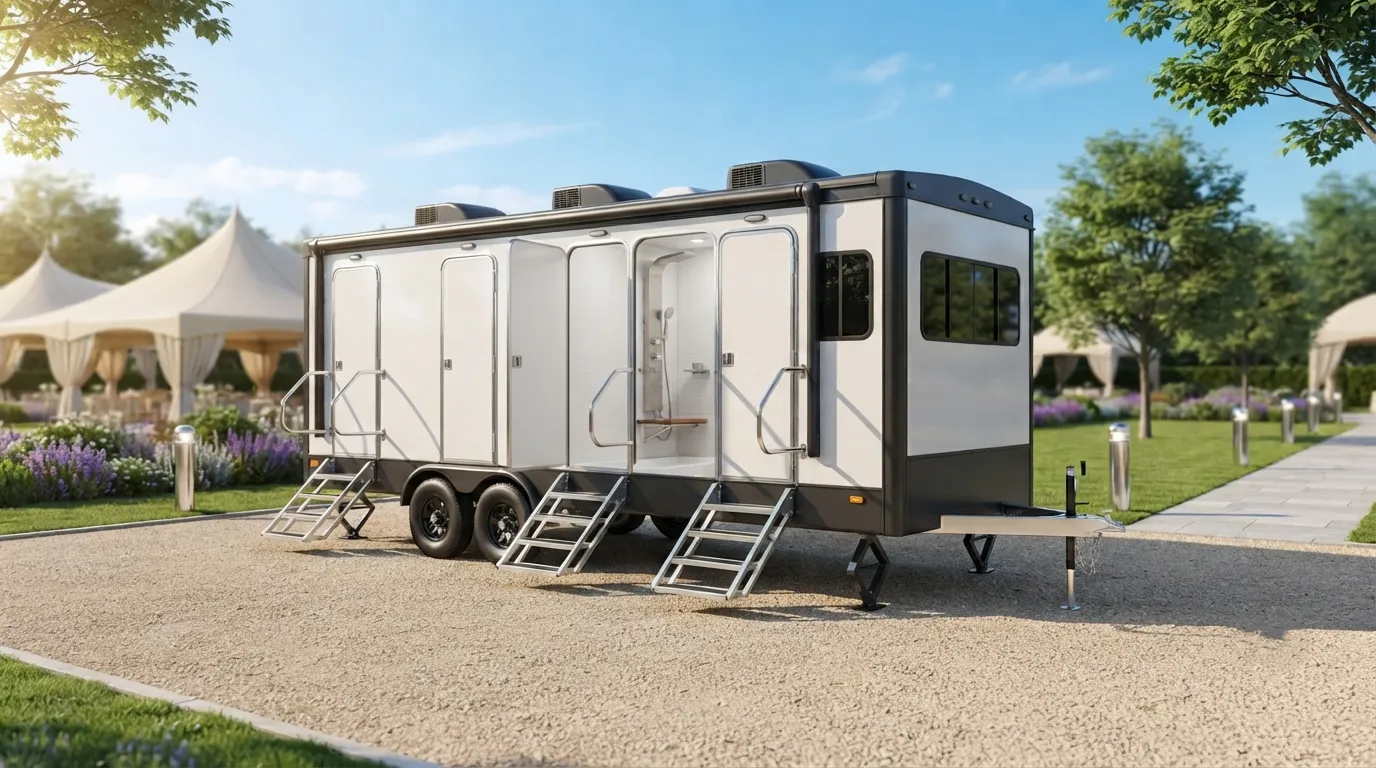
What is a shower trailer?
A shower trailer is a towable unit containing private shower stalls with hot running water, built on the same chassis as a restroom trailer but plumbed for volume instead of flushing. A typical stall has a changing bench, a hook, a non-slip floor, a lockable door and a thermostatic mixing valve so the water does not swing hot and cold when someone else turns a tap.
Configurations split three ways. Shower-only trailers put every room on the same job. Combination units pair showers with toilets and sinks in one body. Gang units run an open bay with multiple heads for crews who need throughput rather than privacy. Which one you want depends entirely on who is using it, and the answer for a film cast is not the answer for a demolition crew.
Water: the number that decides everything
The Energy Policy Act of 1992 caps residential showerheads at 2.5 gallons per minute, and the EPA WaterSense specification tightens that to 2.0. At 2.0 gallons a minute, a ten-minute shower is 20 gallons in and 20 gallons out.
Run that against a crew of 30 and you are moving 600 gallons a day. Water weighs 8.34 pounds per gallon, so 600 gallons of greywater is a two and a half ton problem sitting under the trailer. This is why shower trailers are specified around supply and disposal rather than stall count:
| Users per day | Water in and out | Practical setup |
|---|---|---|
| Up to 15 | 300 gal | 2 station unit, hose supply, daily pump |
| 15 to 40 | 300 to 800 gal | 4 station unit, hose supply, daily pump |
| 40 to 100 | 800 to 2,000 gal | 6 to 8 station unit, dedicated supply, twice-daily pump |
| 100 plus | 2,000 gal plus | Multiple units plus a staged holding tank |
Figures are planning estimates based on a ten-minute shower at the WaterSense rate, not a quote. Where there is no tap, a holding tank staged beside the trailer handles the greywater between pumps, and septic pumping service covers the vacuum truck. Pulling from a city hydrant is not an option without a hydrant permit from the Department of Environmental Protection, which delivers roughly a billion gallons of drinking water a day and regulates hydrant use tightly.
When does OSHA require showers on a New York job?
More often than most contractors here expect, because of what New York buildings are made of.
- Lead. OSHA 1926.62(i)(2) requires shower facilities where feasible for employees working above the permissible exposure limit for lead. In a city where New York's Local Law 1 of 2004 governs lead paint hazards in residential buildings and most housing stock predates 1978, that comes up on ordinary renovation work.
- Asbestos. OSHA 1926.1101 requires hygiene facilities including showers for Class I asbestos work, and the New York City Department of Environmental Protection runs the Asbestos Control Program that most renovation filings pass through.
- Hazardous waste and emergency response. OSHA 1926.65 sets decontamination requirements for hazardous waste operations, and OSHA 1910.151(c) requires quick-drench facilities where corrosive materials are present.
- General washing facilities. OSHA 1926.51(d) requires washing facilities on construction sites and OSHA 1926.51(f) requires potable water, which is a separate obligation from showers and is usually met with a portable sink or a handwashing station.
Handwashing requirements covers the sink side, and OSHA portable toilet requirements covers the restroom ratios that run alongside. Read them together, because a decon shower without a toilet on site fails the inspection anyway.
What does a shower trailer cost in New York City?
| Trailer | Per day | Weekend | Per week | Per month |
|---|---|---|---|---|
| 2 station shower | $175 to $450 | $700 to $1,300 | $850 to $1,600 | $1,800 to $3,000 |
| 4 station shower | $350 to $800 | $1,100 to $2,000 | $1,300 to $2,500 | $2,800 to $4,800 |
| 6 station shower | $550 to $1,200 | $1,500 to $2,500 | $1,800 to $3,200 | $3,800 to $6,000 |
| 8 station shower | $800 to $1,600 | $1,900 to $3,000 | $2,400 to $4,200 | $5,000 to $8,000 |
Market ranges reviewed July 2026, not a quote. Shower units price in the same territory as restroom trailers of the same length because they are built on the same chassis, but the servicing cost is higher: more water in, more water out, more pump visits. Delivery in a per-week context typically adds $50 to $150, and each additional service $30 to $220. The restroom trailer cost breakdown itemises the lines, and porta potty rental cost covers the sanitation you will need beside it.
Power, heat and the New York winter
A shower trailer heats water, and heating water is the largest electrical load on any portable unit. A 120 volt, 20 amp branch circuit delivers about 2,400 watts under NFPA 70, the National Electrical Code, which is not enough for a multi-stall unit with an electric water heater. Expect a 50 amp requirement on anything above four stations, or a propane-fired heater with the fuel storage that implies, which brings FDNY permitting into the conversation on a city site.
Cold weather is the other constraint. Water freezes at 32 degrees Fahrenheit and a shower trailer carries far more exposed plumbing than a restroom trailer does. Between roughly December and March, ask specifically about heated tanks, heat-traced supply lines and an interior heater, and budget for the extra power they draw. Porta potties in winter covers the cold-weather side of the standard fleet, and a temporary power pole is the honest fix on any long jobsite.
Where a shower trailer goes in the five boroughs
Placement is decided by pedestrian clearance before anything else, and a shower trailer adds a drainage question on top. It must never block a curb ramp, a building entrance, an emergency path or a work-zone route, and the 2010 ADA Standards require a minimum 36 inch clear width on a pedestrian access route in section 403.5.1.
Greywater is the part that catches people out. It does not go into a storm drain. New York City runs a largely combined sewer system, and discharge is regulated by the Department of Environmental Protection, which operates 14 wastewater resource recovery facilities treating about 1.3 billion gallons a day. Waste from a shower trailer is pumped and hauled to one of them, same as restroom waste.
Any placement on a street or sidewalk needs a Department of Transportation permit, filed through the Bureau of Permit Management and Construction Control at 55 Water Street with the borough offices doing approvals, and turnaround ranges from about a day to several weeks. Commercial vehicles are banned from the parkway network, so routing runs on the NYC DOT truck route network instead. See porta potty permit requirements and the placement guide.
Who rents shower trailers here
Film and television is the steady customer. Production books through the Mayor's Office of Media and Entertainment, and a base camp holding a cast for fourteen hours needs somewhere to clean up before a second unit call. Film set restroom rental covers the wider base camp setup, alongside the mobile office trailer.
The rest of the demand splits into:
- Long construction and demolition jobs, particularly lead and asbestos work in pre-war buildings. Construction site services bundles it with restrooms and fencing.
- Emergency and storm response. A coastal city with a dense low-lying shoreline needs washing capacity fast when power or water goes down. See disaster relief sanitation and emergency porta potty rental.
- Endurance events. The marathon runs 26.2 miles through all five boroughs, and races staging out of Randalls Island Park, roughly 480 acres, and Prospect Park, 526 acres, put showers at the finish under an NYC Parks special event permit. See marathon restroom rental and festival restroom rental.
- Camps, farms and outdoor programmes outside the dense boroughs, covered on camping porta potty rental and farm and agricultural restrooms.
How often does a shower trailer get serviced?
More often than a restroom trailer, because greywater accumulates faster than blackwater. ANSI/PSAI Z4.3, the American National Standard for nonsewered waste-disposal systems, sets weekly service as the baseline for a standing portable unit, but a shower trailer carrying 30 users a day will need pumping daily and restocking of soap and towels on the same visit.
Service means pumping greywater, refilling fresh water, checking the heater and the mixing valves, cleaning the stalls and clearing the drains. How often units are cleaned covers the standard schedule, and emergency septic service is the number when a tank fills ahead of the plan.
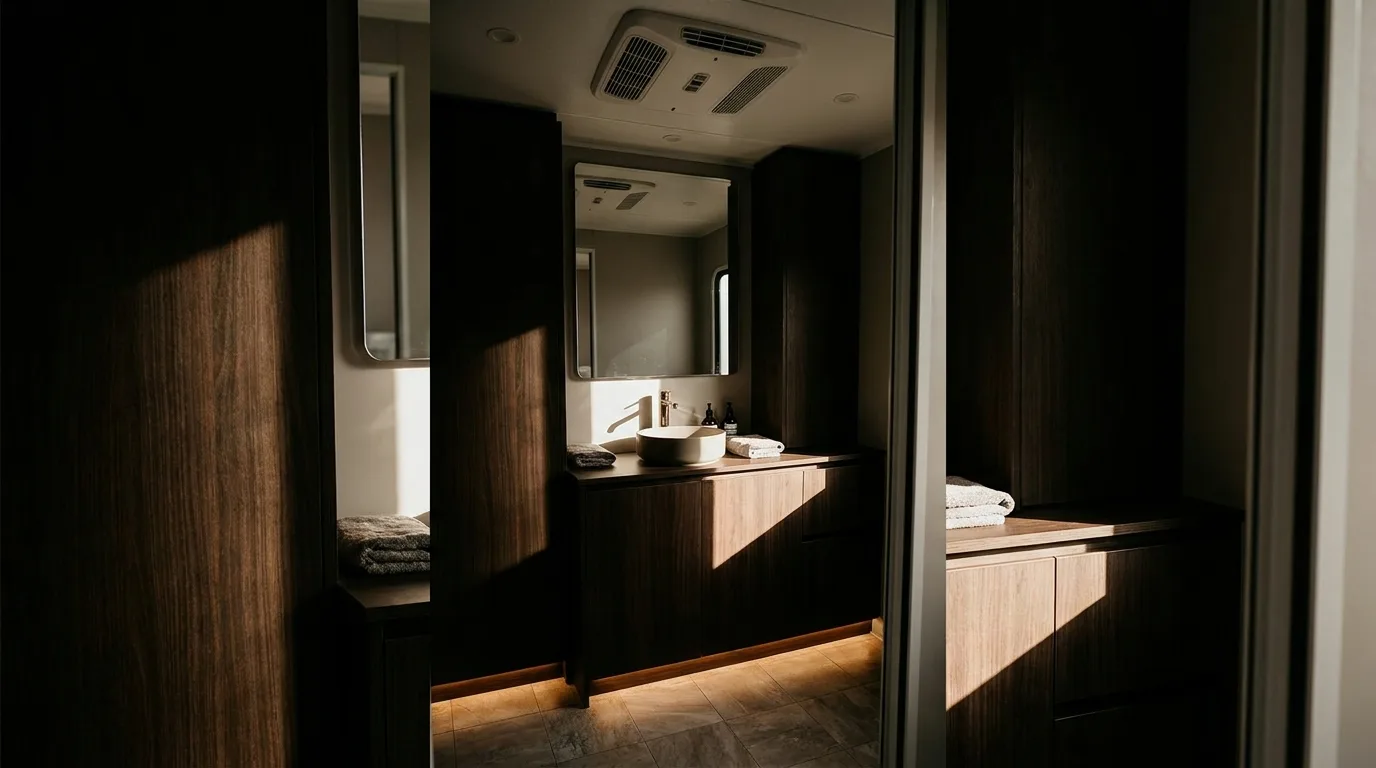
Booking a shower trailer
Tell us four things and we can size it in one call: how many people, how many days, what water source exists on site, and what power exists on site. If the answer to the last two is nothing, that is fine, it just changes the equipment list. Accessible stalls follow the 2010 ADA Standards, which cap ramp running slope at 1:12 in section 405.2 and require 32 inches of clear door width in section 404.2.3; see ADA restroom requirements.
Can I rent shower trailer units by the week?
Yes. Portable shower trailer rental runs weekly or monthly, with a service schedule attached.
The rental checklist has the full list, the quote form collects it, and the contact page is the direct line. We deliver across all five boroughs plus Jersey City, Newark, Hempstead and the rest of the areas we serve. For higher-finish units see luxury restroom trailers, and for a small footprint the 2 station trailer is the one that fits a Brooklyn garden.
Next step
Get a delivery date
Tell us the address, the dates and the headcount. We size the order and confirm the route.