
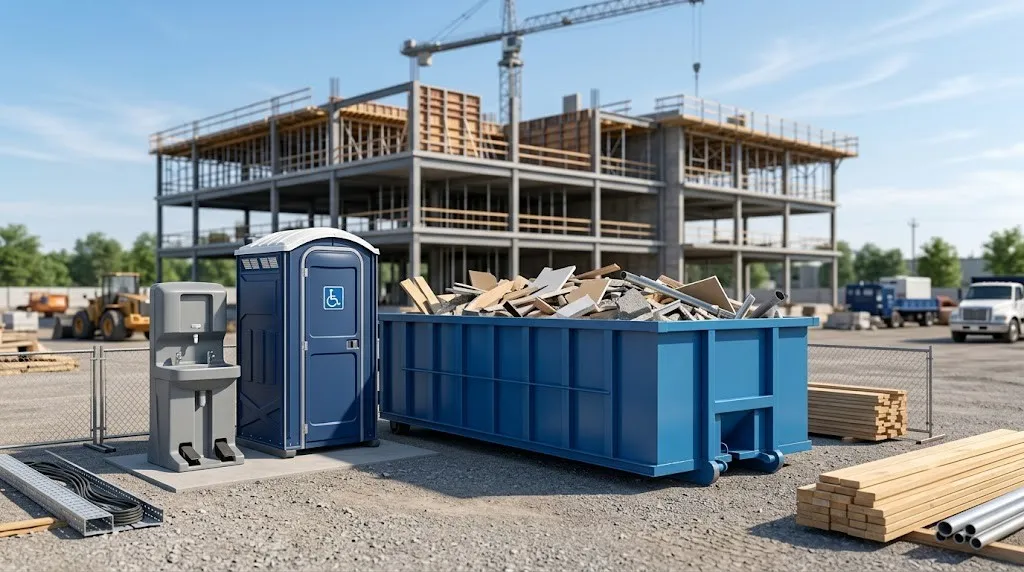
What size dumpster does a construction site need?
It depends on the debris density far more than on the size of the job. A construction dumpster is a roll-off container assigned to a jobsite and hauled on a schedule, and picking the size wrong is the most common way a project overpays for waste.
- 10 yard. Concrete, masonry, tile, soil. Anything dense. This is the heavy-material container by design.
- 20 yard. The default for renovation and fit-out work. Roofing tear-offs, mixed interior demolition, framing and finishes.
- 30 yard. Full gut-outs and commercial strip-outs where the debris is bulky rather than dense.
- 40 yard. Light high-volume material on a site with real space, so mostly private lots and industrial buildings.
The 20, 30 and 40 yard containers share a 22 by 8 foot footprint per manufacturer spec, so on a site with the room, sizing up costs less than the extra haul it saves. Full measurements sit on the sizes and dimensions page, and the roll-off dumpster overview covers the mechanics.
How does a dumpster swap schedule work?
A swap is a single trip where the truck hauls the full container and leaves an empty one in the same spot. On a long job it beats a long rental for three reasons: your footprint on site stays constant, you never wait for a round trip, and you pay per haul rather than for days a container sat idle.
Typical rhythm on a New York renovation:
- Demolition phase, two or three swaps a week while the gut is happening.
- Rough phase, one swap a week as the trades generate packaging and offcuts.
- Finish phase, one swap every week or two, mostly cardboard and protection.
- Final clean, one last haul before punch list.
Tell us the phase you're in and the schedule follows. What breaks a swap schedule is a container loaded past its tonnage, because then the truck can't take it and the whole rhythm stalls. Federal rules cap a loaded vehicle at 80,000 pounds gross weight under 23 CFR 658, so the allowance isn't negotiable no matter how urgent the site is. Dumpster weight limits has the numbers.
How construction debris gets separated
Separation saves money on almost every New York job, because different streams go to different facilities at different rates. Clean concrete, clean wood and scrap metal are all worth more sorted than mixed.
Some of it isn't optional. Asbestos goes to a licensed abatement contractor, and the NYC Department of Environmental Protection requires an ACP-5 filing before many Department of Buildings sign offs. Televisions, monitors and computers have been banned from landfill disposal since January 2015 under New York State's Electronic Equipment Recycling and Reuse Act, which matters on any commercial strip-out. Refrigeration equipment needs certified refrigerant recovery under Section 608 of the federal Clean Air Act, and window air conditioners come out of residential buildings by the dozen. The complete list is on what cannot go in a dumpster.
Pre-war building stock adds a lead question too. New York City's Local Law 1 of 2004 governs lead paint hazards in residential buildings, and painted-surface demolition in an older apartment is not a straightforward roll-off job.
Debris chutes and loading from upper floors
On a Manhattan or Brooklyn interior job, the container is often nowhere near the work. Debris comes down a chute hung off scaffolding, or gets carried down in bins, and both change how the container has to be positioned.
Two things follow. The chute discharge point has to line up with the container, which means the placement is set by the building rather than by the curb. And chute-fed loads fill unevenly, so somebody needs to level the load before the truck arrives, or it can't be tarped. Chapter 33 of the New York City Building Code covers safeguards during construction, and on a Department of Buildings permitted job the container position is usually written into the site safety arrangements before anybody calls a hauler.
Do construction sites need a permit for the container?
If the container sits on a street or sidewalk, yes. The New York City Department of Transportation issues the permit through its Bureau of Permit Management and Construction Control at 55 Water Street, borough offices handle approvals, and turnaround runs from about a day to several weeks depending on the borough and the type of work. 311 answers questions about a specific address.
Placement legality is tested before the permit is. The 2010 ADA Standards require a minimum 36 inch clear width on a pedestrian access route in section 403.5.1, and no container can block a curb ramp, building entrance or emergency path. Overhead is the other test, since a roll-off truck needs roughly 22 feet of clearance to raise its hoist, and the city's Facade Inspection Safety Program keeps thousands of sidewalk sheds standing across Manhattan and the Bronx. Under a shed, no container. Dumpster permit requirements has the full sequence.
One more check for commercial work: private trade waste in New York City is regulated by the Business Integrity Commission under Title 16-A of the Administrative Code. Most general contractors want the carter's BIC license number on file before a container arrives on a permitted site.
What does a construction dumpster cost in New York City?
Typical market ranges are $425 to $800 per haul depending on container size and debris, with extra days around $50 to $115 and tonnage allowances from 1 to 6 tons. Prices reviewed July 2026, and they are market ranges rather than a quote.
Long jobs are priced on hauls and tonnage rather than a flat monthly figure, because that's what actually drives the cost. Get two numbers named before you start: the per-haul rate and the per-ton overage rate. Everything else is detail. The dumpster rental cost page breaks out each line.
What else does a New York City jobsite need alongside the container?
Sanitation, usually on the same delivery. OSHA 1926.51(c)(1) requires one toilet per 20 workers on a construction site working a 40-hour week, counting people on site rather than companies, so a job running four trades counts all of them. OSHA 1926.51(f)(1) separately requires washing facilities where workers handle harmful substances, which is why a portable sink belongs on a real jobsite order.
The rest of a typical New York site package:
- Porta potty rental on monthly service, priced on the cost page
- An ADA accessible unit where the site is open to the public
- Temporary fencing around the work zone, priced on the fence cost page
- Light towers for winter afternoons and night pours
- A mobile office trailer and a temporary power pole on larger sites
- A storage container for tools and materials
- Crowd control barrier where pedestrians pass the work
Construction site services bundles it into one order and one invoice.
Questions people ask about construction dumpsters
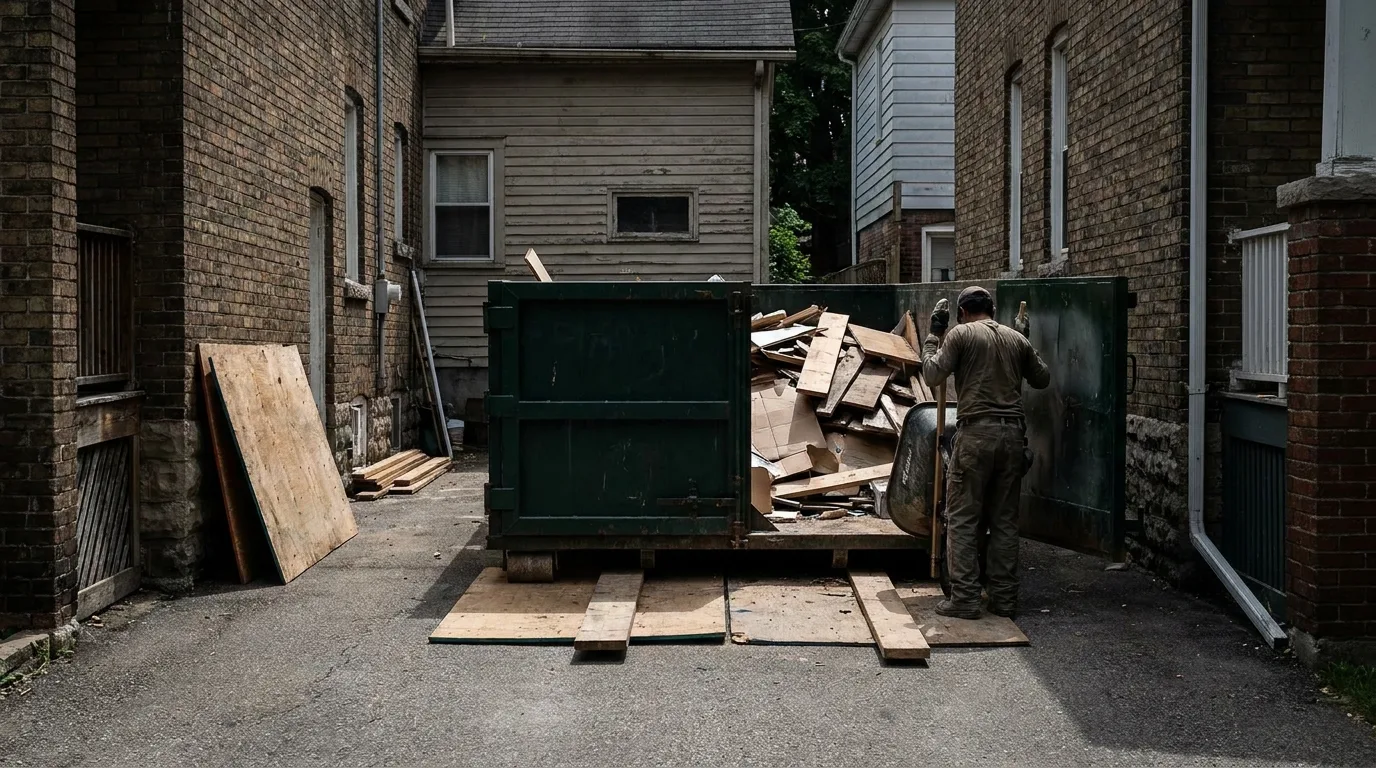
How many containers does a typical renovation need? One on a swap schedule, sized to the debris. Two only when heavy and light material need separating, which is common on demolition.
Can the container stay on the street for the whole job? Only for as long as the DOT permit runs. Build the duration into the original filing rather than amending later.
What if the site can't take a container at all? It happens in Manhattan more than people expect. The usual answer is a 10 yard container placed during a permitted window and swapped frequently.
Do you work with film and television productions? Yes. Strike days generate a large volume of light bulky waste, and film set restroom rental covers the sanitation side.
Where do you deliver? All five boroughs plus Jersey City, Newark, Hoboken and North Bergen. The full list is on the service areas page.
What does construction dumpster rental cost on a small build?
Construction dumpster rental prices in New York City move with tonnage, not with how long the box sits.
Is there a small construction dumpster rental for tight sites?
Yes. A 10 yard construction dumpster fits where a 30 cannot, and it takes heavy clean loads.
Send the job address, phase and debris type through the quote form and you'll get container sizing, a haul rate and a tonnage allowance back. The contact page has the direct line, the FAQ covers the rest, and everything we run sits on the home page.
Next step
Get a delivery date
Tell us the address, the dates and the headcount. We size the order and confirm the route.