
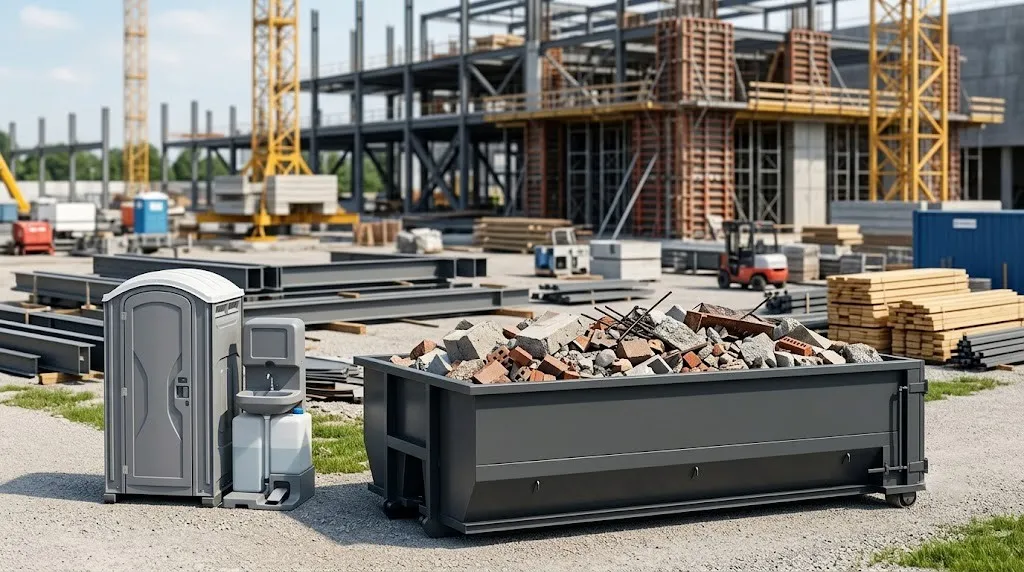
How many tons does a dumpster hold?
Every roll-off rental includes a tonnage allowance, separate from the cubic yard capacity. Volume tells you what fits. Tonnage tells you what can legally leave the site.
| Container | Volume | Typical allowance | Empty weight | Suits |
|---|---|---|---|---|
| 10 yard | 10 cu yd | 1 to 2 tons | 2,000 to 3,000 lb | Concrete, dirt, brick, tile |
| 20 yard | 20 cu yd | 2 to 3 tons | about 4,000 lb | Renovation debris, roofing |
| 30 yard | 30 cu yd | 3 to 4 tons | 5,000 to 6,000 lb | Gut-outs, mixed light debris |
| 40 yard | 40 cu yd | 4 to 6 tons | 7,000 to 8,000 lb | Bulky light demolition waste |
Empty weights are typical manufacturer figures and vary with steel gauge. That tare weight is deducted at the scale, so you only ever pay for the debris. Full dimensions for each size are on the sizes and dimensions page.
Why is there a weight limit at all?
Because the truck has to drive on public roads. Federal weight rules under 23 CFR 658 cap a loaded commercial vehicle at 80,000 pounds gross vehicle weight, and once you subtract the tractor, the hoist and an empty container of 2,000 to 8,000 pounds, what's left is the payload. That number is what appears on your quote as the tonnage allowance.
New York State layers its own limits on top of the federal ones. Section 385 of the New York State Vehicle and Traffic Law sets dimension and weight limits for vehicles on state highways, and inside New York City the Department of Transportation truck route network is where a loaded roll-off truck is actually allowed to run. Commercial vehicles are banned from the parkway network, so the FDR Drive, the Belt Parkway and the Henry Hudson Parkway are all closed to it. Longer routes and more bridges mean a driver has less margin for an overloaded container, not more. A truck that can't legally move is a wasted day for everyone.
How much does construction debris weigh?
Far more than people expect, and this is where jobs go wrong. Approximate weights per cubic yard:
| Material | Weight per cubic yard |
|---|---|
| Broken concrete | about 4,000 lb |
| Brick and block | about 3,000 lb |
| Soil and fill | 2,000 to 2,700 lb |
| Plaster and lath | 1,200 to 1,600 lb |
| Mixed construction debris | 500 to 800 lb |
| Drywall | about 500 lb |
| Wood framing and lumber | 300 to 500 lb |
| Yard waste and brush | about 350 lb |
Asphalt shingles are usually counted by roofing square instead, at roughly 230 to 400 pounds per 100 square feet of roof. A 22 square tear-off is therefore 2.5 to 4.4 tons of shingle before anyone touches the plywood underneath, which is the whole allowance on a 20 yard container.
Run the concrete number and the logic becomes obvious. Two and a half cubic yards of broken concrete is 5 tons. That's why concrete goes in a 10 yard container as a clean load, and why a 40 yard can full of it would be undriveable.
What happens if you go over the weight limit?
Overage bills per ton at the prevailing transfer station rate. The rate moves with the disposal market, so we quote it live rather than publishing a figure, and you should get that number named on your quote before the container arrives. A booking without a stated per-ton rate isn't a complete quote, and we won't take a demolition job without giving you one.
If a container is loaded well past what the truck can carry, the driver can't take it at all. That means a stood-down crew, a rescheduled haul, and material moved by hand into a second container. It's a bad day and it's entirely avoidable with one honest conversation about what's going in. Dumpster rental cost breaks out every line including overage, and roll-off dumpster rental covers how swap schedules keep long jobs under the limit.
How much does an empty dumpster weigh?
Between roughly 2,000 pounds for a 10 yard and 8,000 pounds for a 40 yard, depending on manufacturer and steel gauge. A 20 yard sits around 4,000 pounds and a 30 yard between 5,000 and 6,000.
Those figures matter for two reasons beyond the scale. First, the ground under the container carries the tare weight plus the load, which is why plywood under the rails is standard on a driveway. Second, on a permitted street placement in New York the combined weight sits on a city roadway for the duration of the rental, and that's part of what a permit from the Department of Transportation, issued through its Bureau of Permit Management and Construction Control at 55 Water Street, is authorising. Borough turnaround runs from about a day to several weeks, and the placement still has to leave the 36 inch minimum clear pedestrian width required by section 403.5.1 of the 2010 ADA Standards. See dumpster permit requirements.
How to stay under the weight limit
- Separate heavy material. Concrete, dirt, brick and tile go in their own small container at a
dedicated tonnage rate.
- Book by weight, not by volume, when the debris is dense. Two swaps on a small container beat
one overloaded big one.
- Tarp the container if rain is forecast. Water in drywall or soil is tonnage you pay for.
- Load evenly and keep it level with the top rail. An overfilled container legally can't be
tarped or moved.
- Pull the recyclables and restricted items first. Metal has value, and prohibited material gets
the whole load rejected. See what cannot go in a dumpster.
- Tell your hauler what the debris actually is. Guessing costs more than being honest.
Weight problems that are specific to New York City
Pre-war building stock across New York City is heavier than almost anything a national calculator assumes. Plaster and lath instead of drywall, cast iron soil stacks instead of PVC, terrazzo and mud-set tile instead of thinset, and old-growth framing throughout. A brownstone bathroom gut in Park Slope or Bed-Stuy can run past 2 tons out of a room that would barely register in a 1990s subdivision.
Transfer station distance is the second factor. Where the container is hauled from a Manhattan or inner-Brooklyn placement affects both the routing and the tipping cost, and it's one reason quotes vary by borough for identical containers. The third is access: a container that has to be hand-loaded because the truck can't get square tends to end up unevenly loaded, and uneven loads are the ones that fail at the scale.
Crews doing this work need facilities on site while it happens. OSHA 1926.51(c)(1) requires one toilet per 20 workers on a construction site working a 40-hour week, counting every trade rather than every company. See porta potty rental in New York City, what it costs or the bundled construction site services.
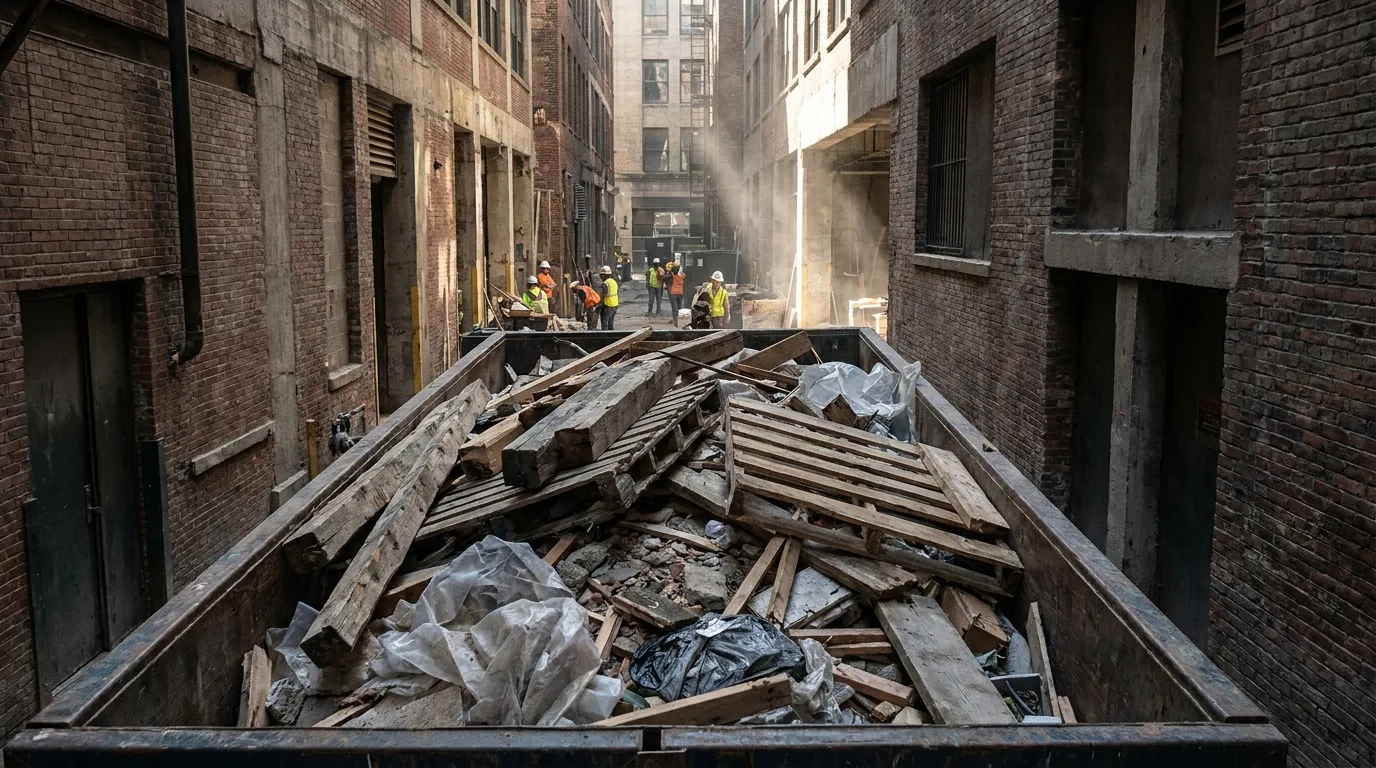
Questions people ask about dumpster weight
How many tons does a 30 yard dumpster hold? Typically 3 to 4 tons of allowance. It physically holds far more, but the truck can't legally carry it.
How many tons does a 40 yard dumpster hold? Usually 4 to 6 tons. Because 40 cubic yards of mixed debris would weigh 10 to 16 tons, this size is meant for bulky light material rather than dense waste.
How much does a 20 yard dumpster weigh empty? Around 4,000 pounds per manufacturer spec, subtracted at the scale.
Can I mix concrete with regular debris? You can, but it's priced as a heavy mixed load. A dedicated clean load in a 10 yard container is usually cheaper. Same reasoning applies on construction dumpster rental for phased jobs.
Does the container size change the tonnage rate? The per-ton overage rate is normally the same. What changes is how much is included before it kicks in.
How many tons does a 20 yard dumpster hold?
Usually 2 to 3 tons included. Past that you pay the transfer station rate per ton.
How many tons can a 30 yard dumpster hold?
Three to four on a normal allowance. How many tons does a 30 yard dumpster hold legally is a truck question.
How much does a 20 yard dumpster weight empty?
Roughly 4,000 to 6,000 pounds of steel. That tare comes off at the scale.
Send the debris type and rough volume through the quote form and you'll get a tonnage allowance and an overage rate in the same reply. The contact page has the direct line, the FAQ covers the common questions, coverage is on the service areas page, and everything we run is on the home page.
Next step
Get a delivery date
Tell us the address, the dates and the headcount. We size the order and confirm the route.