
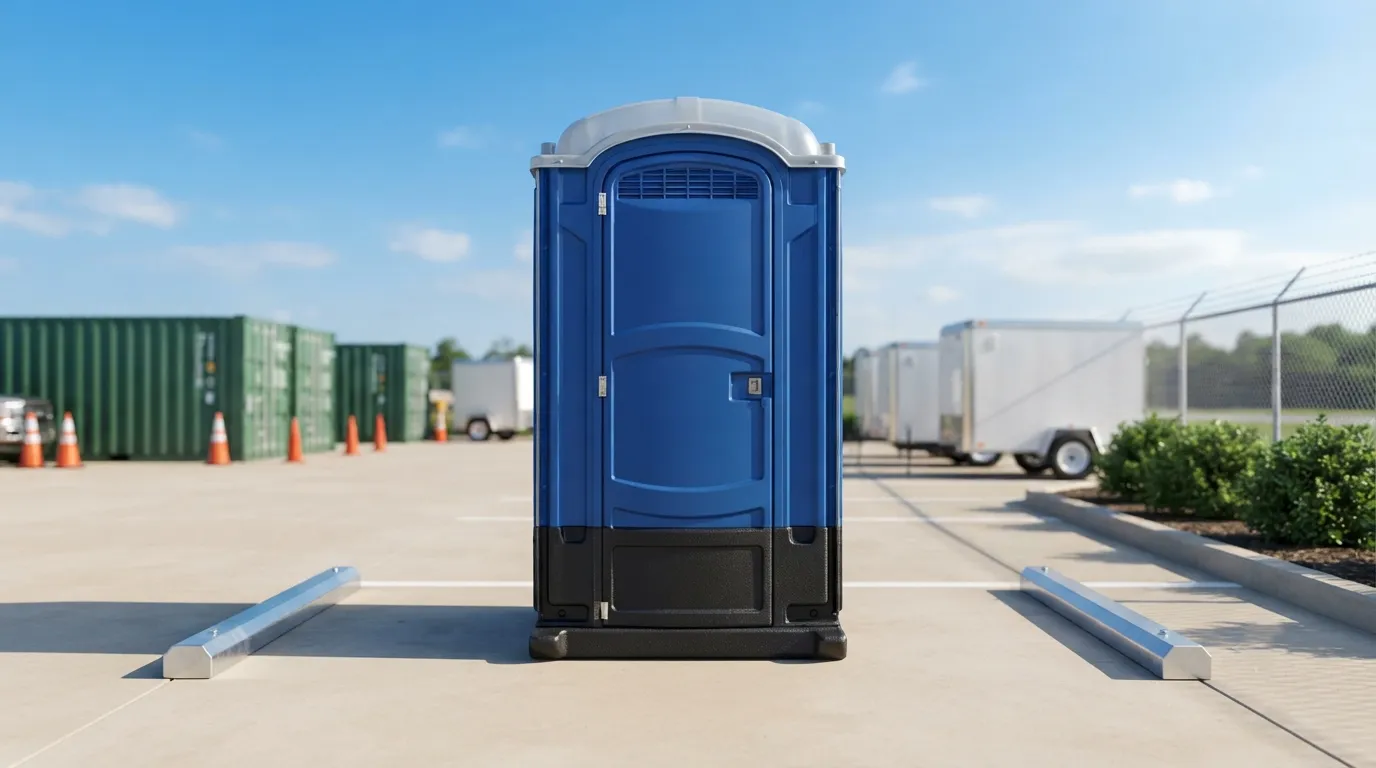
What is a standard porta potty?
A standard porta potty is a single-occupant portable toilet with a sealed holding tank under the seat, a wall urinal, a vent stack and a latching door, delivered by truck and pumped out on a service schedule. Nothing connects to it. No water line, no drain, no power. That is why one can sit on a Bronx rooftop, a Staten Island driveway or a Brooklyn back lot with no site prep at all.
The trade sells this same unit under four names. Porta john rental, portable toilet rental and portable restroom rental are the other three, and if a quote uses one of those words instead of this one it is almost certainly the same blue box on the same truck. How porta potties work covers the mechanics if you want them.
Standard porta potty dimensions and size
Manufacturer specs vary a little by brand, but the working numbers are close enough to plan around. These are the figures a New York site manager needs before anyone measures a spot.
| Measurement | Typical spec | Why it matters here |
|---|---|---|
| Width | about 44 inches | Decides whether a sidewalk placement is even legal |
| Depth | about 48 inches | Plus door swing, so allow 5 feet clear in front |
| Height | about 90 inches | Clears most scaffold decks, not most parking garages |
| Empty weight | 150 to 200 pounds | Two people can walk one in through a wide gate |
| Holding tank | 60 to 70 gallons | Sets the service interval, not the footprint |
| Full weight | roughly 700 pounds | Why a rooftop drop needs the structural sign-off |
That 44 inch width kills more New York placements than price ever does. The 2010 ADA Standards require a minimum 36 inch clear width on a pedestrian access route under section 403.5.1, so on a narrow sidewalk the unit and the required clearance do not both fit, whatever the block looks like at 2am. The placement guide walks through measuring a spot before you book.
What does a standard porta potty rental cost in New York City?
Typical five-borough market ranges, reviewed July 2026. These are market bands, not a quote.
- Per day: $125 to $350, and porta potty rental per day explains why one day costs the most
- Weekend: $175 to $300
- Per week: $175 to $500
- Per month: $150 to $350, covered on the monthly rental page
- Delivery: $75 to $200, top of the band in Manhattan and on restricted-hours blocks
- Weekly service visit: $40 to $75
Manhattan below 96th Street sits at the top of every one of those bands. Eastern Queens and Staten Island sit at the bottom. Same unit, different job. The full breakdown, including what should never be a separate charge, is on the porta potty rental cost page.
Where a standard unit fits on a New York City job
Almost every placement in this city falls into one of four spots, and the spot decides the paperwork.
- Off-street lot or driveway. No permit, no wait, truck pulls alongside. The easiest job we do.
- Rear yard or side alley. Fine, as long as there is roughly 30 feet of hose reach from wherever the truck can legally stop.
- Scaffold deck or sidewalk shed. Common on renovation work. Check the deck loading before you put 700 pounds of full unit on it.
- Public sidewalk or roadway. Permit territory, and by a distance the slowest of the four.
Rooftop placements happen more here than anywhere else, and they need a crane or a lift plus written confirmation from the building. We turn down rooftop drops we do not think are safe, which costs us work and is still the right call. Construction site services covers the bundled version and home renovation porta potty covers the small end.
Do you need a permit for a standard porta potty in NYC?
Only when the unit touches public right of way. A standard porta potty on a New York City street or sidewalk needs a permit from the Department of Transportation, filed through borough offices, with turnaround running from about a day to several weeks depending on the borough and the type of work. The NYC DOT Bureau of Permit Management and Construction Control at 55 Water Street runs the process, and 311 will tell you what applies to your block.
Pedestrian clearance decides placement before anything else. Nothing blocks a curb ramp, a building entrance, an emergency path or a work-zone route, and in a city of 8.8 million people across five boroughs those are hard rules rather than preferences. On private property none of it applies. Full sequence on porta potty permit requirements, and dumpster permits are a separate filing if you need both.
How often does a standard unit get serviced?
ANSI/PSAI Z4.3 sets weekly servicing as the floor for a unit in normal use, and that is what a standard rental here includes: tank pumped, interior washed down, deodoriser recharged, paper restocked, seat and touch points sanitised. New York State regulates the haulers who move that waste under 6 NYCRR Part 364, the waste transporter permit rule, so the truck emptying your unit carries a permit of its own.
Busy sites need more than the floor. Film units, street fairs and two-shift jobs usually run twice or three times a week, which is a different service level rather than a surcharge. How often porta potties are cleaned has the detail, and do porta potties smell answers the question everybody actually wants to ask.
How many standard units does the job need?
OSHA 1926.51(c)(1) requires one toilet per 20 workers on a construction site running a 40-hour week, counted by heads on site rather than by contractor. Above 20 workers, OSHA 1926.51(c)(2) steps to one toilet seat and one urinal per 40 workers. Non-construction work sits under OSHA 1910.141(c)(1)(i) instead, which starts at one toilet for 1 to 15 employees.
For events, plan one unit per 50 guests over four hours and add 15 to 20 percent where alcohol is served. Run your own numbers on how many porta potties you need or read the OSHA portable toilet requirements in full. OSHA 1926.51(f)(1) separately calls for washing facilities where workers handle harmful substances, which is why a handwashing station or a portable sink belongs on most jobsite orders.
When a standard unit is the wrong unit
Standard is right for construction, renovation, back-of-house and anything involving hard hats. It is the wrong call in three situations. Guests in good clothes want a deluxe flushable unit or a restroom trailer. Anywhere the public is invited needs an ADA accessible unit in the mix, because the 2010 ADA Standards section 213.2 exception 4 puts the accessible share of a cluster at 5 percent. And a site with no legal placement at all needs a conversation, not a unit.
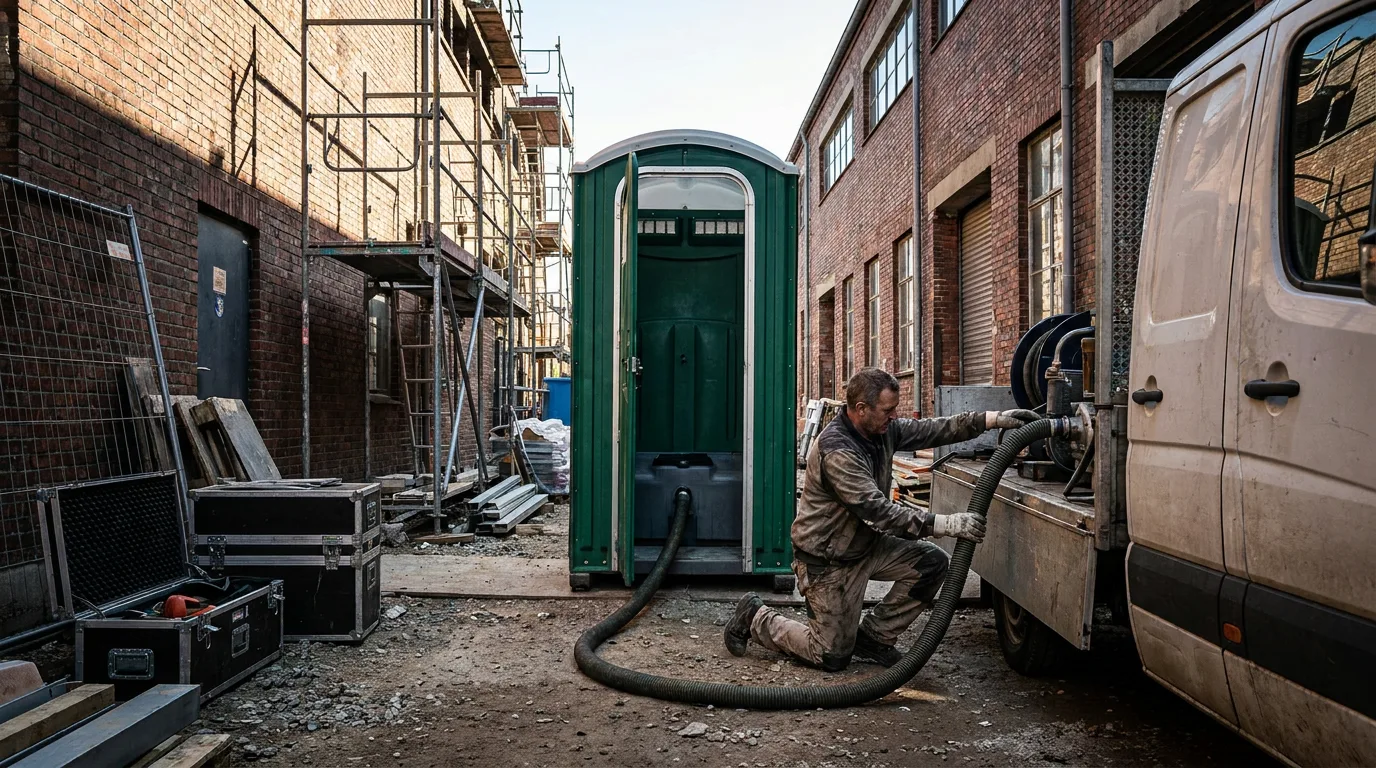
Questions about standard porta potty rental in New York City
How fast can you deliver a standard unit? Same day or next day on private property in all five boroughs. Anything on the sidewalk moves at the permit's pace. Emergency porta potty rental is the fast track.
Will it fit through a 36 inch gate? No. At about 44 inches wide it needs a double gate, a driveway or a lift. Measure before you book.
Does the price change by borough? Yes, by more than most people expect. Drive time, parking and delivery windows do it, not the unit. Porta potty rental in New York City breaks it down borough by borough.
What about winter? Standard units handle cold better than flushing ones because there is no water line to freeze. Porta potty in winter covers what changes.
Do you rent into New Jersey and Long Island? Yes. Jersey City, Newark and Hempstead are all in normal range, with the full list on the service areas page.
Is basic porta potty rental the same product?
Yes. Basic porta potty rental cost and standard pricing describe one unit.
Ready to price one? Send the cross streets through the quote form, work through the rental checklist first, or call from the contact page. How we work sits on the about page, the FAQ covers the rest, and everything else we run is listed on the home page.
Next step
Get a delivery date
Tell us the address, the dates and the headcount. We size the order and confirm the route.