
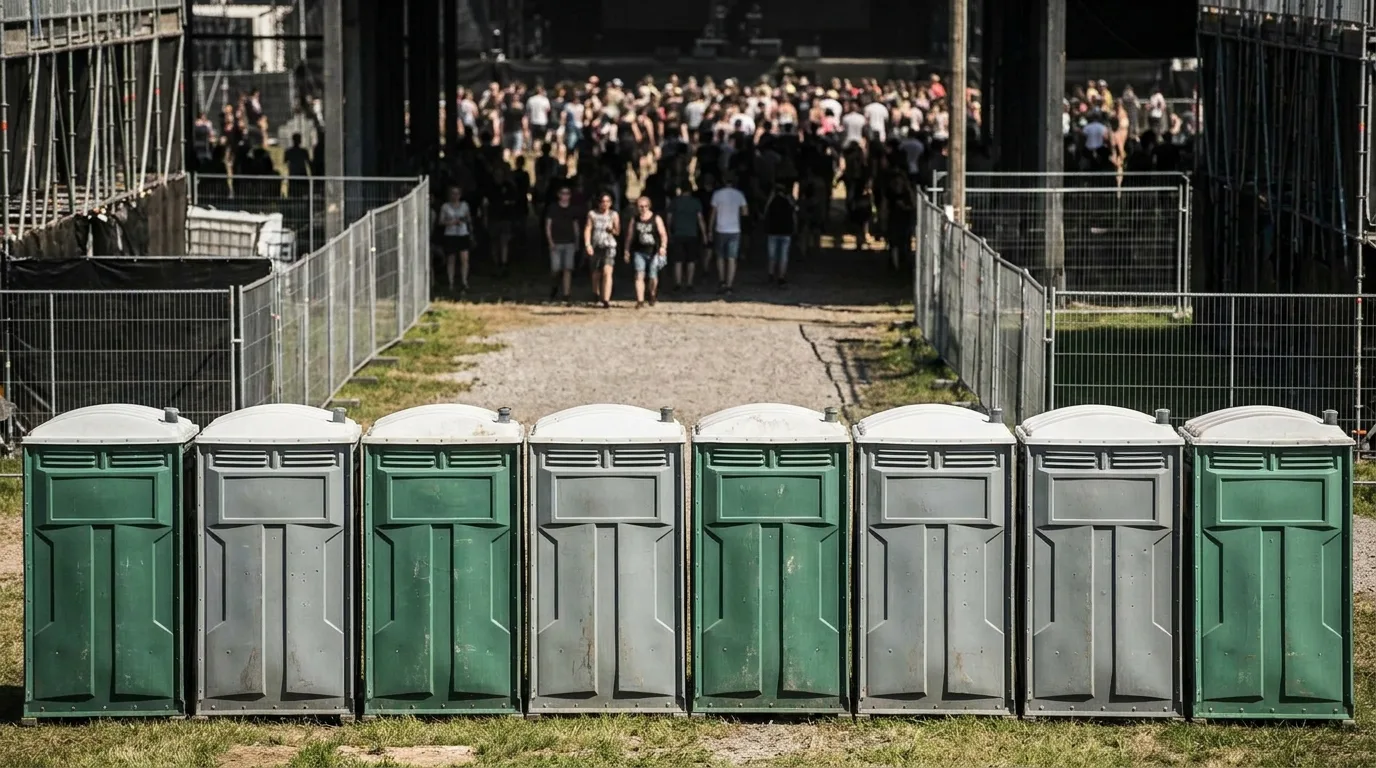
What does OSHA require for portable toilets on a construction site?
The controlling rule for construction is 29 CFR 1926.51(c), inside the sanitation standard. It sets a ratio, not a fixture type, and a chemical toilet is one of the accepted ways to meet it where the site has no sanitary sewer.
| Workers | OSHA 1926.51(c)(1) minimum |
|---|---|
| 20 or fewer | 1 toilet facility |
| More than 20 | 1 toilet seat and 1 urinal per 40 workers |
| 200 or more | 1 toilet seat and 1 urinal per 50 workers |
Two supporting clauses matter as much as the table. OSHA 1926.51(c)(2) requires at least one toilet facility under temporary field conditions, which removes any small-job exemption. And 1926.51(c)(4) exempts mobile crews that have transportation readily available to nearby toilet facilities, which is the clause most often misread on New York service jobs.
Sizing past the minimum is the normal outcome on a real site. The sizing calculator works through crew counts and event headcounts with the arithmetic shown.
Does OSHA set a maximum distance to a portable toilet?
Not for construction. There is no number in 1926.51(c) that says a toilet must be within a given number of feet, which surprises people who have read a California specification and assumed it was federal.
What federal OSHA does require is access. In its longstanding interpretation of 1910.141(c)(1)(i), OSHA states that employers must allow employees prompt access to toilet facilities and may not impose unreasonable restrictions on their use. A unit at the far end of a 400 foot site behind a locked gate fails that test even though no distance rule was broken.
The one place federal OSHA does publish a distance is agriculture. OSHA 1928.110 field sanitation requires toilets within a quarter-mile walk of each hand-laborer, or at the nearest point of vehicular access where terrain makes that impractical. That standard covers farm work rather than construction, and it shapes how the farm and agricultural restrooms page is put together.
What about Cal/OSHA rules?
They do not apply in New York, and that is worth stating plainly because Cal/OSHA construction toilet guidance dominates search results. California runs its own approved state plan with its own construction toilet rule at 8 CCR 1526, which carries location and access provisions federal OSHA does not have.
New York is different in a specific way. New York's state plan, the Public Employee Safety and Health programme run by the Department of Labor, covers state and local government employees only. Private sector construction across the five boroughs falls under federal OSHA, enforced from the federal area offices. So a private contractor in Brooklyn works to 1926.51(c). A city agency crew in the same pit works to PESH, which adopts the federal standards for public employers.
What does OSHA require for handwashing and drinking water?
OSHA 1926.51(f)(1) requires washing facilities where employees are engaged in operations involving harmful substances, and 1926.51(a) requires an adequate supply of potable water on every site. Neither is satisfied by a case of bottled water left in the sun and a bucket.
- Potable water containers must be capable of being tightly closed and equipped with a tap, under 1926.51(a)(2).
- Single-use drinking cups must be in a sanitary container, with a separate receptacle for used ones, under 1926.51(a)(4).
- Non-potable water outlets have to be posted so they cannot be mistaken for drinking water, under 1926.51(b).
- Washing facilities have to be in the immediate vicinity of the worksite when harmful substances are in play.
In practice most New York sites pair each unit or pair of units with a portable handwash station or a freshwater sink, plus sanitizer stands at the gate. The handwashing requirements page covers where a sink stops being optional.
How often do the units have to be serviced?
OSHA 1926.51(c) requires that toilet facilities be maintained in a sanitary condition, and it stops there. The number comes from the industry standard instead. ANSI/PSAI Z4.3, the American National Standard for nonsewered waste disposal systems, treats weekly servicing as the floor for a standard unit in normal use.
That baseline assumes about 10 workers per unit across a 40 hour week. Run 20 people through one unit and weekly service is no longer enough, which is when a compliant site starts smelling like a non-compliant one. The cleaning frequency guide sets out what each visit involves and when to move to twice weekly.
How does New York City change what you have to do?
OSHA governs the toilet. The city governs the ground it stands on, and in New York that is the harder half.
A unit placed on a New York City street or sidewalk needs a permit from the Department of Transportation, run through borough offices by the Bureau of Permit Management and Construction Control at 55 Water Street. Turnaround ranges from about a day to several weeks depending on the borough and the type of work, and 311 is the fastest route to guidance on a specific block.
Sidewalk clearance decides the rest. Pedestrian path comes before everything: no curb ramp blocked, no building entrance blocked, no emergency egress or work-zone route obstructed. The ADA Standards for Accessible Design set 36 inches at 403.5.1 as the minimum clear width of an accessible route, and that is the number to design the walk-around from. The placement guide and the permit requirements page go through both in detail.
Two smaller local points catch people out. Work outside 7am to 6pm on weekdays generally needs an after-hours variance from the Department of Buildings under the city noise rules, which affects when a truck can deliver or service. And on a shed-covered facade job under the Facade Inspection Safety Program, the usable footprint is whatever the shed leaves you, not the frontage on the drawing.
What gets cited on a real inspection?
Rarely the count. Almost always the condition, the access, or the missing handwash.
- A unit that has not been serviced and is out of paper, which fails the sanitary condition requirement of 1926.51(c).
- No washing facility on a site handling harmful substances, contrary to 1926.51(f)(1).
- Drinking water in an open container, contrary to 1926.51(a)(2).
- A locked unit, or one a subcontractor's crew has been told not to use, which runs against OSHA's prompt access interpretation.
- No accessible unit where the public or a worker needs one, which is an ADA question rather than an OSHA one, and covered on the accessible unit page.
Setting a compliant site up in the five boroughs
Count the crew, apply 1926.51(c)(1), then add units until nobody is walking more than a couple of minutes. Pair every one or two units with a sink. Put the service on a weekly schedule at minimum, and in July move it to twice weekly before the complaints rather than after.
Most sites run a standard unit, sometimes a flushable deluxe for a site office or client walkthrough, and a restroom trailer on longer or higher-profile builds. Cold months bring their own problems, which the winter guide covers.
What are the osha portable toilet requirements construction sites must meet?
OSHA 1926.51(c): one toilet for 20 or fewer workers, then one seat and one urinal per 40.
Are there osha portable toilet distance requirements?
OSHA does not set a fixed distance. It requires facilities be readily accessible on the site.
How many porta potties do i need osha compliance for?
Count the crew, then apply 1926.51(c). Round up, never down.
Rates sit on the rental cost page, with monthly hire usually the right structure for a build. Construction site services shows what typically goes on the same order, from roll-off dumpsters and temporary fencing to a mobile office trailer. Coverage is on the service areas page, the city overview at porta potty rental in New York City, and you can price a job through the quote form or the contact page.
Next step
Get a delivery date
Tell us the address, the dates and the headcount. We size the order and confirm the route.