
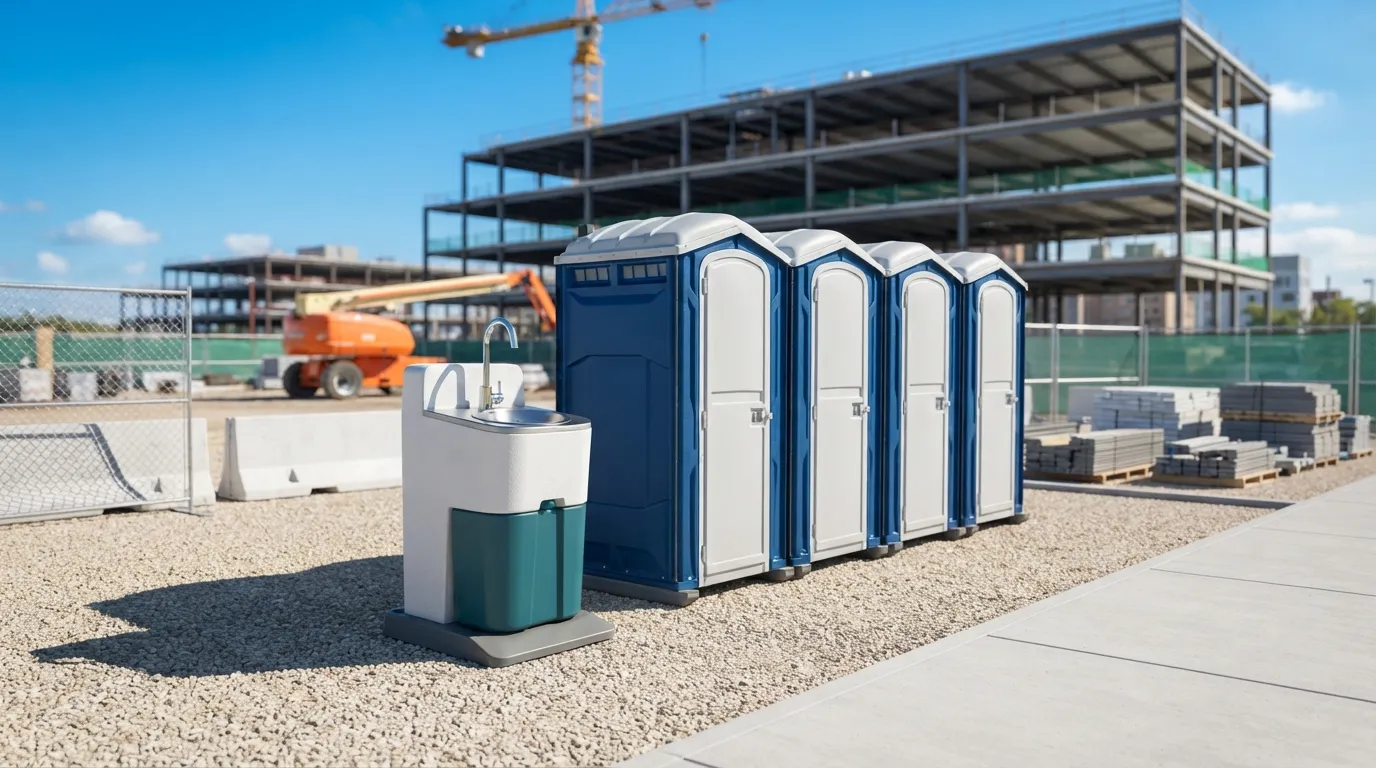
What does OSHA require for handwashing on a jobsite?
OSHA 1926.51(f)(1) requires an employer to provide washing facilities wherever employees apply paints, coatings, herbicides, insecticides, or work in operations where contaminants could be harmful. OSHA 1926.51(f)(3) adds that the facilities have to be in near proximity to the worksite and equipped so a worker can actually remove those substances.
Two things follow from the wording. First, the trigger is the material, not the headcount, so a small crew stripping lead paint on an Upper West Side brownstone is covered and a large crew doing dry framing may not be. Second, distance is part of the rule. A sink at the gate of a construction site that spans a full block does not satisfy near proximity, and no inspector reads it that way.
Separately, OSHA 1926.51(c)(1) sets one toilet for 20 or fewer workers on a construction site, and OSHA 1926.51(a)(1) requires potable water on site. OSHA portable toilet requirements has the full ratio table.
How many handwashing stations do you need?
There is no federal number that maps sinks to workers the way OSHA maps toilets to workers. What the industry does instead is tie sinks to restroom units, and the working ratio across New York contractors is one sink per two units.
| Site | Restroom units | Sinks |
|---|---|---|
| 20 person crew | 1 | 1 |
| 45 person crew | 2 to 3 | 1 to 2 |
| 100 person crew | 5 | 2 to 3 |
| Street fair, per food vendor | Shared bank | 1 per vendor |
| 5,000 person race | 25 to 30 | 10 to 12 |
Run the restroom count first, then divide. How many porta potties do I need does the first half, and handwashing station rental covers the units themselves. For general industry rather than construction, OSHA 1910.141(d)(2) is the relevant rule, and it requires lavatories with hot and cold or tepid running water, soap, and a means of drying hands.
What are the ADA requirements for a portable sink?
The 2010 ADA Standards for Accessible Design set the numbers. Section 606.3 caps the rim or counter surface of a lavatory at 34 inches above the floor. Section 308.2.1 limits an unobstructed forward reach to 48 inches. Section 309.4 caps the force needed to operate a control at 5 pounds, which is why foot pumps and lever taps pass and stiff push valves do not.
Approach matters as much as the fixture. Section 305.3 sets a clear floor space of 30 by 48 inches at the unit, and section 403.5.1 requires a 36 inch minimum clear width on the pedestrian access route leading to it. Put those together on a New York sidewalk and you often find the sink has to sit on private property rather than at the curb. Full detail is on ADA restroom requirements, and the matching restroom unit is on the ADA accessible porta potty page.
Do New York City street fairs need handwashing stations?
Yes, and this is where most of the enforcement in this city actually happens. The New York City Department of Health and Mental Hygiene licenses temporary food service establishments, and Article 81 of the New York City Health Code governs food service establishments and the handwashing facilities they have to provide.
An inspector at a Ninth Avenue fair or a Bronx block party checks for running water, soap and single use towels at the vendor's own station, not somewhere down the row. Vendors get shut down for this more than for anything else. Street activity permits themselves come through the Street Activity Permit Office, and the sanitation plan is part of that filing. Festival restroom rental, county fair restrooms and event restroom rental cover the wider event setup.
Does hand sanitizer meet the requirement?
Not on its own, and not for food. The CDC recommends alcohol based sanitizer at 60 percent or higher as a supplement, and it explicitly does not work on visibly soiled hands. Health inspectors treat a gel dispenser as an addition to a sink, never as the sink.
Where sanitizer earns its place is winter, tight sidewalks and the space between service visits. Hand sanitizer station rental covers the stands, refill intervals and where they sit relative to the restroom bank.
New York City permit rules for a sink on the sidewalk
A unit on a New York City street or sidewalk needs a permit from the Department of Transportation, filed through its Bureau of Permit Management and Construction Control at 55 Water Street. Borough offices handle approvals, and turnaround runs from about a day to several weeks depending on the borough and the type of work. 311 is the fastest way to get an answer on a specific block.
Inside a construction fence there's no permit, which is one reason perimeter fencing goes up before sanitation arrives on most New York jobs. New York City Building Code Chapter 33, safeguards during construction, is what governs that perimeter, and an 8 foot construction fence along a public way is the standard requirement. Temporary fence rental covers it, and porta potty permit requirements has the sanitation filing.
Service frequency under the industry standard
ANSI/PSAI Z4.3 is the industry standard for non sewered waste disposal systems, and it is what a service visit is measured against. For a sink that means pumping the grey tank, refilling fresh water, restocking soap and towels, and cleaning the basins.
Once a week is the baseline. A two bay unit holds about 22 gallons of fresh water, which is roughly 140 washes at a normal six second pump cycle, so a 40 person crew empties it in under two days and needs twice weekly service or a four bay unit. How often are porta potties cleaned has the schedule logic, and septic pumping service covers where the grey water ends up.
Soap, towels and the signage rule
Soap has to be there, and it has to be in a sealed cartridge rather than an open bottle if the unit sits anywhere the public can reach it. Towels need a bin beside them, or the wind puts them in the gutter and that's a sanitation summons.
Signage is required at food events and sensible everywhere else. Wash hands before returning to work, at eye height, in English and Spanish. That single sign is the cheapest compliance item on any New York site.
The winter exception nobody plans for
Water in a pump line below freezing splits it. New York delivers those nights from December through March, and a split line means a unit that fails inspection on a Monday morning.
Three workable answers: drain the fresh tank at shutdown, run gel dispensers through the coldest weeks, or put the sink inside a heated unit such as a shower trailer or a restroom trailer. Porta potty in winter covers the full cold weather routine.
Questions people ask about handwashing requirements
Is a sink required on every construction site? No. It's required where workers handle harmful substances under OSHA 1926.51(f)(1). Most New York general contractors provide one anyway, because the trigger is easy to hit and hard to argue after the fact.
Does a flushing unit count as a sink? A deluxe flushable porta potty has an integrated basin, which covers casual handwashing. It does not replace a dedicated sink where the OSHA trigger applies.
What about hot water? OSHA 1910.141(d)(2) calls for hot and cold or tepid running water in general industry. Construction sites commonly run cold water with antibacterial soap. Portable sink rental covers the heated options and what powers them.
Who is responsible, us or the sub? The employer of the exposed workers, under OSHA. On a multi trade New York site that usually lands on the general contractor by contract. Bring the rental checklist to the preconstruction meeting.
How fast can you get a sink out? Next business day for private property across the five boroughs, plus Jersey City, Newark and Hempstead. Same day goes through emergency porta potty rental, and the service areas page lists everywhere we run.
Send crew size, materials and dates through the quote form and you'll get a real count rather than a guess. The contact page has the direct line, the FAQ answers the common ones, porta potty rental in New York City covers the restroom line, what it costs has the pricing, and everything is listed on the home page.
Next step
Get a delivery date
Tell us the address, the dates and the headcount. We size the order and confirm the route.