
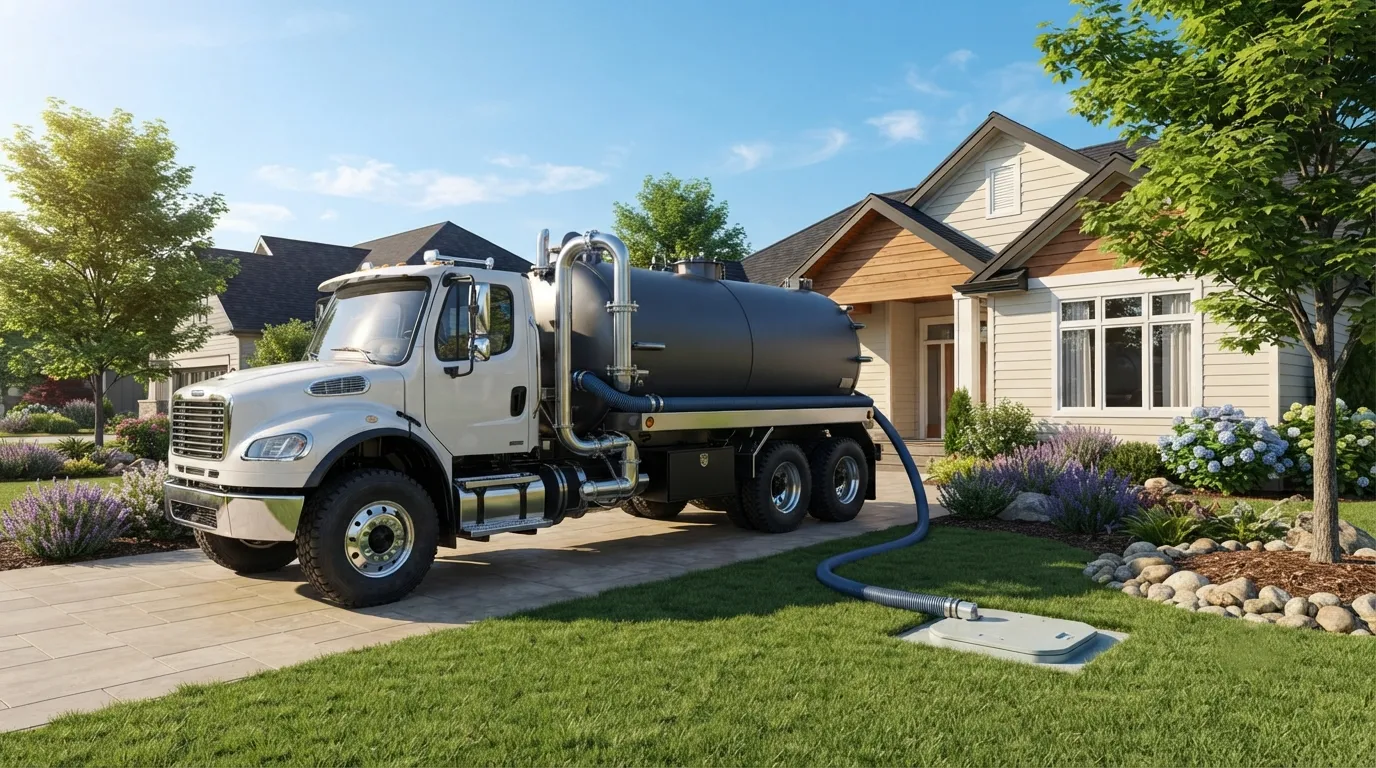
What is septic pumping, and what does the visit include?
Septic pumping is the removal of sludge, scum and liquid from a septic tank by vacuum truck, so the tank keeps separating solids instead of pushing them out into the drain field. A real pump-out is not just sucking the water off the top. The crew uncovers the access lid, measures the sludge and scum layers, pumps the tank down to the floor, then backflushes to break up the crust that has hardened against the walls.
- Locate and uncover the manhole lid, not just the inspection ports
- Measure sludge depth off the bottom and scum thickness at the surface
- Pump the full working volume, then rinse and re-pump the residue
- Pull and clean the effluent filter if the system has one
- Check the inlet and outlet baffles for cracks or missing tees
- Note the liquid level, which tells you whether the drain field is backing up
- Haul the septage away under a manifest and leave you a copy
The US EPA's SepticSmart guidance says a tank is due when the scum layer sits within 6 inches of the outlet baffle or the sludge layer within 12 inches of it. Those two measurements are the only objective test there is, and a crew that never takes them is guessing. Full detail on the process lives on the septic tank cleaning page.
Where septic systems still exist in the five boroughs
New York City is overwhelmingly sewered. The NYC Department of Environmental Protection runs 14 wastewater resource recovery facilities treating roughly 1.3 billion gallons a day through about 7,400 miles of sewer main, so most addresses here will never own a tank. The systems that remain are concentrated on Staten Island's South Shore, where sewer build-out came late and lots are larger, with scattered private systems on other properties that predate their local sewer connection.
Onsite systems anywhere in the state fall under New York State Department of Health Appendix 75-A of 10 NYCRR, which sets the design and separation standards for residential onsite wastewater treatment. That matters when a pump-out turns up a failing tank, because a replacement is a permitted job, not a same-week fix. Plenty of calls we take are not septic tanks at all. They are cesspools, or sealed holding tanks on properties with no leach field, and those run on a completely different schedule.
How often does a septic tank need pumping?
The EPA recommends a household septic system be inspected at least every 3 years and pumped every 3 to 5 years. Tank size and how many people live over it move that in both directions.
| Tank size | 2 people | 4 people | 6 people |
|---|---|---|---|
| 1,000 gallon | about every 5 years | about every 3 years | about every 2 years |
| 1,250 gallon | about every 6 years | about every 4 years | roughly every 2 to 3 years |
| 1,500 gallon | about every 7 years | about every 5 years | about every 3 years |
Those intervals assume normal indoor water use. EPA WaterSense puts average indoor use near 70 gallons per person per day, and a household well above that fills a tank faster than the table says. A garbage disposal is the other big variable: the EPA notes disposals can raise the solids load reaching a tank by up to 50 percent. If you run one daily, take a year off the interval. The septic pumping frequency guide works through the arithmetic properly.
What does septic pumping cost in New York City?
The published market band for a standard residential pump-out is $150 to $300 per job, and that is what a straightforward 1,000 gallon tank with an accessible lid should land near. Prices reviewed July 2026. These are typical market ranges rather than a quote, and our data on septic work is thinner than our data on portable toilets, so treat the edges as soft.
| Job | Typical range | What moves it |
|---|---|---|
| 1,000 gallon residential pump-out | $150 to $300 | Lid depth, truck access, distance |
| Larger tank or two-compartment | above that band | Volume and disposal fees scale |
| Lid excavation, buried access | added labour | Ask for it as a separate line |
| After-hours or same-day | above the band | See emergency septic service |
| Effluent filter clean | usually included | Confirm before you book |
Get the disposal fee named separately. Full breakdown on the septic tank pumping cost page, and our quote form asks for tank size and access up front so the number comes back right the first time.
Tank size, and what it changes on the day
Appendix 75-A sets minimum residential tank volumes in New York State at 1,000 gallons for a one to three bedroom house, 1,250 gallons for four bedrooms and 1,500 gallons for five. Most of what we pump on Staten Island is at or near that 1,000 gallon minimum.
Weight is the constraint nobody thinks about. Water runs 8.34 pounds per gallon, so 1,000 gallons of septage is over four tons before you count the truck. A typical vacuum tanker carries between 1,500 and 5,000 gallons per manufacturer spec, which means one truck can usually take two or three residential tanks before it has to go and offload. On a tight block that sequencing decides your appointment window more than anything else does.
What are the warning signs that a tank is overdue?
Slow drains across the whole house, gurgling in the lowest fixture, standing water or unusually green grass over the leach field, and sewage odour near the tank lid after rain. Any one of those is worth a call. Two together usually means the tank is full and effluent is being pushed somewhere it should not go.
The expensive failure is not the tank. It is the drain field, because solids carried out of an overfull tank clog the soil and a field that has been blinded off does not recover with a pump-out. That is the entire argument for a schedule instead of a reaction. Each symptom is broken out on the septic tank warning signs page, including the ones people misread as a plumbing problem.
Getting a pump truck to a New York City address
This is the part that makes the city different, and it has nothing to do with the tank.
Commercial vehicles are banned from New York City's parkways, so a tanker heading for the South Shore runs the Staten Island Expressway and the West Shore Expressway rather than the Belt or the Grand Central. Trucks also have to stay on the NYC DOT designated truck route network for through travel and leave it only for the local delivery leg. That is real routing, and it is why a Staten Island appointment and a Bronx appointment are not interchangeable slots on the same morning.
On site, three things decide whether the job takes an hour or a morning:
- Hose reach. A pump truck carries roughly 100 to 200 feet of suction hose. Measure from where a truck can legally stop to the tank lid before you book.
- Where the hose crosses. A hose run over a public sidewalk has to leave a walkable path. The 2010 ADA Standards require a minimum 36 inch clear width on a pedestrian access route in section 403.5.1, and that clearance is not negotiable while a crew is working.
- Kerbside space. Alternate side rules, hydrants, bus lanes and loading zones all remove stopping options, and a tanker cannot double park indefinitely the way a van can.
If the work needs to occupy the street or sidewalk beyond ordinary standing, that is a New York City Department of Transportation permit. Approvals run through the borough offices, and turnaround ranges from about a day to several weeks depending on the borough and the type of work. The DOT Bureau of Permit Management and Construction Control at 55 Water Street handles it, and 311 is the fastest way to get a straight answer for your block. The same logic governs porta potty permits and dumpster permits, so if a job needs more than one thing on the street, file once and file early. Our placement guide covers what a driver needs to see before the truck leaves the yard.
Where the septage goes after it leaves your property
Anyone hauling septage in New York State needs a New York State Department of Environmental Conservation Part 364 waste transporter permit, and the load has to be delivered to a facility permitted to receive it. In this city that generally means one of DEP's 14 wastewater resource recovery facilities, the largest being Newtown Creek in Greenpoint.
Ask for the manifest. A hauler who can name where your septage went and hand you the paperwork is doing the job properly, and a price well under the market band is often a hint that the disposal step is being skipped. That documentation matters more on commercial work, where an inspector may ask for it later.
Grease traps, holding tanks and portable toilet waste
We run the same trucks and the same disposal chain across four related jobs, which is why one call usually covers all of it.
- Grease trap pumping for restaurants and commissary kitchens, on a schedule set by interceptor size rather than by calendar habit.
- Holding tank rental for film base camps, event sites and any location with no sewer connection at all.
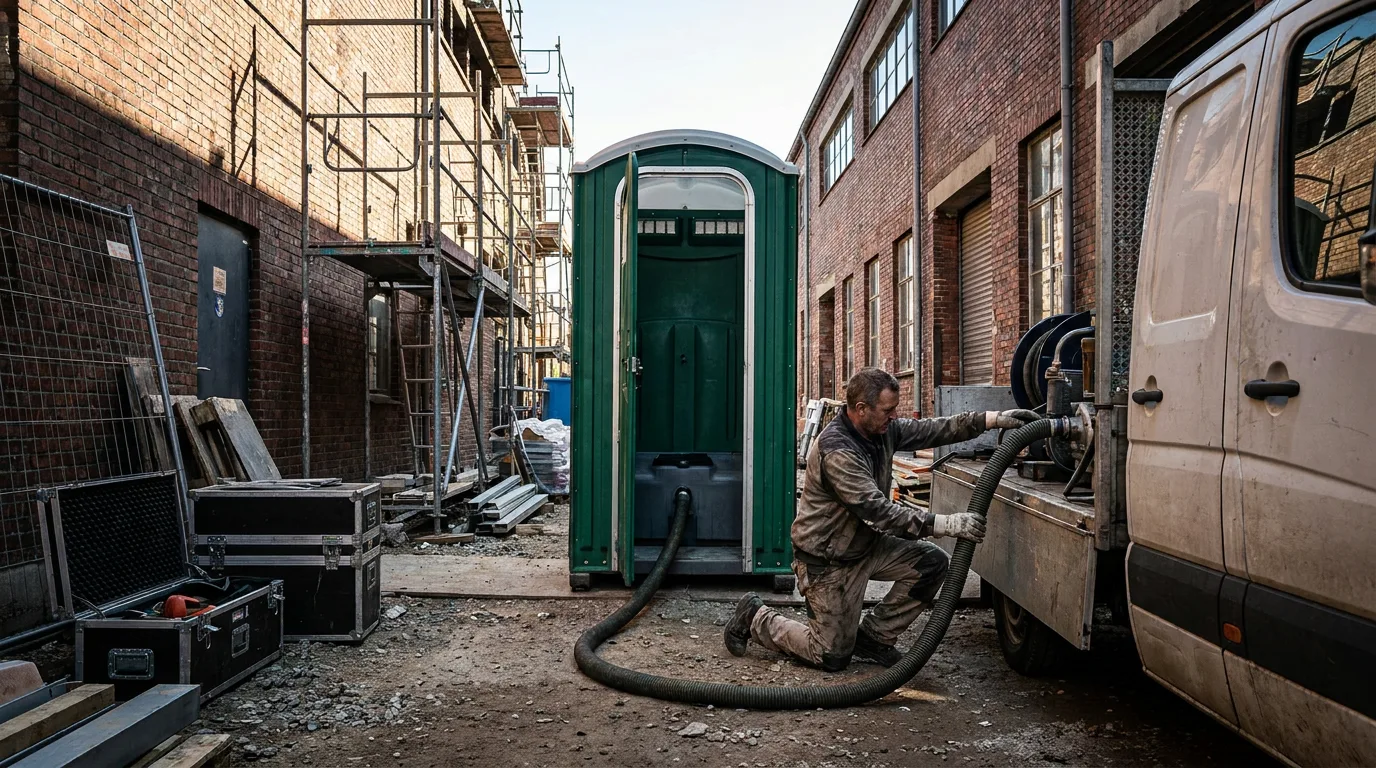
- Portable toilet servicing on the porta potty rental side, where ANSI/PSAI Z4.3 sets weekly servicing as the floor for a standard unit in normal use. The detail is on how often porta potties get cleaned.
- Jobsite packages through construction site services, usually alongside a roll-off dumpster, a handwash station and a portable sink. OSHA 1926.51(c)(1) requires one toilet per 20 workers on a construction site working a 40-hour week, which is what usually sets the unit count. Run it through the sizing calculator or read the OSHA requirements in full.
Film and television production is a genuinely New York demand driver here. Base camps parked on a Brooklyn or Queens block for a week need film set restrooms and tank service on a fixed daily window, because the block has to be clear again by the time the permit expires. Race and street event work runs the same way, which is why marathon restroom rental and general event restrooms are quoted with the servicing built in rather than added after.
When is a septic problem an emergency?
Sewage backing up into a fixture inside the house, effluent surfacing in the yard, or an alarm on a pump tank. Those three need someone out the same day, because every additional flush makes the cleanup bigger. Slow drains and a faint odour outside are not emergencies, and paying an after-hours premium for them wastes money.
Storm surge is the New York version of this. Low-lying South Shore properties can have tanks saturated by groundwater after a serious coastal event, and a pump-out into a flooded field accomplishes nothing until the water table drops. We handle those and broader disaster relief sanitation work, and the emergency septic service page covers response and what it costs.
Questions people ask about septic pumping service
How long does a septic pump-out take? Two to three hours for a standard 1,000 gallon tank with an accessible lid. Add time if the lid has to be dug out or the truck has to park a long way off.
Do septic tank additives replace pumping? No. The EPA is explicit that additives do not remove the need to pump a tank on schedule, and some can push solids into the drain field where they do real damage.
How do I find the lid if it was never marked? Trace the sewer line out of the house and probe. Most tanks sit between 5 and 25 feet from the foundation with the lid 4 to 24 inches down. We can locate it, and it is worth fitting a riser so the next visit is cheaper.
Can you pump a tank in winter? Yes. Frozen ground makes buried lids harder to open, which is the main reason winter jobs run longer. The same seasonal constraints show up on the winter porta potty page.
Do you serve outside the five boroughs? Yes. Jersey City, Bayonne, Elizabeth, Newark, Hoboken and Freeport are inside our normal range. The full list is on the service areas page.
Does a pumped tank smell afterwards? For a day or so near the lid, yes, and then it settles. That is the tank breathing, not a fault. Do porta potties smell explains the same chemistry on the portable side.
Can I get a tank done the same week? Usually, on a private driveway or yard. Short-notice work on the portable side is covered by emergency porta potty rental, and long-running sites are cheaper on monthly rental than on repeat one-off visits.
What if the tank turns out to be failing? We will tell you what we saw and give you the measurements. Repair and replacement are permitted work under Appendix 75-A and go through a licensed installer, not through us.
Book a pump-out
Is septic tank pumping service the same as a clean?
Pumping removes the contents. Cleaning scrapes the walls after. Septic system pumping service usually means both.
Is septic pumping service near me priced by tank size?
Largely. 1000 gallon septic tank pumping cost is the common benchmark around New York City.
Give us the borough, the cross streets, the tank size if you know it and roughly where the truck can stop. That is enough to price the job and put it on a route that works. Call us, use the contact page, or read the FAQ first. Everything else we run across the five boroughs, from portable toilets and restroom trailers to storage containers, temporary fencing and light towers, is listed on the home page. Pricing across the whole range sits on the porta potty rental cost page, and there is more about how we work on the about page.
Next step
Get a delivery date
Tell us the address, the dates and the headcount. We size the order and confirm the route.