
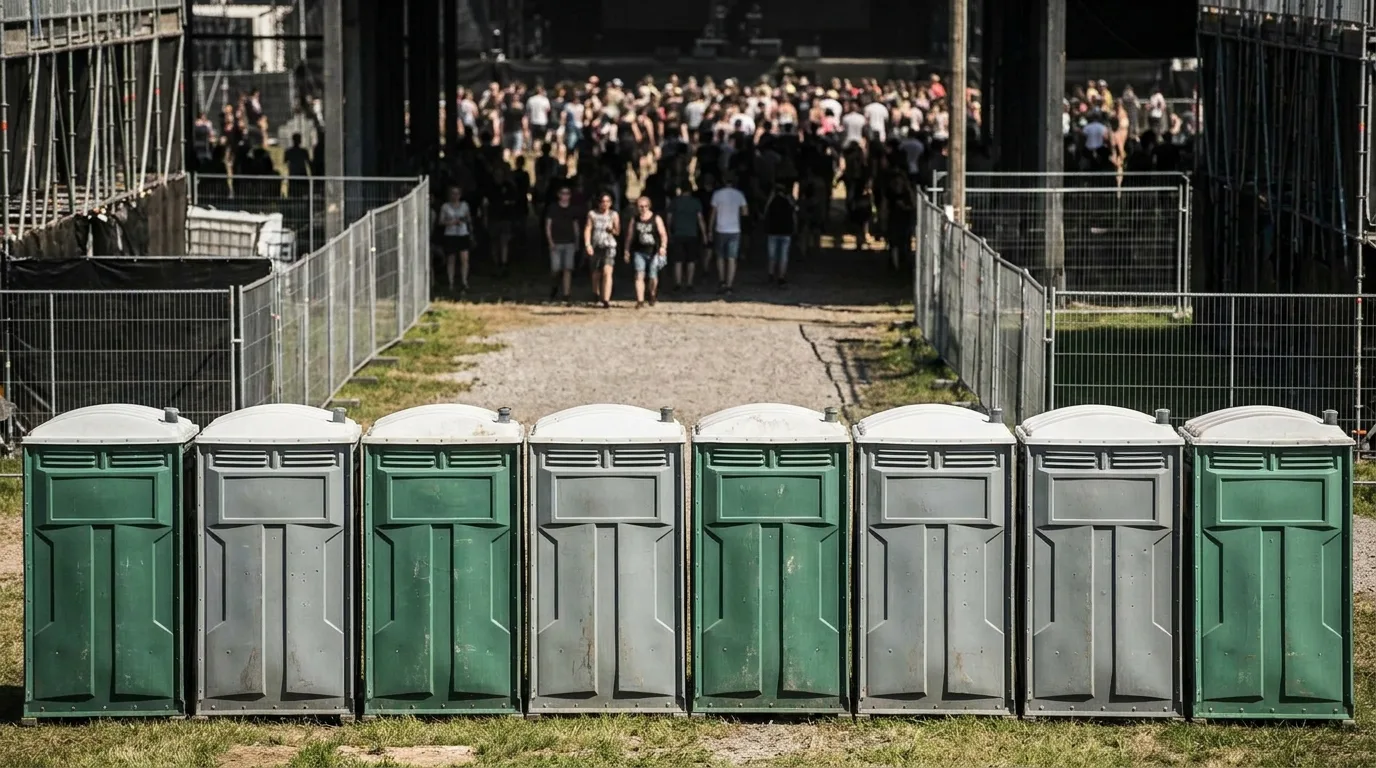
How many porta potties does OSHA require on a New York City jobsite?
The federal rule is short, and it is the one an inspector reads off. OSHA 1926.51(c)(1) requires one toilet facility for 20 or fewer workers, then one toilet seat and one urinal per 40 workers above 20, and one seat plus one urinal per 50 workers once the site carries 200 or more people.
| Workers on site | Toilet seats required | Urinals required | What that means in practice |
|---|---|---|---|
| 1 to 20 | 1 | 0 | One standard unit |
| 21 to 40 | 1 | 1 | One standard unit, urinal option |
| 41 to 80 | 2 | 2 | Two units, often three by choice |
| 81 to 120 | 3 | 3 | Three units minimum |
| 121 to 160 | 4 | 4 | Four units minimum |
| 200 | 4 | 4 | The ratio shifts to one per 50 |
| 300 | 6 | 6 | Six units minimum |
| 500 | 10 | 10 | Ten units, usually split by floor or gate |
OSHA 1926.51(c)(2) adds that under temporary field conditions there must be at least one toilet facility available, so there is no crew small enough to skip it. Two men on a brownstone stoop replacement still need one. The construction site services page covers what usually goes with it on a New York job.
Why do most New York contractors run more units than OSHA requires?
Because the OSHA number is a legal floor rather than a productivity number, and in this city walking time is the real expense. The Portable Sanitation Association International publishes sizing guidance of roughly one unit per 10 workers on a standard 40 hour week with weekly service, which is double the OSHA minimum at most crew sizes.
On a 30 story tower in Long Island City that gap decides your schedule. A single unit at street level serving 60 workers means a two elevator ride and a long round trip per person, several times a day. Two units on the deck and one at grade costs less than the lost hours. Sizing on dense New York sites usually gets driven by vertical distance rather than by headcount.
Duration matters as much as headcount. ANSI/PSAI Z4.3 treats weekly servicing as the baseline for a standard unit in normal use, so a unit carrying 20 people through a 40 hour week is already at the edge of what one weekly pump can handle. Push past that and you either add units or add service visits, which the cleaning schedule guide breaks down by job type.
What does OSHA require for non-construction work?
Different table, different rule. OSHA 1910.141(c)(1)(i) governs general industry, including warehouses, film stages, manufacturing and most fixed workplaces, and it counts fixtures by employee bands rather than by a ratio.
| Employees | Minimum toilet facilities |
|---|---|
| 1 to 15 | 1 |
| 16 to 35 | 2 |
| 36 to 55 | 3 |
| 56 to 80 | 4 |
| 81 to 110 | 5 |
| 111 to 150 | 6 |
| Over 150 | 6, plus 1 for each additional 40 employees |
OSHA 1910.141(c)(1)(ii) lets mobile crews rely on nearby toilet facilities as long as transportation to them is readily available. In Manhattan that provision gets stretched constantly, and it is worth being honest about it. A deli two blocks away that has already thrown your crew out twice is not readily available. A unit on monthly hire costs less than the argument.
How many porta potties do I need for an event?
For events the driver is guests multiplied by hours, not guests alone. A crowd of 500 for three hours uses far less capacity than the same 500 across eight. The table below is a planning starting point built from PSAI event sizing guidance, before any adjustment for alcohol or heat.
| Guests | 2 to 4 hours | 5 to 6 hours | 7 to 8 hours |
|---|---|---|---|
| 50 | 1 | 1 | 2 |
| 100 | 2 | 2 | 3 |
| 250 | 3 | 4 | 6 |
| 500 | 6 | 8 | 11 |
| 1,000 | 12 | 15 | 20 |
| 2,000 | 20 | 25 | 34 |
| 5,000 | 50 | 63 | 80 |
Read those as typical planning figures, not a guarantee. A seated dinner in a Brooklyn loft behaves nothing like an open gate street festival at the same headcount. Sizing a specific event is what the event restroom rental page and the festival planning page are for.
Does alcohol change the count?
Yes, and by more than people expect. Standard event sizing practice adds 15 to 20 percent to the unit count when alcohol is served, and closer to 30 percent for a beer festival or anything where drinking is the point rather than an accompaniment.
Four other adjustments are worth building in before you book:
- Heat. National Weather Service climate normals for Central Park put the average July high near 85 degrees, and a hot afternoon in Flushing Meadows Corona Park drives both water consumption and traffic through the units. Add roughly 10 percent for a July or August daytime event.
- Multi-day. A two day event does not need double the units. It needs the same count plus a service visit between days. A three day run usually needs both.
- Skewed crowds. A crowd that is mostly women, or mostly families with small children, runs higher per capita than a mixed adult crowd, because trips take longer.
- No other restrooms. If a park comfort station or a venue restroom is open and close by, you can size down. If everything else is locked at 6pm, you cannot.
Four worked examples across the five boroughs
A facade repair job in Midtown Manhattan
Fourteen workers, six months, sidewalk shed up under the city's Facade Inspection Safety Program. OSHA 1926.51(c)(1) requires exactly one toilet. The practical answer is one standard unit plus a handwash station inside the shed footprint, serviced weekly to ANSI/PSAI Z4.3, with a New York City Department of Transportation permit because the unit stands on the sidewalk. Working inside a shed is tight, and the placement guide covers the clearances that decide it.
A 5K in Prospect Park
Roughly 1,200 runners, a three hour window, no alcohol. The table gives about 14 units. Race sizing adds a wrinkle: demand is not spread across three hours, it spikes in the 40 minutes before the gun. Prospect Park runs 526 acres, so you split the bank rather than centralising it, usually a larger cluster near the start and a smaller one past the finish. At least one accessible unit is required, and the US Access Board's guidance on accessible temporary events puts the working figure at 5 percent of the total. See race and marathon restrooms for how the banks get laid out.
A block party in Astoria
Roughly 400 people, six hours, beer served. The base figure is 6 to 8 units. Alcohol pushes it to 8 or 9. The street closure runs through the city's Street Activity Permit Office, and the units stand inside the closure rather than on the open sidewalk, which changes the permit picture completely. The permit requirements page explains which office handles which case.
A film shoot in Greenpoint
A 60 person crew, twelve hour days, two weeks. OSHA 1910.141(c)(1)(i) puts the floor at four facilities for a general industry workforce that size. Production almost always goes further and brings in a restroom trailer with flushing toilets and running water, usually a four stall unit, because the crew includes talent and the call sheet runs past midnight. Film permits in the five boroughs run through the Mayor's Office of Media and Entertainment. More on that setup at film set restroom rental.
How many handwash stations and accessible units go with them?
A workable rule is one handwash station per two toilet units, and at least one on any job. OSHA
1926.51(f)(1) requires washing facilities where employees are engaged in operations involving harmful substances, and around food service the practical standard runs higher again. The handwashing requirements page sets out where a sink is mandatory rather than optional, and the portable sink page covers the freshwater units.
For accessibility, the ADA Standards for Accessible Design require a 60 inch turning space at
304.3.1, which is why an accessible unit is roughly five feet square inside instead of a standard unit's four foot footprint. Plan 5 percent of the total as accessible, minimum one, and set them on firm level ground rather than at the end of a gravel run. Full detail sits on the ADA restroom requirements guide and the accessible unit page.
What New York City adds on top of the federal numbers
Nothing in the OSHA tables mentions a sidewalk, and in this city the sidewalk is the constraint. Placement on a New York street or sidewalk needs a permit from the Department of Transportation, handled through borough offices by the Bureau of Permit Management and Construction Control at 55 Water Street, with turnaround from about a day to several weeks depending on the borough and the type of work. Call 311 for guidance on a specific block.
That changes the arithmetic in a way it does not elsewhere. If only two units fit on a Manhattan frontage, the answer for a crew of 80 is not four units on the sidewalk. It is two at grade plus two on the deck, or a trailer in the loading zone, or a shorter service interval. Here the count and the placement get decided together, never in sequence.
Delivery timing follows the same logic. Work outside 7am to 6pm on weekdays generally needs an after-hours variance from the Department of Buildings under the city's noise rules, so a 6am drop on a residential block is not automatically available. Sizing a job you can only reach once is different from sizing one you can top up on Wednesday.
What happens if you under-count
Three things, in the order they usually appear. Units go out of service before the next scheduled visit, which means an emergency call out at short notice. Workers start walking off site to find a bathroom, which is the cost nobody puts on the schedule. And at an event, queues form, which is the most reliable way there is to generate complaints about an otherwise good day.
Under-counting also breaks the service maths. ANSI/PSAI Z4.3 assumes a weekly visit against normal use. Run a unit at triple its intended load and weekly service stops being enough, which is where the odour complaints start. The smell guide explains why the tank chemistry fails when the ratio is wrong, and how porta potties work covers what is happening inside the tank between visits.
Getting the count right for your job
Give us the crew size or the headcount, the hours, whether alcohol is involved, and where units can physically stand. That is enough to size it properly. Pricing for the units themselves is on the cost page, with day rates at per day rental and longer terms at monthly rental.
Most jobs use a standard unit. Weddings and higher-end events tend to want a flushable deluxe unit or a luxury trailer. Longer builds pair units with roll-off dumpsters, temporary fencing and light towers.
How many cubic feet in a 10 yard dumpster?
About 270. How many feet is a 10 yard dumpster on the ground? Roughly 12 to 14.
How many cubic feet in a 20 yard dumpster?
About 540. How many feet is a 20 yard dumpster? Around 22 long by 8 wide.
Before you book, run the rental checklist and the OSHA requirements guide. Coverage across the boroughs and into Jersey City and Newark is on the service areas page, the city overview sits at porta potty rental in New York City, common questions are on the FAQ, and you can send the job through the quote form or the contact page.
Next step
Get a delivery date
Tell us the address, the dates and the headcount. We size the order and confirm the route.