
What disaster relief sanitation means in a dense city
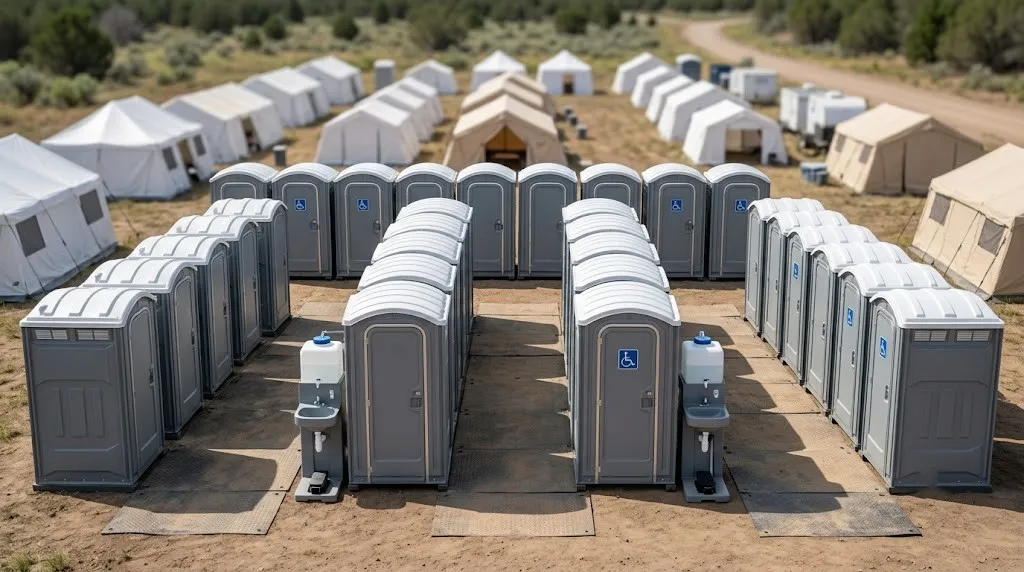
Disaster relief sanitation is the emergency supply of portable toilets, handwashing, showers and holding tanks to a location whose plumbing has failed or become unusable, delivered on hours of notice and serviced far more often than a normal rental. In most of the country that means a staging field or a shelter parking lot. In New York it usually means a residential block, a building courtyard, or a hospital or shelter forecourt with no room to spare.
Three failure modes account for most of the calls we take:
- Coastal flooding. New York City has roughly 520 miles of coastline and six hurricane evacuation zones mapped by NYC Emergency Management. Hurricane Sandy in October 2012 flooded parts of Staten Island, the Rockaways, Coney Island and Lower Manhattan.
- Extreme rainfall. The remnants of Hurricane Ida in September 2021 produced record rainfall and catastrophic basement flooding across Queens and Brooklyn. Much of the city's sewer network is combined, per the NYC Department of Environmental Protection, so heavy rain loads the same pipes carrying sewage.
- Power and water loss in tall buildings. Above roughly the sixth floor, water reaches apartments by pump. Lose power and the taps and the toilets stop together, whatever the sewer is doing.
How many units does an emergency site need?
Work from the Sphere figure of one toilet per 20 people for anything running longer than a few days, and one per 50 for the first phase of a response. Where the site is a workplace rather than a shelter, OSHA 1910.141(c)(1)(i) applies to the crews instead, starting at one toilet for 1 to 15 employees, and OSHA 1926.51(c)(1) applies to a construction or demolition response at one toilet per 20 workers on a 40-hour week.
| Population served | First phase | Sustained response | Handwash units |
|---|---|---|---|
| 100 | 2 units | 5 units | 2 |
| 250 | 5 units | 13 units | 3 to 4 |
| 500 | 10 units | 25 units | 5 to 6 |
| 1,000 | 20 units | 50 units | 8 to 10 |
Where units are clustered at one location, the 2010 ADA Standards section 213.2 exception 4 sets the accessible share at 5 percent of the cluster with a minimum of one, and in a displacement setting the accessible units get used harder than that ratio suggests. Sizing method on how many porta potties you need, with the accessibility detail on ADA restroom requirements.
What gets deployed, and in what order
- Standard porta potty rental, the first thing on the truck, with a 60 to 70 gallon holding tank per manufacturer spec
- ADA accessible units, placed on the flattest ground available and nearest the building entrance
- Handwashing stations and portable sinks, which matter more here than in any other application
- Hand sanitizer stations at entrances, as a supplement rather than a substitute
- Shower trailers and restroom trailers where power and water can be provided
- Holding tank rental where a building has water but nowhere for it to go
- Light towers, because relief sites operate after dark
Do emergency units need a DOT permit?
A unit standing on a New York City street or sidewalk needs a permit from the Department of Transportation, filed through borough offices, with turnaround running from about a day to several weeks depending on the borough and the type of work. The NYC DOT Bureau of Permit Management and Construction Control at 55 Water Street administers it, and 311 is the fastest route to the right office. In a declared emergency, agencies coordinate access differently, and NYC Emergency Management is the body running that coordination, so the practical answer is to ask the agency directing the response what applies at your site.
None of that changes the clearance rules. Nothing blocks a curb ramp, a building entrance, an emergency path or a work-zone route, and the 2010 ADA Standards require a 36 inch minimum clear width on a pedestrian access route in section 403.5.1. In a response those rules matter more, not less, because emergency vehicles are the traffic you are working around. On private ground, a courtyard, a lot or a driveway, no city permit applies. See porta potty permit requirements.
Servicing under load
ANSI/PSAI Z4.3 sets weekly servicing as the floor for a unit in normal use, and relief use is nothing like normal use. A unit serving 20 displaced people will need pumping every day or two, not every week. That means the service plan, not the delivery, is the real commitment, and it is the question to ask any supplier before accepting a quote in an emergency.
New York State licenses the haulers moving that waste under 6 NYCRR Part 364, and after a flood the transfer and treatment side of the system is under pressure too, which lengthens turnaround on every truck in the city. Plan for that rather than being surprised by it. How often porta potties are cleaned covers what a normal visit involves, and emergency porta potty rental covers same-day dispatch.
What emergency sanitation costs
Typical five-borough ranges reviewed July 2026, presented as market bands rather than a quote. Emergency placements sit at the top of every band, and honestly so: the work is out of hours, the access is bad and the servicing is intensive.
| Item | Typical range |
|---|---|
| Standard unit, monthly | $150 to $350 |
| Standard unit, weekly | $175 to $500 |
| ADA unit, monthly | $275 to $550 |
| Handwash station, monthly | $50 to $110 |
| Delivery | $75 to $200 |
| Additional service visit | $75 to $125 |
| Holding tank, shower trailer | quoted per job |
We do not quote a premium against a disaster and we will say plainly when we cannot reach a site. After a major coastal event, road access and fuel are the limits, not willingness. Full pricing on the porta potty rental cost page.
Cleanup, debris and the weeks afterwards
The sanitation order is the first week. The debris order is the next three months. Flood cleanup on residential blocks generates enormous volumes of gutted drywall, flooring and ruined contents, and that goes into roll-off dumpsters, usually 20 yard or 30 yard containers. What cannot go in a dumpster matters more after a flood than at any other time, because household chemicals and fuel end up in the debris pile.
Properties on septic rather than sewer, mostly on Staten Island and past the city line, need the tank checked before the system is used again. See septic pumping service, septic tank warning signs and emergency septic service.
Questions agencies and building managers ask
How fast can you get units to a site? Same day where roads are open and the placement is on private ground. We will tell you straight if we cannot.
Can you service daily? Yes, and in a relief setting that is the assumption rather than an extra.
Do you cover the surrounding area? Yes. Staten Island and the outer boroughs plus Bayonne, Jersey City and Hempstead.
What about winter conditions? Porta potty in winter covers freezing, access after snow and what changes below 32 degrees.
Call from the contact page rather than using the form if this is live, or send the site details through the quote form. Related capability sits on construction site services and porta potty rental in New York City, with everything else on the home page and in the FAQ.
Next step
Get a delivery date
Tell us the address, the dates and the headcount. We size the order and confirm the route.