
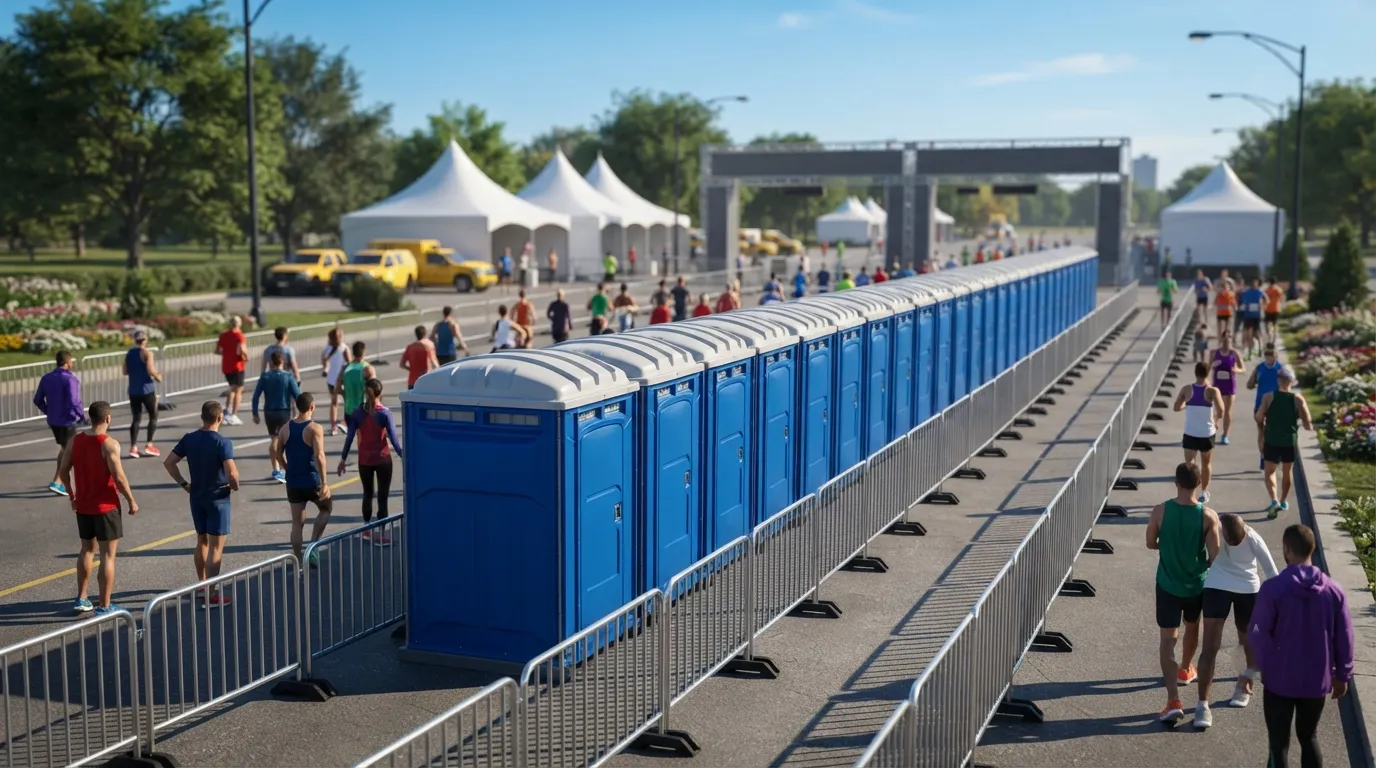
Why race restrooms are sized differently from event restrooms
A race is the only event type where almost every attendee uses a restroom inside the same short window, and most of them do it twice. That single fact drives the whole plan. Sizing a start village from an event ratio produces a queue that is still moving when the corrals close, which is the complaint that ends up in every post-race survey.
Three zones need separate numbers, and only the first one is negotiable:
- The start village. The heaviest concentration by a wide margin, sized for the pre-race window rather than the whole morning.
- The course. Units at mile markers and aid stations, sized for a fraction of the field, spread along the route.
- The finish and the family reunion area. Lighter than the start, but sustained for hours as the field comes in over a long tail.
How many portable toilets does a race start need?
Race directors work from one unit per 50 to 75 runners at the start, tightening toward one per 50 for a wave start where the whole field arrives together. Course placements run far lighter, commonly two to six units at each aid station depending on field size and how far into the race the station sits.
| Field size | Start village | Course, total | Finish area |
|---|---|---|---|
| 1,000 | 14 to 20 units | 8 to 12 units | 6 to 8 units |
| 5,000 | 70 to 100 units | 20 to 30 units | 20 to 25 units |
| 10,000 | 140 to 200 units | 40 to 60 units | 35 to 45 units |
| 25,000 | 340 to 500 units | 80 to 120 units | 70 to 90 units |
Where units are clustered at one location, the 2010 ADA Standards section 213.2 exception 4 puts the accessible share at 5 percent of the cluster, so a start village bank of 100 units needs at least five ADA accessible units with a level approach, and they belong at the near end of the run rather than the far one. Work through the arithmetic on how many porta potties you need and check ADA restroom requirements.
What makes New York races harder than most
The city's race calendar is unusually demanding on logistics. The TCS New York City Marathon starts at Fort Wadsworth on Staten Island, crosses the Verrazzano-Narrows Bridge and runs 26.2 miles through all five boroughs before finishing in Central Park, with a field that has passed 50,000 finishers in recent years. New York Road Runners also runs a half marathon that starts in Prospect Park and finishes at Coney Island, plus a year-round Central Park calendar.
What that means for restrooms is a delivery plan that crosses borough lines, bridge and highway closures that only open at set times, and staging areas that are parkland rather than pavement. Every one of those pieces is permitted by a different office. Get the race permit holder to tell you the access windows before anyone quotes a unit count.
Do race restrooms need a DOT permit?
If a unit stands on a New York City street or sidewalk, yes. It needs a permit from the Department of Transportation, obtained through borough offices, with turnaround running from about a day to several weeks depending on the borough and the type of work. The NYC DOT Bureau of Permit Management and Construction Control at 55 Water Street administers it, and 311 is the fastest route to a straight answer for a specific block.
Course and staging areas inside city parkland run through the NYC Parks special events permit process instead, and street closures are coordinated with the NYPD alongside DOT. Pedestrian clearance still governs placement everywhere: no curb ramp, building entrance, emergency path or work-zone route blocked, and the 2010 ADA Standards require a 36 inch minimum clear width on a pedestrian access route in section 403.5.1. Full detail on porta potty permit requirements.
Delivery timing for a Sunday morning race
Almost every race placement in this city happens overnight or in the small hours, because the streets are open until the closure starts and the units have to be standing before the field arrives. That means a night crew, an agreed access point at each zone, and a course marshal who can move a barrier.
- Place the start village first, and place it complete. A half-built bank at 5am is a real problem.
- Stage course units the evening before where the route allows it, and after closure where it does not.
- Leave the vacuum truck a legal stop within roughly 30 feet of each bank for the reset between waves.
- Collect from the finish first. It clears fastest and it is usually the hardest area to get a truck back into later.
A standard unit holds 60 to 70 gallons per manufacturer spec, and a start village bank will move a long way through that before the gun. ANSI/PSAI Z4.3 treats weekly servicing as the floor for normal use, which a race is not, so units arrive freshly serviced and stocked rather than mid-cycle. Race staff and volunteers are a workplace in their own right, and OSHA 1910.141(c)(1)(i) applies to them, starting at one toilet for 1 to 15 employees.
The placement guide covers measuring the ground, and the rental checklist is what we ask race operations to work through before the site walk.
What race restrooms cost in New York City
Typical five-borough market ranges, reviewed July 2026. Large race orders are quoted per job, because the overnight placement and the multi-zone routing cost more than the units do.
| Item | Typical range |
|---|---|
| Standard unit, event use | $250 to $450 |
| ADA unit, event use | $300 to $600 |
| Handwash station | $75 to $150 |
| Hand sanitizer stand | $25 to $60 |
| Delivery | $75 to $200 |
| Overnight or restricted-window placement | quoted per job |
Per-unit rates fall on volume once the trucks are committed to the morning. The full picture on what should and should not be a separate line is on the porta potty rental cost page.
Handwashing, sanitizer and the finish area
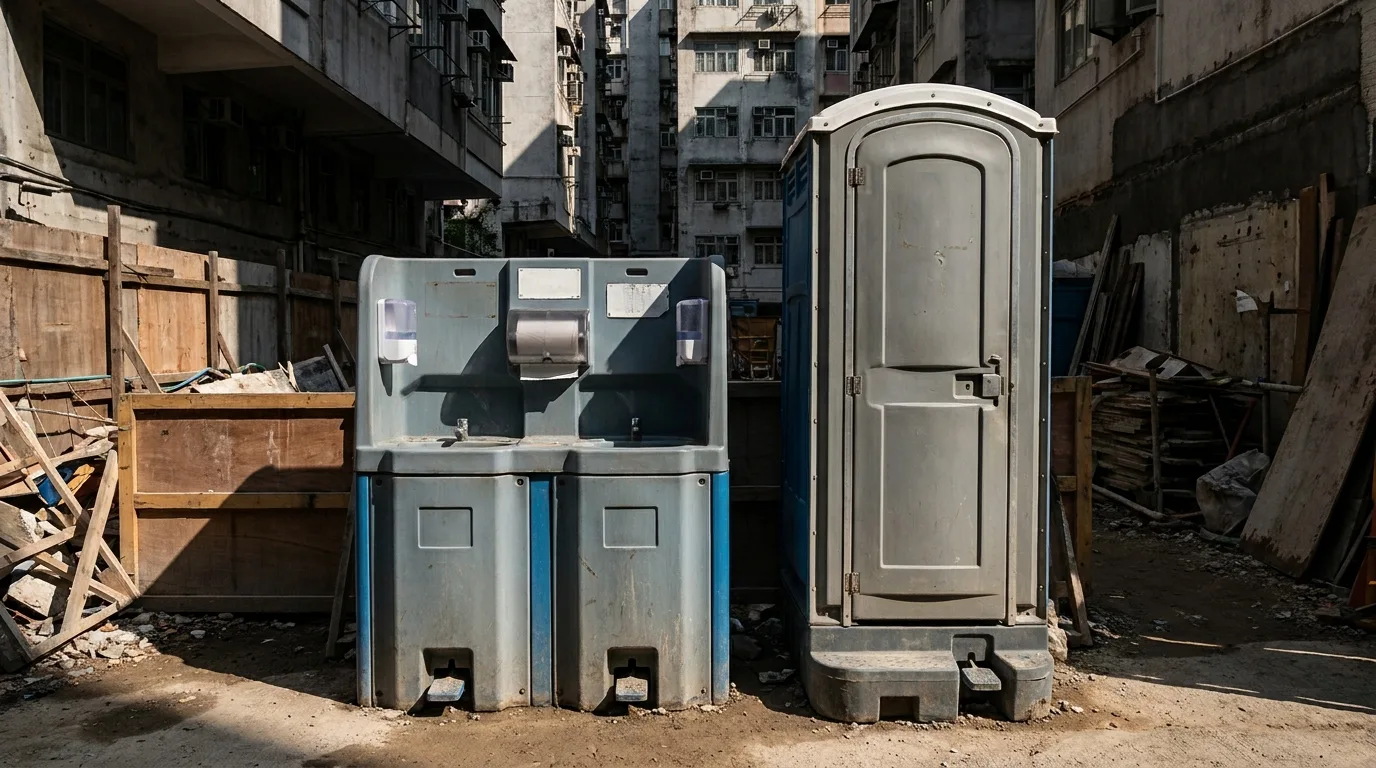
Handwashing belongs at the start village near the toilet banks and at the finish near the food, and the New York City Department of Health and Mental Hygiene requires handwashing facilities as part of the temporary food service permit any race vendor operates under. A two-station sink covers a bank of about 10 units at a race, less if the field is large and the window is short.
Handwashing station rental covers the free-standing units, portable sink rental covers vendor sinks, and handwashing requirements explains what applies where. Sanitizer stands are cheap and they move queues, so put them at both ends of every bank.
Questions race directors ask
How early do we need to book a marathon order? Months, for anything over a few thousand runners. Fleet, drivers and an overnight crew all have to be committed at once.
Can you service the start village between waves? Yes, where the site plan leaves a truck route. It has to be designed in, not improvised on the day.
What about a race outside the five boroughs? Jersey City, Bayonne and Hempstead are in normal range, with the rest on the service areas page.
Do you handle the rest of the event build? Crowd control barrier, temporary fencing, light towers and roll-off dumpsters all come off the same dispatch.
Does the finish line need temporary power?
Often. If you need to know how to brace a temporary power pole for it, ask before race week.
Send the race date, the field size and the zone plan through the quote form, or call from the contact page. Related work sits on event restroom rental, festival restroom rental and concert restroom rental, with the market overview on porta potty rental in New York City and everything else on the home page and in the FAQ.
Next step
Get a delivery date
Tell us the address, the dates and the headcount. We size the order and confirm the route.