
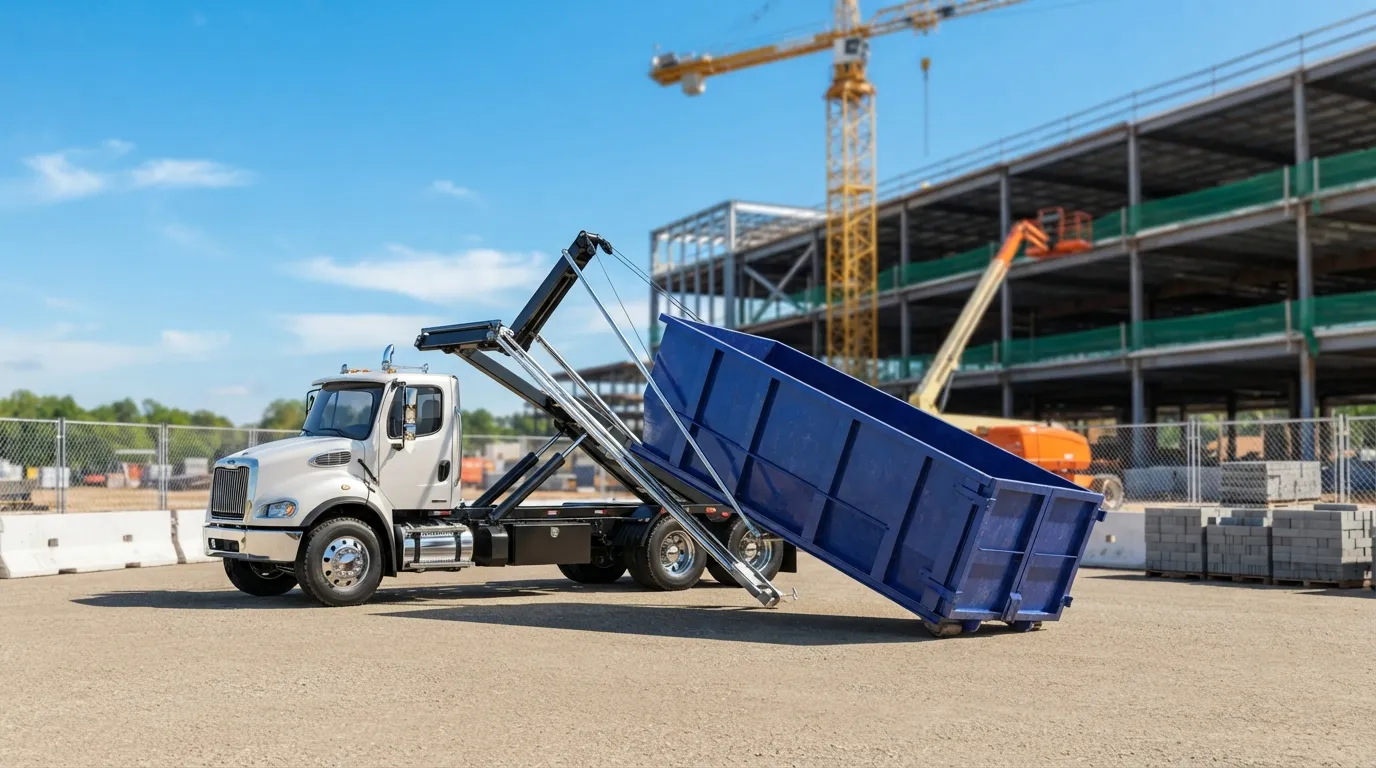
What is a roll-off dumpster, and what size does a New York City job need?
A roll-off dumpster is an open-top steel container delivered on a hooklift or cable truck, loaded on site, then winched back onto the same truck and hauled to a transfer station. Four sizes cover almost every job: 10 yard, 20 yard, 30 yard and 40 yard.
In most American cities, picking a size is a volume question. In New York it's a block question. A 40 yard container measures roughly 22 feet long, 8 feet wide and 8 feet tall per manufacturer spec, which on a Park Slope brownstone street is three parked cars worth of curb before the truck needs room to work. A lot of Manhattan and Brooklyn jobs end up in a 10 yard can not because the debris fits, but because nothing larger does. Every measurement is broken out on the dumpster sizes and dimensions page.
Roll-off dumpster sizes and what each one actually holds
The table below shows typical container dimensions from manufacturer specifications, along with the debris volume each one swallows in practice. Yardage is cubic yards of volume, not weight, and the two are not interchangeable.
| Size | Typical footprint | Height | Holds about | Common NYC use |
|---|---|---|---|---|
| 10 yard | 12 to 14 ft long, 8 ft wide | 3.5 to 4 ft | 3 to 4 pickup loads | Bathroom gut, brownstone stoop, small cleanout |
| 20 yard | 22 ft long, 8 ft wide | 4 to 4.5 ft | 6 to 8 pickup loads | Kitchen and bath renovation, roof tear-off |
| 30 yard | 22 ft long, 8 ft wide | 6 ft | 9 to 12 pickup loads | Full apartment gut, commercial fit-out |
| 40 yard | 22 ft long, 8 ft wide | 8 ft | 12 to 16 pickup loads | Bulky light debris, demolition, film strike |
Notice that the 20, 30 and 40 yard containers share a footprint. Only the wall height changes. That matters more here than anywhere else, because if a 20 yard can fits your curb space, so does a 40, and the extra volume is often cheaper than a second haul. The exception is a low overhead: taller walls mean a taller load line and less room under scaffolding.
What does roll-off dumpster rental cost in New York City?
Typical weekly market ranges for the five boroughs sit between $425 and $800 depending on size, debris type and where the truck has to stand. Those are market ranges reviewed July 2026, not a quote, and New York placements sit toward the top of every national band because of drive time, parking and permit work rather than the steel.
| Container | Typical week | Extra day | Included tonnage |
|---|---|---|---|
| 10 yard | $425 to $650 | $50 to $115 | 1 to 2 tons |
| 20 yard | $475 to $700 | $50 to $115 | 2 to 3 tons |
| 30 yard | $550 to $780 | $50 to $115 | 3 to 4 tons |
| 40 yard | $600 to $800 | $50 to $115 | 4 to 6 tons |
Heavy debris changes the shape of the quote completely. Concrete, brick, dirt and roofing tear-off are usually priced as a dedicated clean load in a 10 yard can with its own tonnage rate, because the weight ceiling arrives long before the container is full. The dumpster rental cost breakdown walks through every line, and weight limits covers overage. If your job also needs somewhere to lock tools overnight, a storage container rides in on the same kind of truck and gets priced on the storage rental cost page.
One thing worth checking before you compare two numbers: in New York, your hauler has to hold a license from the NYC Business Integrity Commission, which regulates the private trade waste industry under Title 16-A of the Administrative Code. A price that undercuts everyone by 40 percent is occasionally a company that doesn't hold one.
Weight allowances, tonnage and overage
Every roll-off rental includes a tonnage allowance, and everything above it is billed by the ton at the transfer station rate. That rate moves with the market, so ask for it as a number on your quote rather than accepting "standard overage charges" as an answer. We won't book a heavy demolition load without naming the per-ton figure first, because that's the line that turns a $600 rental into a $1,400 one.
Rough weights to plan against: a cubic yard of mixed construction debris runs about 500 to 800 pounds, drywall about 500 pounds, and broken concrete roughly 4,000 pounds. Do the arithmetic on the concrete number. Two and a half cubic yards of it hits the 5 ton mark, which is why nobody loads concrete into a 30 yard can.
Federal weight rules cap a loaded truck at 80,000 pounds gross vehicle weight under 23 CFR 658, and that ceiling is what sets the tonnage allowance on every container size. It isn't a policy we made up. It's the axle limit on the truck that comes to get it.
Do you need a permit for a dumpster on a New York City street?
Yes. A container placed on a New York City street or sidewalk needs a permit from the Department of Transportation, handled through the Bureau of Permit Management and Construction Control at 55 Water Street, with borough offices doing the approvals. Turnaround ranges from about a day to several weeks depending on the borough and the type of work, and 311 is the fastest route to a straight answer for a specific address.
If the container sits entirely on private property, a driveway, a lot, a fenced site, none of that applies and you can usually get delivery the next business day. The full walkthrough, including what to have ready before you file, is on the dumpster permit requirements page, and porta potty permits run on a separate track if your job needs both.
Plan the permit before you plan the container. In this city the approval timeline drives the schedule far more often than availability does.
Where a roll-off container can actually go in the five boroughs
Placement here is decided by pedestrian clearance before anything else. A container must never block a curb ramp, a building entrance, an emergency path or a work-zone route. The 2010 ADA Standards require a minimum 36 inch clear width on a pedestrian access route in section 403.5.1, and there are sidewalks in Lower Manhattan and Downtown Brooklyn where a container simply cannot go, whatever the paperwork says.
Things that stop a placement in New York and rarely come up elsewhere:
- Sidewalk sheds. The city's Facade Inspection Safety Program keeps thousands of sheds standing across Manhattan and the Bronx, and a roll-off truck needs roughly 22 feet of vertical clearance to raise its hoist. Under a shed, that's gone.
- Protected bike lanes. A container cannot sit in one, and on avenues with a parking-protected lane the curb lane you were counting on is the buffer, not the parking.
- Bus lanes and camera enforcement, which run on far more corridors than most out-of-town contractors expect.
- Alternate side parking, which can move a container mid-rental if the placement wasn't planned around it.
- Fire escapes, scaffolding cross-bracing, low utility lines and mature street trees in Queens and Staten Island, all of which sit under the hoist height.
- Hydrants, standpipes and building siamese connections.
Commercial vehicles are also banned from the parkway network, so the FDR Drive, the Belt Parkway and the Henry Hudson Parkway are closed to the truck no matter how direct they look on a map. Routing runs on the NYC DOT truck route network instead, which is why a Rockaway delivery and a Midtown delivery can be priced very differently for the same container.
What cannot go in a roll-off dumpster here
New York restricts more material than most states, and a load with the wrong thing in it gets rejected at the transfer station and returned at your cost. The short version:
- Asbestos. New York City DEP runs the Asbestos Control Program, and many renovation permits require an ACP-5 filing before the Department of Buildings will sign off. Suspect material goes to an abatement contractor, never into a can.
- Electronics. New York State's Electronic Equipment Recycling and Reuse Act has banned televisions, monitors and computers from landfill disposal since January 2015.
- Refrigerators and air conditioners. Section 608 of the federal Clean Air Act requires certified refrigerant recovery before an appliance is scrapped.
- Paint, solvents, fuel, pesticides, pool chemicals.
- Tires, batteries, propane tanks, medical waste.
The full list, with where each thing actually goes in New York City, is on what cannot go in a dumpster. Liquids of any kind are the most common reason a load gets flagged, and it's usually half a bucket of joint compound nobody thought about.
How delivery works, and what the driver needs from you
Delivery on a clear private-property placement takes about ten minutes. The truck backs in, the container rolls off the rails, the driver checks it's square and level, and that's the job. What turns ten minutes into a wasted trip is almost always something nobody mentioned on the phone.
- Confirm the exact address with cross streets, plus the borough.
- Say what surface it lands on. Asphalt, concrete, pavers or dirt each behave differently, and
plywood under the rails protects a driveway.
- Measure the clear length. A 20 yard container needs roughly 55 to 60 feet of straight approach for
the truck to set it down.
- Check overhead for 22 feet of clearance.
- Tell us the debris type honestly. Mixed, clean wood, roofing, concrete and dirt are priced
differently because they weigh differently.
- Say whether it's public right of way or private property, because that decides the permit
question.
- Confirm building or block access windows if any apply.
Our rental checklist covers the same ground for restroom units, and the placement guide explains what a driver looks at when he pulls up. Plenty of jobs book a container and a restroom on one delivery, and if you need something on the ground today, emergency rental is a separate conversation.
Roll-off dumpsters for construction and demolition
Most of our container volume is construction work, and the debris in New York skews heavy: plaster and lath instead of drywall, cast iron instead of PVC, and old-law tenement framing that weighs more than anything built after 1960. Construction dumpster rental covers the swap-out schedule and how tonnage gets managed across a long job.
While the container is on site, the same crew usually needs sanitation. OSHA 1926.51(c)(1) requires one toilet per 20 workers on a construction site working a 40-hour week, and that count includes every trade on the job rather than every company. Porta potty rental and a portable sink go on the same delivery, and construction site services bundles containers, restrooms, temporary fencing and light towers under one order. Longer jobs usually add a mobile office trailer and a temporary power pole, and monthly restroom pricing is on the monthly rental page.
Home renovation, cleanouts and small jobs
For a co-op kitchen gut or a basement cleanout in Bay Ridge, the 10 yard container is usually the right answer, and often the only answer that fits the block. Building management is the other gate: most co-op and condo boards want the placement, the dates and the insurance certificate before the truck is booked, and that approval takes longer than the container does.
Renovation debris in a pre-1978 building carries a lead question too. New York City's Local Law 1 of 2004 governs lead paint hazards in residential buildings, and painted-surface demolition in an older apartment is not a straight roll-off job. Ask before you swing the hammer. Home renovation restroom rental covers the other half of a long interior job.
Film sets, street fairs and event cleanup
New York carries two demand patterns most cities don't, and both need containers on very short notice. Film and television production books through the Mayor's Office of Media and Entertainment, and a strike day generates a large volume of light bulky waste, which is exactly what a 40 yard container is built for. See film set restroom rental for the sanitation side.
Street fairs and races are the other pattern. Events at Citi Field, Yankee Stadium, Flushing Meadows Corona Park, Prospect Park and Randalls Island each run on their own service vehicle access rules and their own lead times, and none of them match. Ask the venue first, then call us. Cleanup planning for festivals, concerts and marathons sits alongside the restroom count on those pages.
How long can you keep a roll-off container?
A standard rental period is 7 to 14 days, and extra days typically run $50 to $115 each. On a street placement the DOT permit sets the real limit, not us: when the permit expires the container comes back whether the job is finished or not, so build the extension into the original filing.
Long construction jobs work differently. Instead of one long rental, we run a swap schedule, hauling a full container and dropping an empty on the same trip. That's cheaper per ton and it keeps the footprint on site constant, which matters when the footprint is a permitted parking lane.
What a fair roll-off quote includes
A complete quote names six things: container size, rental period, included tonnage, the per-ton overage rate, delivery and haul as separate lines, and whether a DOT permit is needed for that exact address.
Should be included: delivery, pickup, the haul to the transfer station, disposal up to the stated tonnage, and the standard rental days.
Reasonably extra: extra days, tonnage over the allowance, a dry run when the truck can't place the container, permit filing time, restricted-hours delivery, and any load rejected for prohibited material.
Should not be extra: a fuel surcharge nobody mentioned, an environmental fee with no definition, or a "heavy load" charge on a container that never went over its tonnage. Ask what each line means. Anything the sales rep can't explain in a sentence is worth pushing on. Our quote form asks for all of it up front, and the contact page has the direct line if you'd rather talk it through.
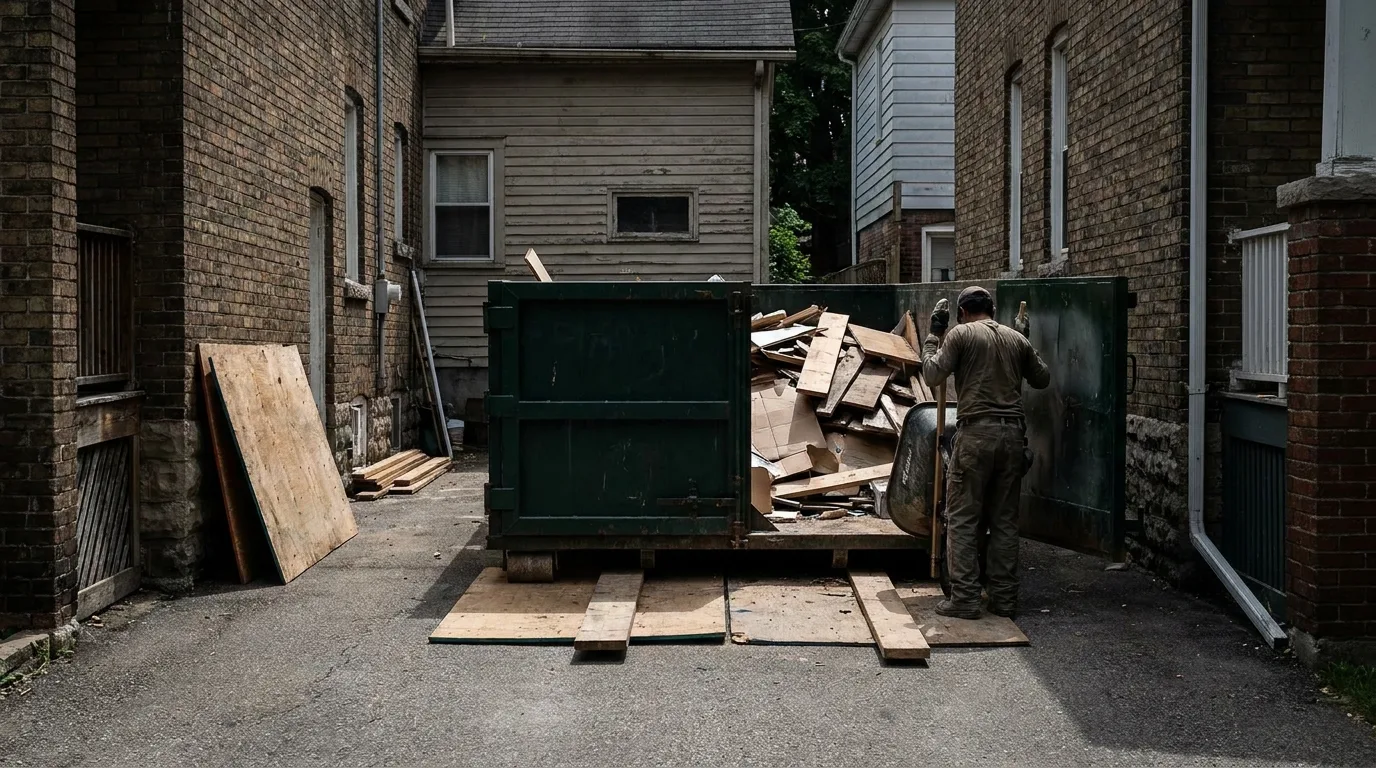
Questions people ask about roll-off dumpster rental in NYC
How much is a roll-off dumpster rental near me? $425 to $800 for a typical week across the five boroughs, depending on size and debris. Manhattan street placements sit at the top of that band because of permit work and truck access.
What size do most New York City jobs rent? The 20 yard container. It handles a kitchen and bath renovation or a roof tear-off, and it fits more curb spaces than a 30 or 40 yard can does.
Can I put a dumpster in front of my building? Only with a DOT permit, and only if the placement clears the pedestrian path, curb ramps, entrances and emergency routes. Many narrow sidewalk blocks can't take one legally.
How fast can you deliver? Next business day is realistic for private property placements in all five boroughs and in Jersey City, Hoboken and Newark. Street placements move at the permit's pace.
Do you take concrete and dirt? Yes, as a clean load in a 10 yard container with its own tonnage rate. Mixed with other debris it gets priced as heavy waste, which costs more.
What happens if it rains? Water adds weight, and on an open container that weight is yours. Tarp a load of drywall or soil if rain is coming, or you'll pay for the rainfall by the ton.
Do you serve outside the five boroughs? Yes. Hempstead, Bayonne, Elizabeth and Paterson are inside normal range. The full list is on the service areas page.
Can I rent a container and a restroom together? That's most of what we do. See what porta potty rental costs for the sanitation side, or the home page for everything we run. The FAQ and the about page cover the rest.
What does dumpster rental roll off actually mean?
The container rolls off the truck bed on rails. That is the whole name.
Which size do most New York City jobs take?
A 20 yard dumpster rental covers most renovations, so a 20 yard roll-off dumpster rental is our default quote.
Is a 10 yard roll off dumpster enough for concrete?
Usually yes. Heavy clean loads go small, because the truck has a legal lift limit.
Is roll off dumpster rental near me next day?
Often, on private property. Street placement waits on the permit, not on us.
Next step
Get a delivery date
Tell us the address, the dates and the headcount. We size the order and confirm the route.