
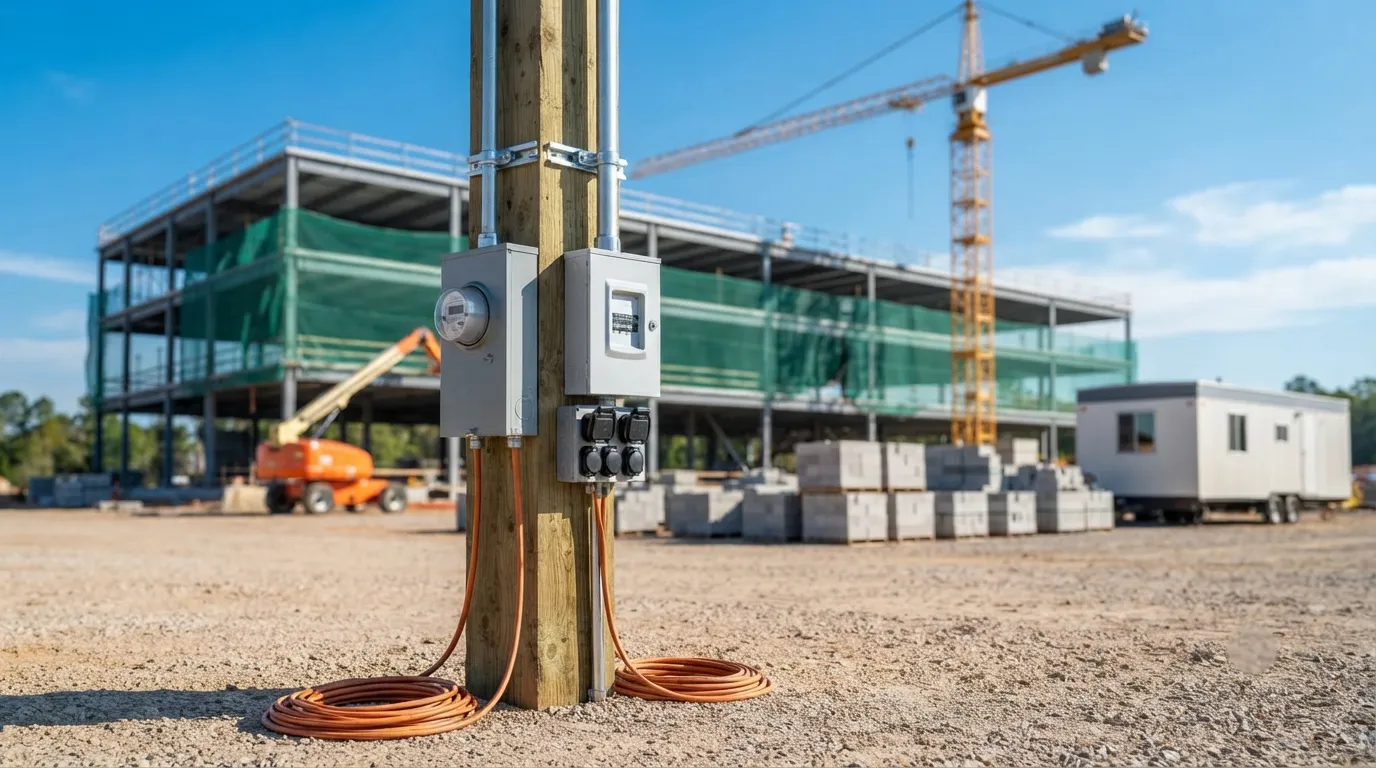
What is a temporary power pole?
A temporary power pole is a free standing post carrying a utility meter socket, a weatherproof distribution panel and GFCI protected outlets, set on a construction site to provide power before the building's permanent service exists. Article 590 of the National Electrical Code is the section that governs temporary installations of exactly this kind.
It isn't a generator. A generator makes its own power and moves with the job. A construction temporary power pole is a metered connection to the grid, which in the five boroughs means Con Edison, and it stays until the permanent service is energised.
Temporary power pole requirements in New York City
The rules stack in a specific order, and skipping the first one wastes weeks.
- A licensed master electrician files the electrical work with the Department of Buildings. In New York City this is not optional and it is not something a general contractor self certifies.
- NEC Article 590 governs the temporary installation, and NEC 590.6(A) requires GFCI protection on all 125 volt, single phase, 15, 20 and 30 amp receptacles used for temporary power on a construction site.
- OSHA 1926.404(b)(1)(ii) requires the same GFCI protection as a workplace safety rule, so it applies whether or not anyone has filed anything.
- A grounding electrode, typically an 8 foot driven ground rod, bonded to the service.
- Con Edison energises the service once the installation passes inspection.
Getting the filing started early is the whole game. The pole itself can be set in an afternoon. It's the approvals that run on someone else's calendar, and you can't shorten them by paying more.
How high does the pole have to be?
Tall enough for the service drop clearance, which is set by NEC 230.24. Over a public street, alley or driveway subject to truck traffic, the conductors have to be 18 feet above grade. Over a residential driveway or a commercial area not subject to truck traffic, 12 feet. Where the area is accessible to pedestrians only, 10 feet at the lowest point of the drip loop.
That is why most poles end up 16 to 20 feet of 4 by 4 or 6 by 6 timber, braced and often guyed. The panel itself sits much lower: NEC 240.24(A) caps the centre of a breaker operating handle at 6 feet 7 inches above grade, and the meter socket usually sits between 4 and 6 feet where the utility can read it.
Reading a temporary power pole diagram
Every temporary power pole diagram shows the same stack, top to bottom, and it helps to know the order before the electrician arrives.
| Position | Component |
|---|---|
| Top of pole | Service drop attachment and weatherhead |
| Below weatherhead | Drip loop, then service entrance conductors |
| 4 to 6 feet | Meter socket |
| Below meter | Main disconnect and weatherproof panel, breaker handles under 6 feet 7 inches |
| Panel face | GFCI protected receptacles, commonly 20 amp and 50 amp |
| Base | Grounding electrode conductor to an 8 foot ground rod |
Bracing is the part drawings under-represent. A pole carrying a service drop is in permanent tension toward the utility pole, so it needs proper bracing or a guy back into the site, and on a New York City lot that bracing has to sit inside the fence line rather than across a sidewalk. That's the detail that gets redesigned on site more than any other.
200 amp temporary power pole vs 100 amp
A 200 amp temporary power pole is the standard for a real construction site. A 100 amp is enough for a small residential job or a single trade.
Size it on the loads that run together, not on the tool count. Two compressors, a welder and a temporary heater will find the limit of a 100 amp service on the first cold morning. A mobile office trailer draws real power on its own, particularly the HVAC start load in August, and a refrigerated storage container draws continuously for the whole term. Add those before deciding.
Installing a temporary power pole: who does what
Installing a temporary power pole is a split job, and being clear about the split saves arguments.
We deliver and place the pole assembly and coordinate it with the rest of the site kit. A New York City licensed master electrician does the wiring, files with the Department of Buildings and arranges the inspection. Con Edison makes the service connection and energises it. Nobody skips a step in that sequence, because an unpermitted temporary service is a stop work order rather than a fine.
While the approval runs, most sites bridge the gap with a light tower, which carries its own generator and needs no filing at all.
Do you need a permit for a temporary power pole in NYC?
Two separate permissions, and people confuse them constantly.
The electrical work needs a Department of Buildings permit filed by a licensed master electrician. Separately, if any part of the pole, its bracing or the working area occupies a New York City street or sidewalk, the Department of Transportation issues that permit through its Bureau of Permit Management and Construction Control at 55 Water Street, with borough offices handling approvals and turnaround running from about a day to several weeks depending on the borough and the type of work. 311 is the fastest route for a specific address.
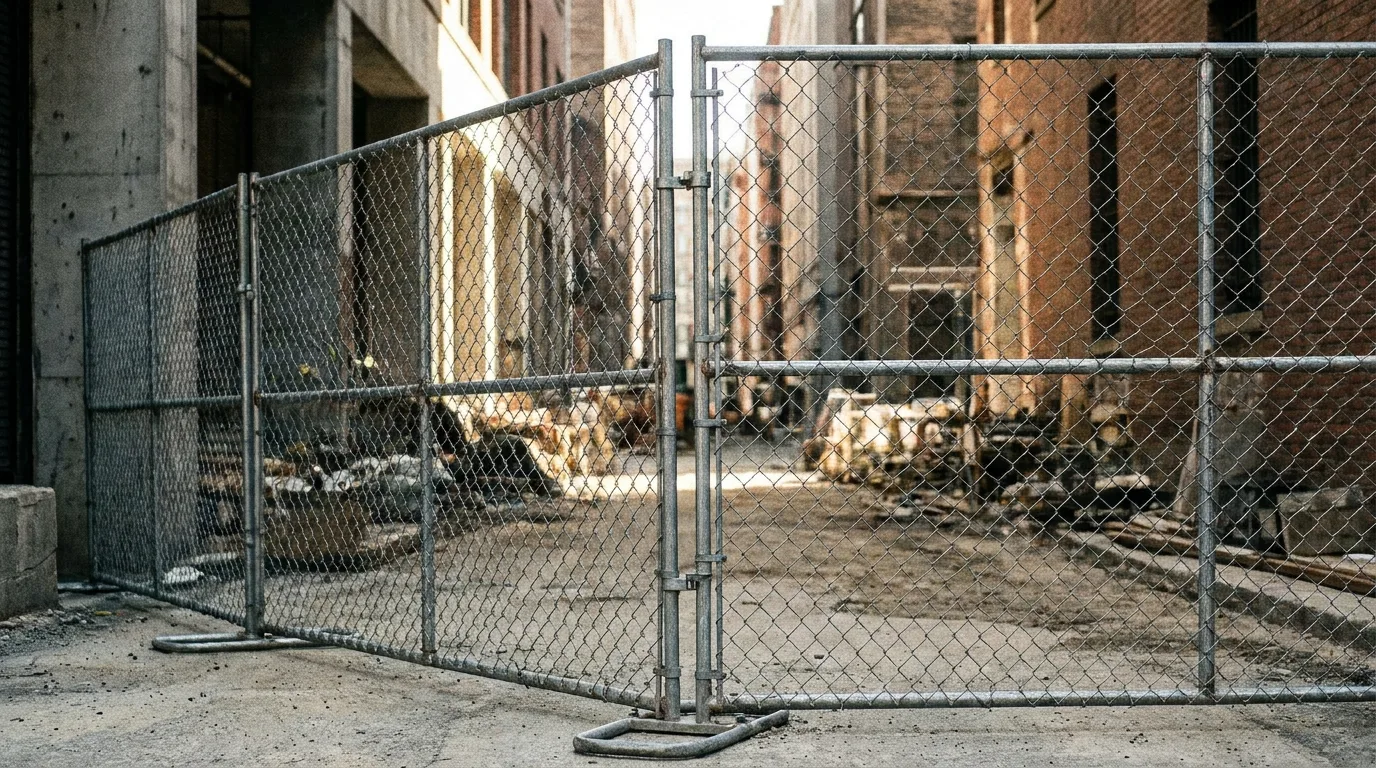
Inside a construction fence, the DOT filing falls away. New York City Building Code Chapter 33 requires an 8 foot construction fence along a public way, so temporary fence rental usually goes in before anything else, and chain link temporary fence covers the panels. Porta potty permit requirements has the same DOT sequence for sanitation.
What a temporary power pole installation costs
Temporary power pole installation cost splits three ways, and only one part of it is equipment.
The pole assembly and its delivery is the smallest line. The licensed electrician's labour and DOB filing is the largest. The utility connection charge is Con Edison's, and it is theirs to quote, not ours. Anyone giving you one number for all three without seeing the site is guessing. For context on adjacent site kit, published market data puts storage containers at $100 to $250 a month and temporary fence at $30 to $75 per day, prices reviewed July 2026, and those are market ranges rather than a quote.
Questions people ask about temporary power poles
How long does the whole process take? The pole goes in fast. The filing, inspection and utility connection are the calendar, and on a temporary power pole for construction site work in this city that is usually weeks rather than days. Start it before you mobilise.
Can I use a generator instead? For a short job, yes, and plenty do. For anything running months, metered power is cheaper than fuel and a lot quieter, which matters under the New York City Noise Code.
Does the pole stay for the whole job? Until the permanent service is energised, then it is removed and the meter is closed out. Plan the removal into the programme.
What else lands on the same site order? Restrooms through porta potty rental in New York City at these prices with monthly rates for long terms, handwashing station rental, a 20ft storage container or 40ft container, a roll-off dumpster and full construction site services.
Do you work outside the five boroughs? Yes, including Jersey City, Newark and Hempstead, though the electrical filing and the utility are different bodies there. The service areas page lists everywhere we run.
Send the site address, the loads and the programme dates through the quote form, or call the number on the contact page. The FAQ answers the common ones, the about page explains how we work, and everything we supply is on the home page.
Next step
Get a delivery date
Tell us the address, the dates and the headcount. We size the order and confirm the route.