
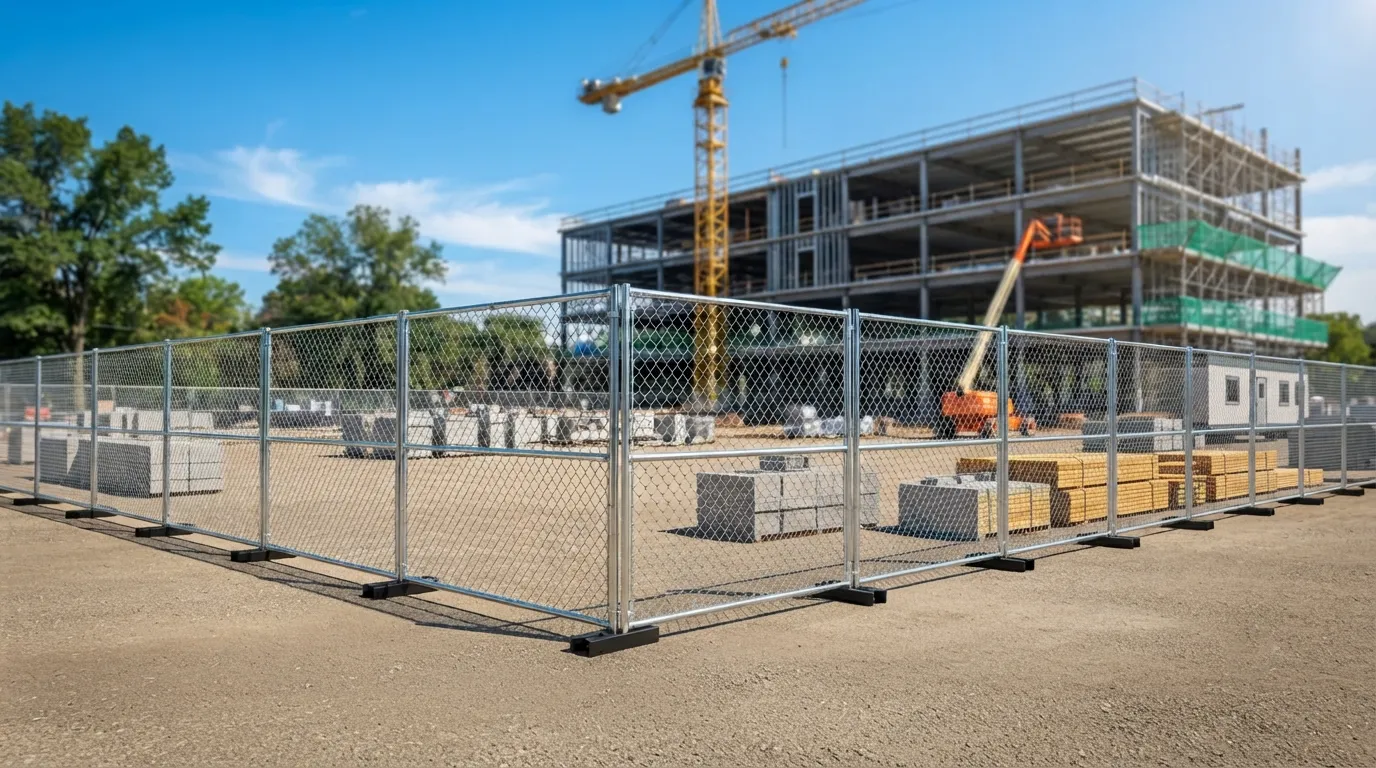
What is a temporary fence?
A temporary fence is a free standing barrier made from steel panels dropped into weighted bases, or from posts driven into the ground with mesh stretched between them. Nothing gets concreted in. Panels arrive on a truck, go up in a few hours, and come out the same way at the end of the job.
Two systems cover almost everything in this city. Panel fence is fast, movable and needs no ground penetration, which matters when the ground is a Manhattan sidewalk with utilities 18 inches below it. Post driven fence is stronger and quieter in wind, but it needs soil you're allowed to drive a post into, so it belongs on open lots rather than on the street.
Temporary fence panels: real specs and weights
| Item | Typical spec |
|---|---|
| Standard panel | 6 feet high by 12 feet wide |
| Alternate panel | 6 by 10 chain link temporary fence panel, for tighter runs |
| New York construction height | 8 feet, per Building Code Chapter 33 |
| Frame tube | 1 3/8 inch outside diameter |
| Mesh | 2 inch diamond, 11.5 or 9 gauge |
| Panel weight | 60 to 90 pounds |
| Base block | 32 to 40 pounds, concrete or moulded rubber |
| Panels per 100 linear feet | About 8 at 12 foot width |
Those numbers do real work when you're planning. A 300 foot perimeter is roughly 25 panels, 25 bases and 25 sets of clamps, which is about 3,000 pounds of steel and ballast landing on your site. That's one truck and a two person crew for most of a morning. Cyclone chain link temporary fence panels, which is what a lot of older New York contractors still call them, are the same product.
How much temporary fence do I need?
Measure the perimeter you need to close, divide by 12, and add panels for gates.
- Walk the line before you measure. A street tree pit, a hydrant, a cellar door and a subway grate all change where the fence can actually sit.
- Add a panel at each corner, because corners eat length in the bracing.
- Every vehicle gate takes two panels on hinges plus room to swing.
- A pedestrian gate takes one, and you want more of them than you think.
- Order 5 to 10 percent spare. Panels get damaged and a run that stops 8 feet short is useless.
For a fenced New York jobsite, that perimeter is also what removes the need for a Department of Transportation permit on everything inside it, which is why fencing goes in before the storage container, the mobile office trailer and the sanitation. The temporary fence cost page works through pricing by run length.
Chain link temporary fence panels vs post driven fence
Chain link temporary fence is the panel system: 6 by 12 sections in bases, clamped together at each joint. It's what you see around almost every New York site because it goes up on any surface, moves in an afternoon and leaves nothing behind.
Post driven fence uses a hydraulic driver to set posts 2 to 3 feet into the ground, with fabric stretched between them. It's far more resistant to wind and to being pushed over, and it's the right answer on a large open lot in Staten Island or eastern Queens where a long run has to survive a winter. It is the wrong answer on a sidewalk, on a slab, over a vault, or anywhere the ground has utilities in it. Chain link temporary fence covers the panel system in detail.
Bases, ballast and the New York wind problem
A panel in a 32 pound base is stable in still air and marginal in a gust. Chain link on its own is mostly holes, so wind passes through and the load is modest.
Add privacy screen and the physics change completely. A 6 by 12 panel with mesh screen on it becomes a 72 square foot sail, and the ballast that held it in still air will not hold it in a January nor'easter funnelled between two Midtown towers. The fix is more weight, closer base spacing and bracing back into the site, and on exposed rooftops or waterfront sites in Red Hook and the Rockaways it means engineered ballast rather than standard blocks. Any fence that comes down in a New York street is a serious incident, so this is the part not to guess at.
Privacy screen, windscreen and printed mesh
Screen does three jobs: it keeps sightlines out of the site, it holds dust in, and it carries branding or a rendering of the finished building.
The trade off is always wind. Solid screen catches the most, knitted windscreen at 70 to 85 percent coverage catches less, and open mesh with cut vents catches least. On a New York street job we tend to specify vented screen and heavier ballast rather than solid screen and hope. Printed mesh on a facade job under a Local Law 11 facade inspection is common enough that most general contractors plan for it at the bid stage.
Does New York City require a construction fence?
For work along a public way, yes. New York City Building Code Chapter 33, safeguards during construction, governs site protection, and an 8 foot construction fence along the public way is the standard requirement rather than the 6 feet used in most of the country.
Where the work involves a taller building, Chapter 33 pushes you past a fence into sidewalk shed territory, and a shed is a structural element with its own filing rather than something that arrives on a truck. The practical read for most contractors: a lot, a low rise or a yard gets fenced, and a tall building over an occupied sidewalk gets shedded. Ask the Department of Buildings expediter on the job which one applies before you order anything.
Do you need a permit for a temporary fence in NYC?
If the fence sits on private property, no. If any part of it occupies a New York City street or sidewalk, yes, and it comes from the Department of Transportation through its Bureau of Permit Management and Construction Control at 55 Water Street. Borough offices handle approvals, and turnaround runs from about a day to several weeks depending on the borough and the type of work. 311 is the fastest route for a specific address.
Pedestrian clearance is decided before the permit. The 2010 ADA Standards require a 36 inch minimum clear width on a pedestrian access route in section 403.5.1, and a fence line cannot block a curb ramp, a building entrance, a hydrant, a subway stair or an emergency egress route. On a narrow sidewalk that single rule often forces the fence line back onto the property. The placement guide covers the same clearance logic for sanitation, and porta potty permit requirements has the DOT filing sequence.
Gates, access and how deliveries get in
Plan the gate before the fence, not after. Everything that arrives on the job has to fit through it, and that includes a tilt bed truck placing a 20ft container, a concrete pump, and the truck that services the restrooms every week.
A double vehicle gate built from two 12 foot panels gives a 24 foot opening, which handles most deliveries. Anything wider needs a removable panel section. Keep the pedestrian gate separate and near the site office so nobody props the vehicle gate open, which is how sites get walked into. If the roll-off dumpster is inside the fence, remember the hooklift truck needs roughly 55 to 60 feet of straight approach to lift it.
Fencing for events, film and street closures
Event work is a different job from construction fencing. Runs are longer, they go up and come down inside a fixed window, and the fence is doing crowd management rather than site security.
Races and festivals across Randalls Island, Flushing Meadows Corona Park and Prospect Park mostly want crowd control barriers rather than chain link, because barricades interlock, move by hand and read as a queue line rather than a wall. Chain link goes around the back of house: generators, catering, the restroom trailer compound and the production area. Film work near Citi Field or on a Brooklyn street closure uses the same split, and film set restroom rental covers the rest of the base camp. Festival restroom rental, marathon restroom rental and concert restroom rental plan the sanitation side.
Temporary fence for a rental house or a residential job
A temporary fence for rental house work usually has nothing to do with construction. Landlords fence a yard during a turnover, around a pool while it's out of service, or to close off a collapsed area until repairs happen. Panel fence suits it because it leaves the ground untouched.
The same applies to brownstone renovations across Brooklyn and the Bronx, where a fenced front area protects the sidewalk and gives somewhere to keep material. A residential job that fences its frontage usually adds a home renovation porta potty inside the line rather than leaving the crew to use the client's bathroom, and a 10 yard dumpster if the work is a gut.
Temporary fence rental cost in the five boroughs
Published market data puts temporary fence at $30 to $75 per day, with around $50 typical. Prices reviewed July 2026, and these are market ranges rather than a quote. Longer New York jobs are normally quoted monthly against a linear foot run instead, because that's how the labour actually falls.
What moves the number here:
- Run length, and how many gates it carries
- Screen or no screen, since screen changes the ballast requirement
- Whether the line sits on private property or on a permitted sidewalk
- Access for the delivery truck, and whether panels have to be carried in by hand
- Term, since installation and removal are fixed costs spread across the rental
- Night or weekend install on a live retail or hospital site
Temporary fence cost breaks the fee lines out one by one, including installation, relocation and repair after damage.
Installation, service and how fast we can get out
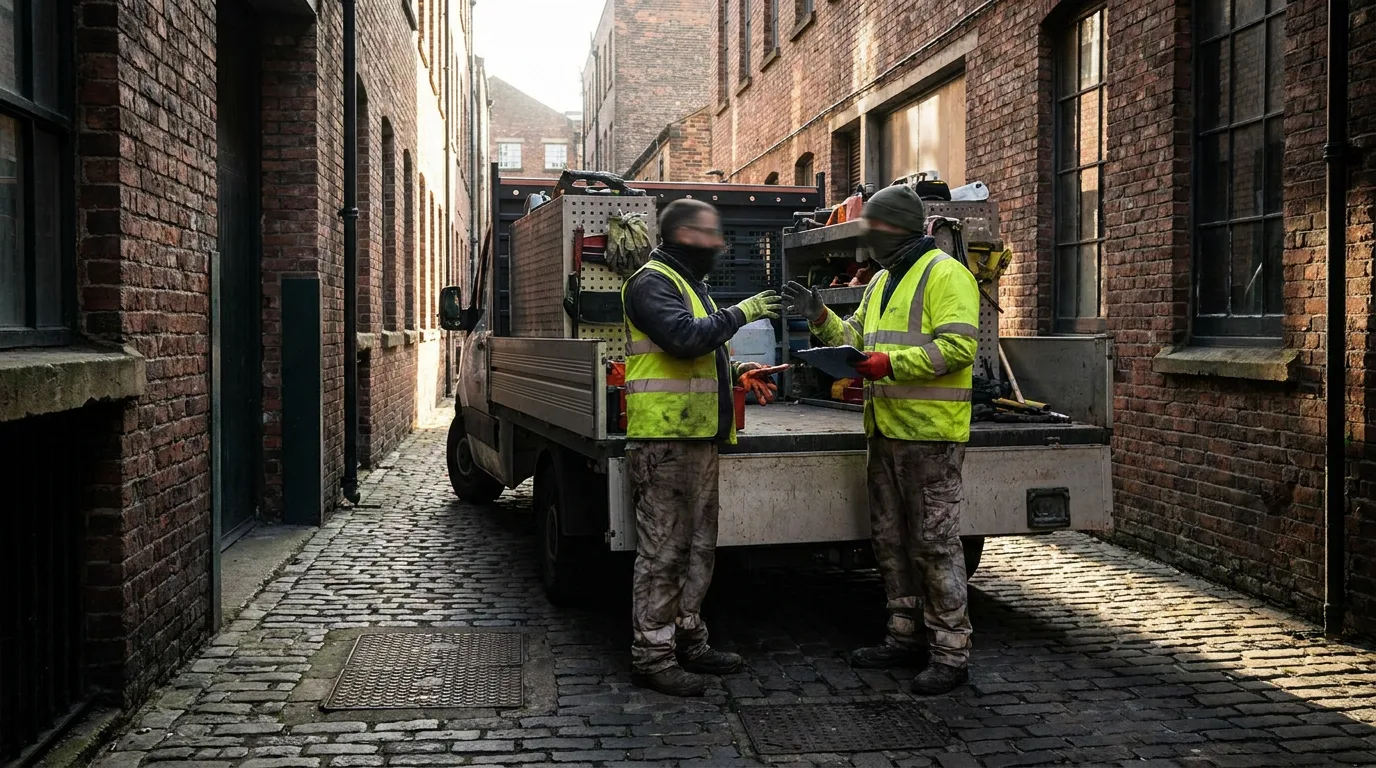
Panels arrive flat packed on a truck with bases and clamps, and a two person crew sets a typical 300 foot run in a morning. Post driven fence takes longer because the driver has to work the whole line.
We check the line on arrival for the same things every time: pedestrian clearance, hydrants, curb ramps, cellar doors, tree pits and where the gate needs to be. If the fence has to move mid job, that is a return visit and it is billed as one, so it pays to walk the line with the superintendent before the truck comes. Sites running night work usually add a light tower inside the perimeter, and anything powered needs a temporary power pole or a generator.
Questions people ask about temporary fence rental
What's the minimum rental period? A month on most jobs. Event work is priced by the day because it's installed and removed inside a fixed window, and that labour is the whole cost.
Can you install on a sidewalk without touching it? Yes, that's exactly what panel fence in weighted bases is for. Nothing gets drilled and nothing gets concreted. The permit is the constraint, not the fixing.
Who's responsible if a panel comes down? Ballast and bracing are specified for the conditions, and screen changes those conditions. Tell us if you're adding screen after installation, because that's the situation that causes failures.
Do you supply barricades as well as fence? Yes. Crowd control barrier rental covers interlocking steel barricades for queue lines, race routes and street closures.
Can I get fence, restrooms and a dumpster on one order? That's the normal New York jobsite package. See construction site services, porta potty rental in New York City, what porta potty rental costs, standard porta potty rental for the units, handwashing station rental for the sinks and dumpster rental cost for the debris side. Portable toilet rental and monthly rates cover long term sanitation.
Do you go outside the boroughs? Yes. Searching temporary fence rental near me from Jersey City, Newark, Hoboken, Bayonne or Hempstead lands in our area. The service areas page lists the full map.
How fast can you get panels out? Next business day for a private property run in all five boroughs. Street runs move at the speed of the DOT permit. Storm and emergency work goes through disaster relief sanitation and emergency porta potty rental.
Send the run length, the gate positions and the dates through the quote form, or call the number on the contact page. The FAQ answers the common ones, the about page explains how we work, and everything we run is on the home page.
Next step
Get a delivery date
Tell us the address, the dates and the headcount. We size the order and confirm the route.