
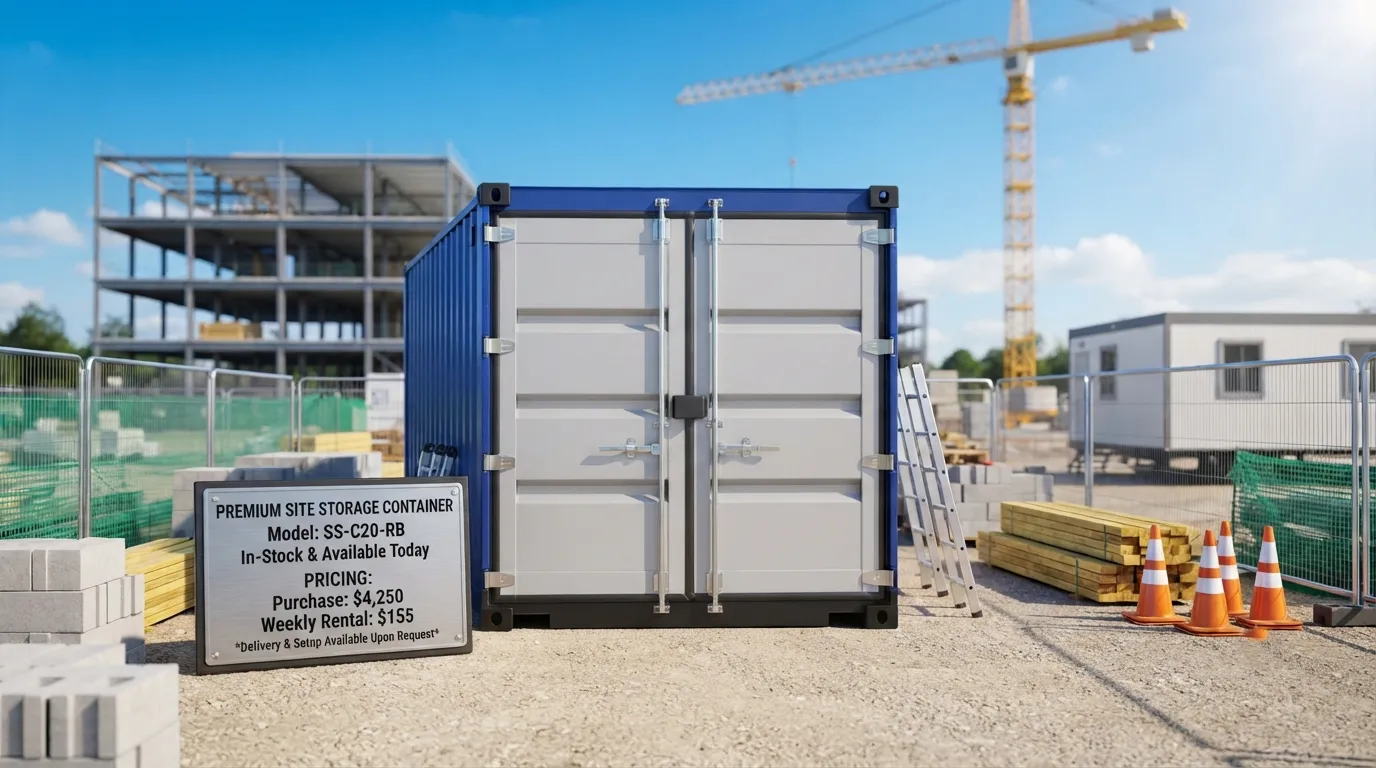
How much does a storage container rental cost in New York City?
The ranges below are typical published market prices reviewed July 2026, not a quote. Storage container rental rates in this market are quoted per month because the delivery is the expensive part and it only happens twice.
| Size | Typical monthly band | Capacity | Best for |
|---|---|---|---|
| 10ft | Lower end, near $100 | Around 560 cubic feet | Tools, small plant, retail overflow |
| 20ft | Middle, around $125 | 1,169 cubic feet | The default New York jobsite box |
| 40ft | Upper end, toward $250 | 2,385 cubic feet | Long material, large fit-outs |
| 40ft high cube | Upper end | 2,694 cubic feet | Stacked pallets, racking |
Those are storage container rental prices for a plain steel box on a normal placement. A refrigerated or modified unit prices separately, and so does anything that has to sit on a permitted curb lane in Manhattan. The storage container rental overview has the full spec on each size.
What moves a storage container rental price here?
Six things, in roughly the order they matter on a New York job:
- Distance from the yard to the placement. A Bronx industrial lot and a Lower Manhattan side street are two different truck movements.
- Whether the placement needs a Department of Transportation permit and a delivery window. That's time before it's money.
- Term length. A six month site prices better per month than a five week one.
- Access. A tilt bed truck needs roughly 60 feet of straight run for a 20ft box and closer to 100 feet for a 40ft, plus 14 to 15 feet of overhead while the bed is up.
- Ground prep. Timber cribbing under the four corner castings, because a loaded 20ft container can pass 30,000 pounds on four points.
- Size and modification. Doors at one end or both, personnel door, shelving, refrigeration.
Searching storage container rental rates near me returns national brokers quoting a national average. The figure that decides your invoice is the one that accounts for your block, which is why we ask for a photo of the approach before quoting.
Fees that sit outside the monthly rate
Most operators bury these. Naming them is the fastest way to compare two quotes honestly.
| Line | What it covers | What drives it |
|---|---|---|
| Delivery | Truck, driver, placement, cribbing | Borough, distance, access, time of day |
| Pickup | The same movement in reverse | Same, plus whether the box is clear |
| Relocation | Moving the box on or between sites | A second full truck visit |
| DOT permit | Street or sidewalk occupancy | Borough office, type of work |
| After hours drop | Night or weekend delivery window | Street placements, live retail sites |
| Dry run | Truck arrives and cannot place | Cars in the spot, locked gate, no access |
For comparison, published delivery figures in the portable sanitation market run $50 to $150 in a weekly rental context, which gives a sense of what a single truck movement is worth in this city. Container delivery is quoted per job because the run is site specific. The dry run is the one worth avoiding: a truck that arrives and cannot set the box down is a wasted trip and it gets billed.
Does a longer term lower the rate?
Yes, and more than people expect, because delivery and pickup are fixed costs spread over the term. A container on site for six months carries the same two truck movements as one on site for six weeks.
That's why the minimum is a month. Anything shorter and the delivery run costs more than the box, and we'd rather say that plainly than dress it up as a special short term rate. The same logic runs through porta potty monthly rental on the sanitation side, while daily rates show what short term really costs.
Refrigerated storage container rental and specialty units
A refrigerated storage container rental is a standard box with an integral compressor and insulated walls, and it prices above a dry container for two reasons: the unit costs more and it needs continuous power for the whole term.
On a New York site that supply comes from a temporary power pole with a Con Edison connection, or a generator sized for the compressor start load rather than its running load. Budget the power as part of the container cost, because it is. Catering, pharmaceutical and event work is where these come up.
Do you pay more for a street placement?
Usually yes, though the permit fee itself is rarely the big number. The Department of Transportation issues street and sidewalk permits through its Bureau of Permit Management and Construction Control at 55 Water Street, borough offices handle approvals, and turnaround runs from about a day to several weeks depending on the borough and the type of work. 311 answers address specific questions fastest.
The real cost is everything the permit brings with it: a fixed delivery window, a route that avoids the FDR Drive, the Belt Parkway and the Henry Hudson Parkway where commercial vehicles are banned, and sometimes a night drop. Placement legality comes first regardless, since the 2010 ADA Standards require a 36 inch minimum clear pedestrian route in section 403.5.1 and nothing can block a curb ramp or building entrance. A private property placement skips all of it, which is why temporary fence rental so often goes up first: New York City Building Code Chapter 33 requires an 8 foot construction fence along a public way, and once that's in, the container is inside the site rather than on the street.
Three real New York jobs, priced
A Bushwick loft renovation, four months, container in the rear yard. One 20ft box at roughly $125 a month plus delivery and pickup, no permit, cribbing under the castings. Around $500 for the term before the two truck movements. Most jobs like this add a standard porta potty and a handwashing station on the same order.
A Long Island City fit-out, six months, 40ft for long material. A 40ft container toward the upper end of the band for six months, with a longer delivery run and a wider lot needed. Sites this size usually run a mobile office trailer and a roll-off dumpster alongside it, priced on the dumpster rental cost page.
A Midtown facade job, eight weeks, container on a permitted curb lane. Two 20ft boxes rather than one 40ft, because the block cannot take a 100 foot delivery run. Budget the DOT permit calendar first, the after hours drop second, and the monthly rate third. Jobs like this also carry chain link fencing, crowd control barriers on the pedestrian side and a light tower for evening work.
Charges that should never appear
- An environmental fee with no definition attached
- A fuel surcharge that was not mentioned at booking
- Cribbing billed as a separate service when it is basic placement practice
- Delivery billed twice because the driver came back for a second look
- A cleaning charge on a container returned empty and swept
If a line cannot be explained in one sentence, push on it. A dry run is a legitimate charge and it is entirely avoidable: clear the spot, open the gate, and have someone on site who can point.
What a fair container quote includes
The monthly rate, the delivery, the pickup, the placement including cribbing, and a named term. If the placement is on the street, the quote should also say who files the DOT permit and what happens if the approval slips.
What it should not include is a number invented for a site nobody has looked at. Send the address and a photo of the approach and you'll get something real.
Questions people ask about storage container rental prices
Is a portable storage container rental cost cheaper than self storage? Usually, once you count your own time. A container comes to you; a storage unit means loading a van twice and paying for the van.
Do you charge for the first month up front? Terms get agreed at booking. The number we give you covers the period we quote, and it does not move because the job overran a week.
Can I get containers and restrooms on one invoice? Yes, and most sites do. See porta potty rental in New York City, what porta potty rental costs and construction site services.
What if I need it tomorrow? Private property placements usually go next business day across the five boroughs, plus Jersey City, Newark, Hoboken and Hempstead. Street placements move at the speed of the permit. Urgent sanitation goes through emergency porta potty rental, and the service areas page has the map.
Send the address, the size and the dates through the quote form and you'll get a real number rather than a range. The contact page has the direct line, the FAQ answers the common ones, the about page explains how we work, and everything we run is on the home page.
Next step
Get a delivery date
Tell us the address, the dates and the headcount. We size the order and confirm the route.