
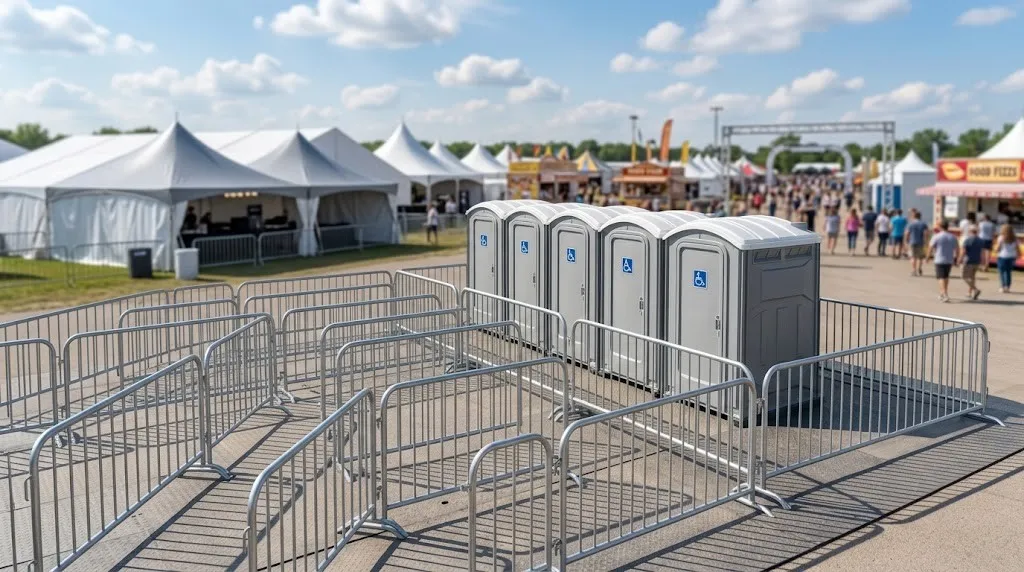
What is a crowd control barrier?
A crowd control barrier is a free standing steel barricade with hooked ends that link into the next unit, forming a continuous line that guides people without enclosing them. Bike rack barricade is the common trade name. It's the barrier you see along every parade route and outside every arena queue in this city.
It does a different job from chain link fence. Fence secures a site and stays up for months. Barricades shape a crowd, go in and out inside a fixed window, and get moved by hand while an event is running.
Barrier types and specs
| Type | Typical size | Weight | Use |
|---|---|---|---|
| Interlocking steel barricade | 8 feet 6 inches by 3 feet 6 inches | 40 to 50 pounds | Race routes, parades, queue lines |
| Short steel barricade | 6 to 7 feet 6 inches long | 35 to 45 pounds | Tight sidewalks, doorway queues |
| Water filled plastic barrier | 6 feet long, filled on site | Around 60 pounds empty | Vehicle separation, lane taper |
| Retractable belt stanchion | Post plus 7 to 13 foot belt | 20 to 30 pounds | Indoor queues, box office |
| Chain link panel | 6 feet by 12 feet | 60 to 90 pounds | Back of house, secure compound |
Steel barricades stack tightly on a truck, which is why a 1,200 foot race line is a realistic single delivery. Water filled units arrive empty and get filled on site, so plan a water source or they stay light and useless.
How many barriers do you need?
Divide the run by 8 feet 6 inches and add 10 percent. A 500 foot queue line is around 60 barricades.
- Double the count anywhere the crowd pushes against the line rather than walking along it, such as a finish chute or a stage front
- Add units at every corner, since corners lose length to the angle
- Leave planned gaps rather than letting stewards drag units out of line
- Count the back of house separately, because that side usually wants fence rather than barricade
Line planning drives the restroom plan too. Once you know where the crowd is held, you know where the units go. Event restroom rental and how many porta potties do I need work through the counts.
Layout rules that come from FDNY and ADA
Two constraints outrank the crowd plan on every New York event.
Fire access first. New York City fire rules require an unobstructed fire apparatus access road, and 20 feet of clear width is the standard figure to design against. A barricade line that closes that lane will be pulled apart by the fire officer on site, usually at the worst possible moment.
Accessibility second. The 2010 ADA Standards require a 36 inch minimum clear width on a pedestrian access route in section 403.5.1, and a barricade line cannot block a curb ramp, a subway stair or a building entrance. Accessible viewing and entry gaps get planned into the line, not improvised. ADA restroom requirements covers the same thinking for sanitation and ADA accessible porta potty covers the unit itself.
Do you need a permit for barriers on a NYC street?
Anything occupying a New York City street or sidewalk needs a permit from the Department of Transportation, filed through its Bureau of Permit Management and Construction Control at 55 Water Street. Borough offices handle approvals and turnaround runs from about a day to several weeks depending on the borough and the type of work.
Street events themselves run through the Street Activity Permit Office, and a route closure involves the police precinct as well. 311 is the fastest way to work out which filing your event needs. The sanitation plan is normally part of the same submission, which is why organisers order barricades and restrooms together. Porta potty permit requirements covers the sanitation filing.
Events we barricade across the five boroughs
Races are the biggest single use. A finish area at Randalls Island or a course through Prospect Park runs barricade along the chute, at every crossing marshal point and around the timing gear. Marathon restroom rental covers the unit plan that goes with it.
Street fairs and festivals are the second. Vendor rows, stage fronts and food areas at Flushing Meadows Corona Park all get lined, and food vendors separately need a working sink under the New York City Health Code, which handwashing station requirements explains. Concerts and stadium adjacent events near Citi Field or Yankee Stadium use barricade for queue management and chain link fence for the compound. Concert restroom rental, festival restroom rental, county fair restrooms and wedding restroom rental cover the sanitation side, usually with a restroom trailer for hospitality areas.
What crowd control barrier rental costs in New York City
Barricades are quoted per event rather than by a published day rate, because the cost is the install and strike labour inside a fixed window, not the steel. A line that goes in at 4am and comes out by midnight on the same day is a different job from the same line over a week.
For a sense of the adjacent market, published data puts temporary fence at $30 to $75 per day with around $50 typical. Prices reviewed July 2026, and that is a market range rather than a quote. Temporary fence cost breaks the fence side out line by line, and the factors are the same here: run length, access, install window, and whether the placement needs a DOT permit.
Questions people ask about crowd control barriers
Can you install overnight? Yes, and most New York event work happens that way. Tell us the load-in window when you enquire, because it drives the crew size more than the barricade count does.
Do the barricades interlock, or do they need clips? Standard steel barricades hook end to end with no tools. That's what makes them practical for a line that has to be reconfigured while an event is running.
Do you supply the fence and the restrooms as well? Yes, and it's one order. Temporary fence rental, portable restroom rental, what porta potty rental costs and a light tower for the overnight build. Film set restroom rental covers production work.
Do you go outside the five boroughs? Yes, including Jersey City, Hoboken and Newark. Searching crowd control barrier rental near me from those places lands in our area, and the service areas page lists everywhere.
Send the route, the barricade count and the load-in window through the quote form, or call the number on the contact page. The FAQ answers the rest and everything we run is on the home page.
Next step
Get a delivery date
Tell us the address, the dates and the headcount. We size the order and confirm the route.