
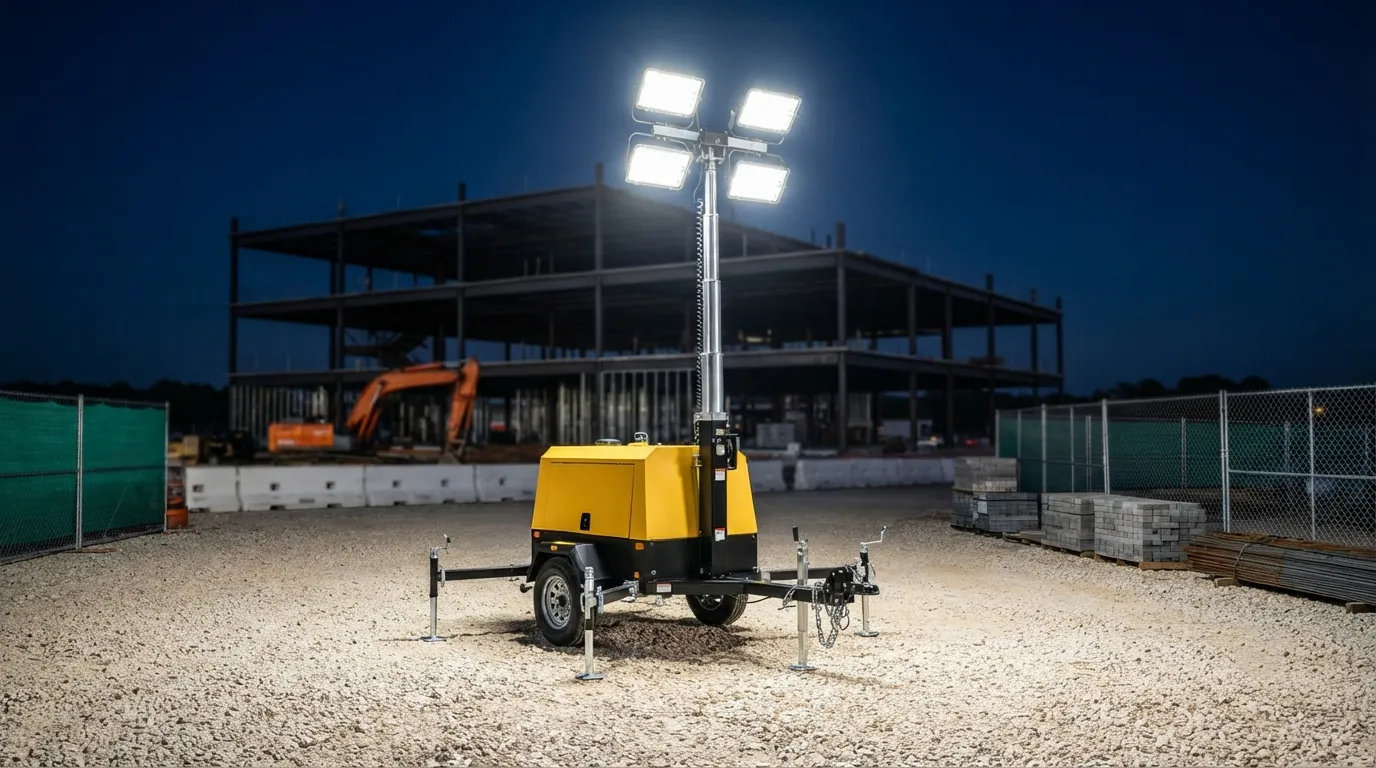
What is a light tower?
A light tower is a towable trailer with a telescoping mast, a bank of lamps on top and its own generator underneath, so it lights an area with no connection to anything. Tow it in, level it on outriggers, raise the mast, start it.
Two things separate a light tower from a work light on a stand. The mast height, usually 30 feet, which is what lets one unit cover a wide area instead of casting long shadows across it. And the onboard generator, which is why a portable light tower rental is often the fastest way to get power and light onto a site that has neither.
Specs on a standard unit
| Item | Typical figure |
|---|---|
| Mast height | 30 feet extended |
| Lamps | 4 metal halide at 1,000 watts each, or 4 LED at 300 to 350 watts |
| Generator | 6 to 8 kilowatt onboard diesel |
| Fuel tank | About 30 gallons |
| Runtime | 50 to 60 hours on a tank, longer on LED |
| Coverage | Roughly 5 to 7 acres at low light levels |
| Trailer weight | Around 4,000 to 4,500 pounds |
| Mast up wind rating | Commonly around 65 miles per hour |
LED heads change the arithmetic more than people expect. Four 350 watt LEDs draw about a third of what four metal halides do, so the same 30 gallon tank runs considerably longer and the generator loafs instead of working. On a long New York job that is fewer fuel visits, which is the line that actually costs money.
How much light do you actually need?
OSHA 1926.56(a) sets the floor and it is worth quoting properly, because most sites overshoot in one place and undershoot in another.
- 3 foot-candles: excavation and waste areas, access ways, active storage, loading platforms, refuelling areas
- 5 foot-candles: general construction areas, indoor corridors and exitways, tunnels and shafts
- 10 foot-candles: general construction plant and shops
- 30 foot-candles: first aid stations, infirmaries and offices
One tower at 30 feet covers a general work area comfortably. Two placed diagonally kill the shadows that a single unit throws behind stacked material, which is where people trip. If the site has a mobile office trailer, that space needs its own lighting to reach the 30 foot-candle figure and a tower will not do it.
Diesel, LED and solar light tower rental
A diesel light tower rental is the default: it runs anywhere, it runs long, and nobody has to think about it. A mobile light tower rental with LED heads is the same trailer with better economics and a quieter generator. A solar light tower rental carries a battery bank and panels, makes no noise at all and burns no fuel, which matters in this city more than in most.
Where solar wins in New York: residential blocks at night, hospital and school adjacent work, overnight utility jobs, and film base camps where a generator would be picked up on the sound mix. Where it loses: December, when there is not enough daylight to recharge a heavy load, and any site that also wants the tower as a light tower generator rental for tools.
Noise rules that matter in New York
A diesel generator running overnight on a residential block is a complaint waiting to happen. The New York City Noise Code, enacted as Local Law 113 of 2005, covers construction devices, and the Department of Environmental Protection enforces it.
Separately, construction work outside normal weekday hours needs an after hours variance from the Department of Buildings, and the noise mitigation plan is part of how that gets granted. Practical answer on a sensitive block: LED heads on a sound attenuated set, or a solar unit. Tell us the site type when you book and we will send the right one rather than the nearest one.
Placement, wind and where a tower can legally sit
Outriggers have to be down and the trailer level before the mast goes up, and the mast comes down in high wind. A tower left extended through a nor'easter is how equipment ends up across a New York street.
Overhead is the other check: 30 feet of mast needs 30 feet of clear air, so scaffold, sidewalk sheds, building overhangs, tree canopy and any overhead line rule out placements that look fine at ground level. The 2010 ADA Standards require a 36 inch minimum clear pedestrian route in section 403.5.1, so a tower on a sidewalk cannot narrow the walking line. The placement guide covers the same checks for sanitation units.
Do you need a permit for a light tower in NYC?
On a New York City street or sidewalk, yes. The Department of Transportation issues the permit through its Bureau of Permit Management and Construction Control at 55 Water Street, borough offices handle approvals, and turnaround runs from about a day to several weeks depending on the borough and the type of work. 311 answers questions on a specific block fastest.
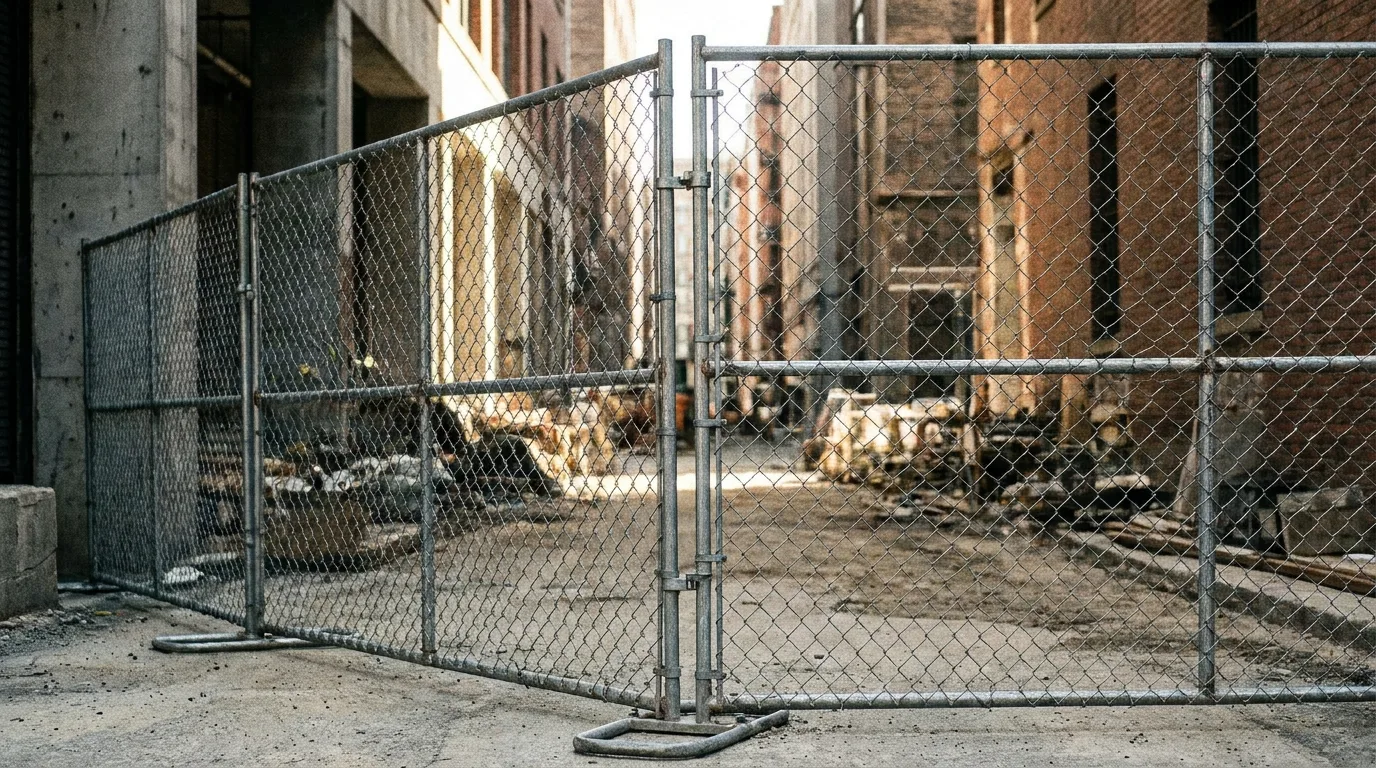
Inside a construction fence there's no filing, which is another reason temporary fence rental goes in early. New York City Building Code Chapter 33 requires an 8 foot construction fence along a public way, and once the perimeter is up, the tower, the storage container and the restrooms all sit inside it. Porta potty permit requirements has the sanitation filing.
What portable light tower rental costs in the five boroughs
Light tower rental rates are quoted per job rather than published, because fuel, delivery and the site type move the number far more than the unit does. A construction light tower rental on a fenced Queens lot for three months and a single overnight unit on a permitted Manhattan street are different products at the same nominal day rate.
The lines to get named before you compare quotes: delivery and collection, whether fuel is included or billed, refuelling visits, and who is responsible for lowering the mast in wind. For context on adjacent site kit, published market data puts temporary fence at $30 to $75 per day and storage containers at $100 to $250 a month, with prices reviewed July 2026. Those are market ranges rather than a quote, and the temporary fence cost and storage container cost pages break them out.
Questions people ask about light towers
How long will it run without attention? 50 to 60 hours on a full 30 gallon tank with metal halide heads, longer with LED. Plan a refuelling visit into any job running more than a week of nights.
Can it power tools as well as lights? Some units have auxiliary outlets, but sizing matters. If the site needs real power, a temporary power pole with a proper service is the right answer.
Do you deliver for one night? Yes, and event work usually is one night. Overnight builds for festival restroom rental, concert restroom rental, marathon restroom rental at Randalls Island and film set restroom rental all run on tower light.
What else comes on the same order? Restrooms through porta potty rental in New York City at these prices, handwashing station rental, crowd control barriers for public separation, a roll-off dumpster and full construction site services.
Do you go outside the boroughs? Yes. Searching light tower rental near me from Jersey City, Newark or Hempstead lands in our area, and the service areas page lists everywhere.
Send the site type, the hours and the dates through the quote form, or call the number on the contact page. The FAQ answers the rest, the about page explains how we work, and everything we run is on the home page.
Next step
Get a delivery date
Tell us the address, the dates and the headcount. We size the order and confirm the route.