
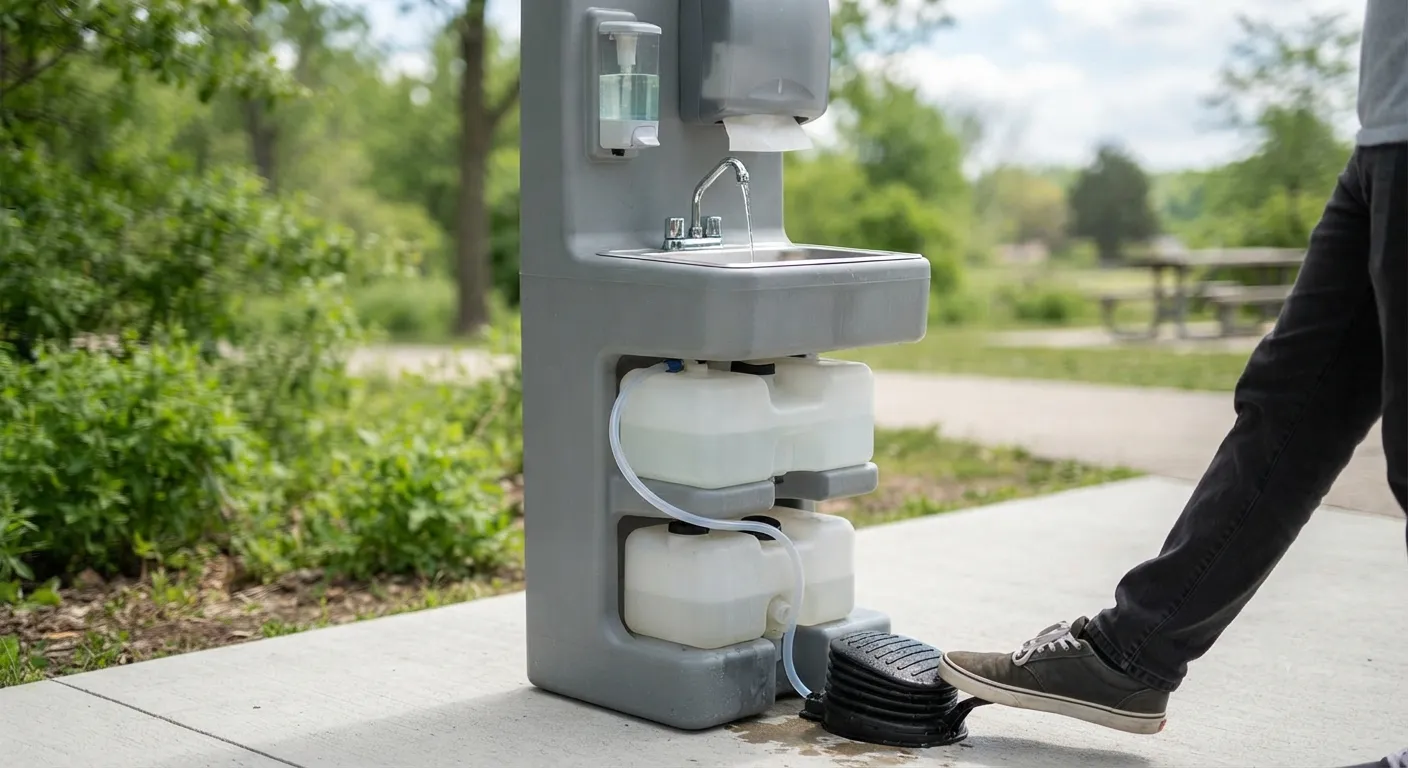
What is a portable sink and how does it work?
A portable sink is a freestanding basin that carries its own fresh water tank, its own grey water tank and a pump, so it runs with no plumbing connection at all. Press the foot pedal, water flows, release it and it stops. Nothing on the unit needs a hand.
Fresh water sits in a tank behind or under the basin. Used water drains into a sealed grey tank below, which we pump out at service. There's no drain to the sewer and nothing goes into a storm inlet, which in New York City matters because the combined sewer system already struggles in heavy rain.
Portable sink stations we deliver across the boroughs
| Unit | Fresh water | Hot water | Typical use in NYC |
|---|---|---|---|
| Tabletop sink | 5 gallons | No | Food stall, check-in desk, small crew |
| Two bay portable sink station | About 22 gallons | No | Jobsites, street fairs, markets |
| Four bay unit | About 44 gallons | No | Large construction, festival food row |
| Hot water portable sink | About 20 gallons | Yes, electric tank | Film hair and makeup, catering |
| Sink in a restroom trailer | Plumbed to trailer tank | Yes | Weddings, corporate, base camp |
Freestanding units run roughly 46 inches wide and 26 inches deep, and a full one weighs several hundred pounds once you add 22 gallons at 8.34 pounds per gallon. That weight decides placement more often than the footprint does. It goes on flat pavement, never on a cellar door or a sidewalk vault light, which is a real hazard on older Manhattan and Brooklyn blocks.
How many portable sinks does a New York City site need?
OSHA 1926.51(f)(1) requires washing facilities wherever workers apply paints, coatings, herbicides, insecticides or handle anything else harmful, and OSHA 1926.51(f)(3) says those facilities have to be near the work rather than parked at the gate. OSHA 1926.51(c)(1) separately sets one toilet for 20 or fewer workers on a construction site.
The working rule most New York contractors land on is one sink per two restroom units, and one sink per food vendor at an event. How many porta potties do I need runs the crew maths, and OSHA portable toilet requirements has the full ratio table. Handwashing station requirements covers what the health rules add on top.
Hot water portable sink and water tank options
Cold water is the default because it needs no power. A hot water portable sink carries a small electric tank, usually around 2.5 to 6 gallons, and it has to plug into something. On a New York jobsite that means a generator or a temporary power pole, and on a film base camp it means the trailer's own supply.
That power requirement is the whole decision. If there's no reliable circuit, a cold water unit with antibacterial soap does the job and the health inspector accepts it. If catering is involved, hot water stops being optional. Portable sink water tanks are gravity fed or pump fed depending on the model, and a pump fed unit gives better flow but needs the same power.
Portable sinks for hair washing on film and TV shoots
New York City runs one of the busiest production markets in the country, and a portable sink for hair is a standing order on location days. Film permits come through the Mayor's Office of Media and Entertainment, and a base camp in Greenpoint, Long Island City or the Bronx gets a sink at hair and makeup as a matter of course.
A portable sink hair washing unit differs from a jobsite sink in three ways: a deeper basin, a flexible spray hose rather than a fixed spout, and heated water. Stylists want a neck rest and a bowl they can lean someone into. Where the trailer already has a plumbed basin, that's usually the better answer. Film set restroom rental covers the full unit list for a shoot, and luxury restroom trailer is what talent trailers usually pair with.
Where a portable sink can legally sit on a NYC sidewalk
Pedestrian clearance decides it. The 2010 ADA Standards require a 36 inch minimum clear width on a pedestrian access route in section 403.5.1, and no unit can block a curb ramp, a building entrance, a hydrant, a subway stair or an emergency egress route. That comes before the site plan, every time.
For an accessible sink, the same standards cap the rim or counter surface at 34 inches above the floor in section 606.3 and set a 48 inch maximum unobstructed forward reach in section 308.2.1. Read ADA restroom requirements alongside the ADA accessible porta potty page, and the placement guide for what the driver checks when the truck pulls up.
Do you need a permit for a portable sink in New York City?
On a city street or sidewalk, yes. The Department of Transportation issues the permit through its Bureau of Permit Management and Construction Control at 55 Water Street, borough offices handle approvals, and turnaround runs from about a day to several weeks depending on the borough and the type of work. 311 is the fastest way to get a read on a specific address.
Behind a construction fence, in a loading dock or on private property, no permit and no wait. The porta potty permit requirements page has the sequence, and it's the same filing whether it's one sink or a bank of restrooms.
Camping portable sink and off grid setups
A camping portable sink is the same idea stripped down: a 5 gallon jug, a foot pump and a bucket underneath. People search for it for Catskills trips and for backyard events in Staten Island and eastern Queens, and it works fine for a handful of people over a weekend.
Where it stops working is volume. Thirty guests will drain 5 gallons before the food comes out. For a backyard party the honest answer is a two bay unit next to a standard porta potty, or a deluxe flushable unit which has a small basin built in. Camping porta potty covers the smaller end, wedding restroom rental the other.
Servicing, refills and winter
ANSI/PSAI Z4.3 is the industry service standard for non sewered systems, and a sink visit under it means pumping the grey tank, refilling fresh water, restocking soap and towels, and cleaning the basins. Weekly servicing typically runs $30 to $220 in published market data, around $60 being common, with delivery in a weekly rental context at $50 to $150. Prices reviewed July 2026, and these are market ranges rather than a quote.
Winter is the part people forget. Water left in a pump line below freezing splits it, and New York gets plenty of those nights between December and March. Drain the tank at shutdown, switch to hand sanitizer stations through the worst weeks, or move the sink inside a heated unit. Porta potty in winter covers the cold routine, and how often are porta potties cleaned explains service frequency. Grey water goes through a licensed disposal stream, which septic pumping service describes.
Questions people ask about portable sink rental
Does it need water or power? Cold water units need neither. Hot water units need a circuit. That's the only real fork in the decision.
How long does a tank last? About 140 washes on a two bay unit at roughly 0.15 gallons per wash. A busy site drains it in a day.
Can I put one on the sidewalk outside my building? Only with a DOT permit. Inside the site fence, no permit needed. See temporary fence rental if the site perimeter isn't up yet.
Do you deliver outside the five boroughs? Yes, including Jersey City, Hoboken, Newark and Hempstead. The service areas page has the full list.
What gets ordered with a sink? Restrooms first. Portable restroom rental and what it costs cover those, plus a light tower for night work, a storage container for stock and a roll-off dumpster for debris. Handwashing station rental is the same product family from the jobsite side.
Send the address and dates through the quote form, or use the contact page. The FAQ answers the common ones, the about page explains how we work, porta potty rental in New York City covers the restroom line, and everything else is on the home page.
Next step
Get a delivery date
Tell us the address, the dates and the headcount. We size the order and confirm the route.