
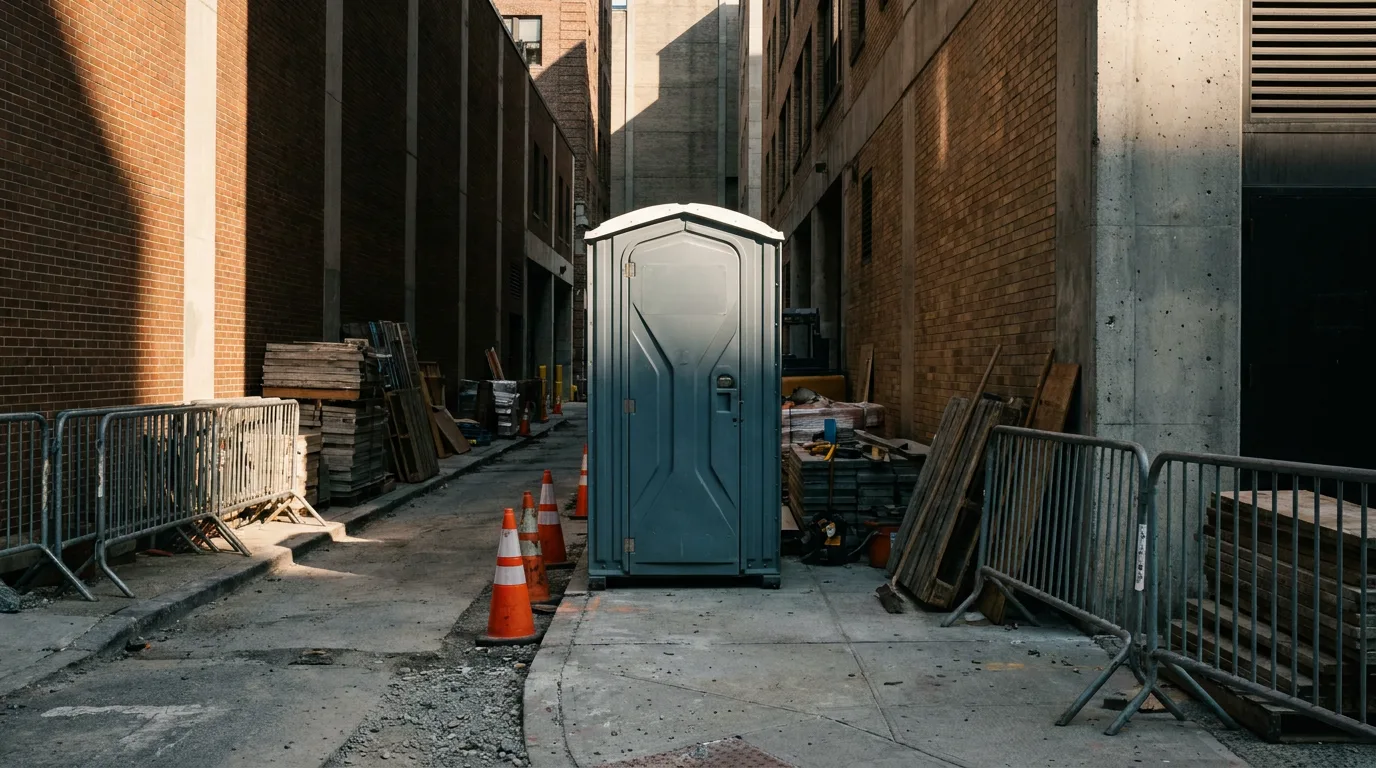
Can you use a porta potty in winter?
A winterised portable toilet is a standard unit charged with an antifreeze solution instead of the usual water and deodorizer mix, so the tank contents stay liquid below freezing. Nothing else about the unit changes. It still holds 60 to 70 gallons, still vents through the roof stack, still needs a weekly pump.
The reason the charge changes is simple. Standard blue deodorizer is water-based, and water freezes at 32 degrees. A frozen tank cannot be pumped, which means a missed service visit turns into a unit that is out of action until it thaws. In a New York January that can be a fortnight.
What actually goes wrong in a New York winter?
Six things, and only two of them are the tank.
| Problem | Why it happens | What we do about it |
|---|---|---|
| Tank contents freeze | Water-based charge below 32 degrees | Winter antifreeze charge, reduced water volume |
| Door latch and hinges seize | Moisture freezing in the mechanism | Silicone lubricant at each service |
| Unit freezes to the pad | Meltwater refreezing underneath | Set on a pallet or a dry, drained spot |
| Buried under plough spoil | Kerbside units on a snow route | Move back from the curb before a storm |
| Handwash station freezes solid | Freshwater tank and pump | Switch to sanitizer or a heated unit |
| Nobody can find it after 4:30pm | December sunset in New York is around 4:30 | Add lighting to the walk-up |
The plough one is the New York specific problem. A unit standing at the curb on a snow route is directly in the path of the Department of Sanitation's winter operation, and it will either be buried or hit. Twelve inches back is not enough. The placement guide covers where to put it instead.
What is a winter charge and how is it different?
It is a swap of chemistry, not an upgrade. Instead of 3 to 5 gallons of fresh water plus standard deodorizer, a winterised unit gets a smaller volume of liquid dosed with an antifreeze additive, so the freezing point of the tank contents drops well below the ambient temperature.
Less water in the tank has a knock-on effect worth knowing about. There is less dilution, so the same number of users produces a stronger tank, and the unit relies more on the vent stack than it does in July. That is one of the few times of year when a blocked stack shows up as a problem in cold weather, and it is why the vent gets checked at every visit. How the airflow works is on how porta potties work, and the odour side is covered on do porta potties smell.
Does the service schedule change in winter?
The interval does not, but the route does. ANSI/PSAI Z4.3 sets weekly servicing as the baseline for a standard unit in normal use, and cold weather does not suspend that. OSHA 1926.51(c) still requires facilities on a construction site to be kept in a sanitary condition in February.
What changes is access. New York City Administrative Code 16-123 requires property owners to clear snow and ice from the sidewalk in front of their premises within 4 hours if the snow stops between 7am and 4:50pm, within 14 hours if it stops between 4:51pm and 8:59pm, and by 11am if it stops overnight. That clock governs whether our truck can reach a sidewalk unit at all, and it is the reason a service visit slips after a storm.
Then there are the practical delays: snow emergency routes, suspended alternate side parking that changes where trucks can stop, and plough windrows that turn a legal parking lane into a wall. Winter schedules in the boroughs get built with slack in them. The cleaning frequency guide covers what a visit involves the rest of the year.
What do you do about handwashing when it freezes?
This is the question that catches most sites out, because a standard portable sink is a freshwater tank and a foot pump, and both freeze. Three workable answers, in order of cost:
- Alcohol-based hand sanitizer stations. Ethanol and isopropanol solutions stay liquid far below
freezing, so a sanitizer station keeps working when a sink does not.
- A hot and cold water portable sink. Self-contained heated units carry their own water heater
and hold both supplies above freezing while powered. These are what most winter food service and medical setups run on. See the portable sink page and the handwash station page.
- A restroom trailer with climate control. Heated cabin, real plumbing, hot water at the tap.
Expensive, and the right answer for a long winter event or a client-facing site. Options at restroom trailer rental and luxury restroom trailers.
OSHA 1926.51(f)(1) requires washing facilities where employees are engaged in operations involving harmful substances, and that does not soften in December. What counts as adequate is set out on the handwashing requirements page.
Does winter change the permit position?
Not the rule, only the timing. A unit on a New York City street or sidewalk needs a permit from the Department of Transportation whatever the season, handled through borough offices by the Bureau of Permit Management and Construction Control at 55 Water Street, with turnaround from about a day to several weeks. Call 311 for a specific block.
What winter adds is a coordination layer. Snow operations, seasonal embargoes on certain corridors and holiday restrictions in the Midtown retail core all affect whether a placement is approved for the dates you want. Apply earlier than you would in June. The permit requirements page goes through which office handles what.
Which jobs actually run through a New York winter?
More than people assume. Interior fit-out carries on year round. Facade work under the city's Facade Inspection Safety Program runs through the cold months because the sheds are already up. Utility and sub-surface work does not stop. And winter events keep going at Prospect Park and across the boroughs.
For sites running through, a monthly rental with a winter charge is the normal arrangement, usually a standard unit plus a sanitizer stand, with light towers because the working day is dark at both ends. A 20ft storage container keeps tools and materials out of the weather on the same footprint, and a mobile office trailer gives the crew somewhere warm.
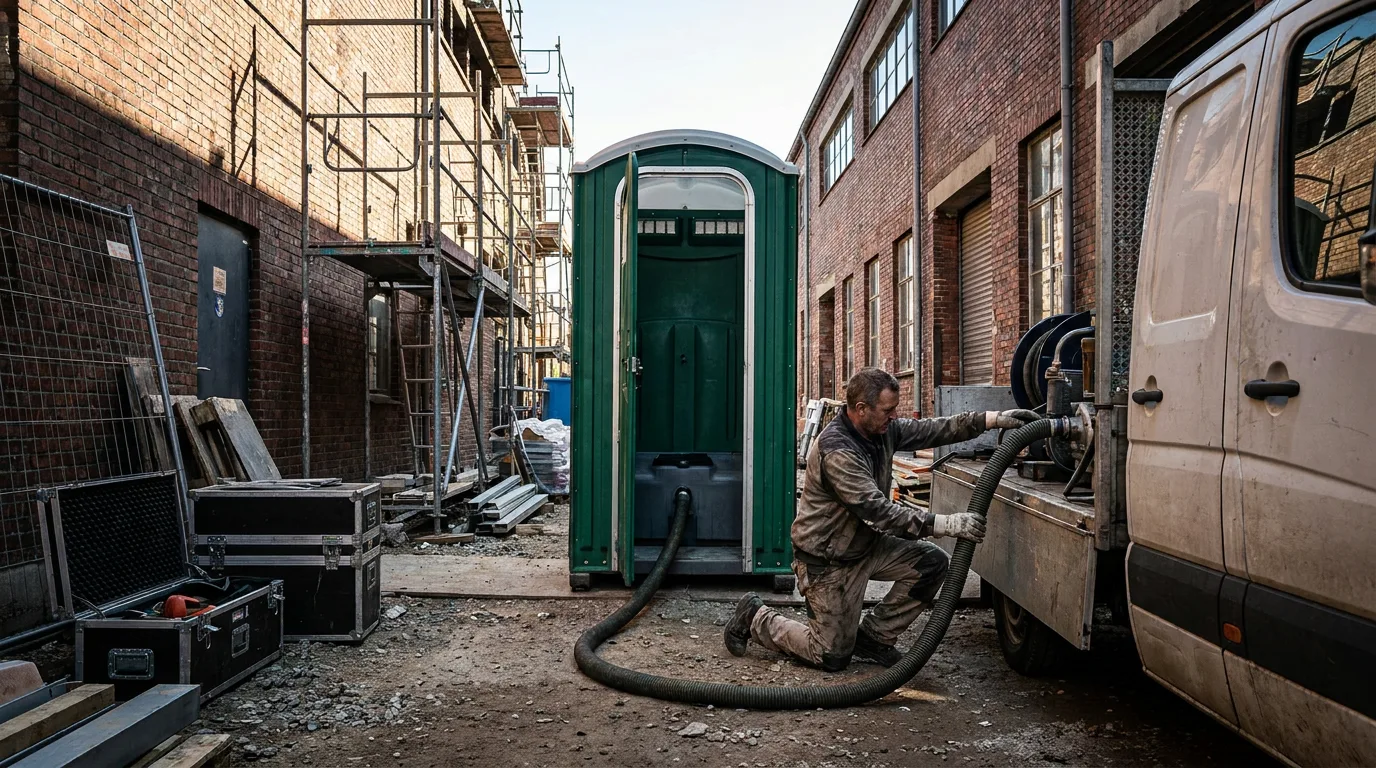
Booking winter units in the five boroughs
Tell us the dates and we will spec the charge for the season rather than fitting a summer unit and hoping. Ask specifically for winterisation. A yard that does not raise it on a January order is not one to use.
Pricing sits on the rental cost page, with day rates for short jobs and emergency service when a unit fails mid-storm. Sizing for the crew is on the unit count guide, compliance on the OSHA requirements page, accessibility on the ADA requirements guide, and everything worth confirming before delivery on the rental checklist.
Is there a portable sink hot and cold water option?
There is. A hot and cold portable sink runs off a small heater and a fresh tank.
How often is a unit serviced?
Weekly is the ANSI/PSAI Z4.3 baseline. Heavy use moves it to twice a week.
Coverage across the boroughs and into Jersey City and Union City is on the service areas page, the city overview at porta potty rental in New York City, questions on the FAQ, and orders through the quote form or the contact page.
Next step
Get a delivery date
Tell us the address, the dates and the headcount. We size the order and confirm the route.