
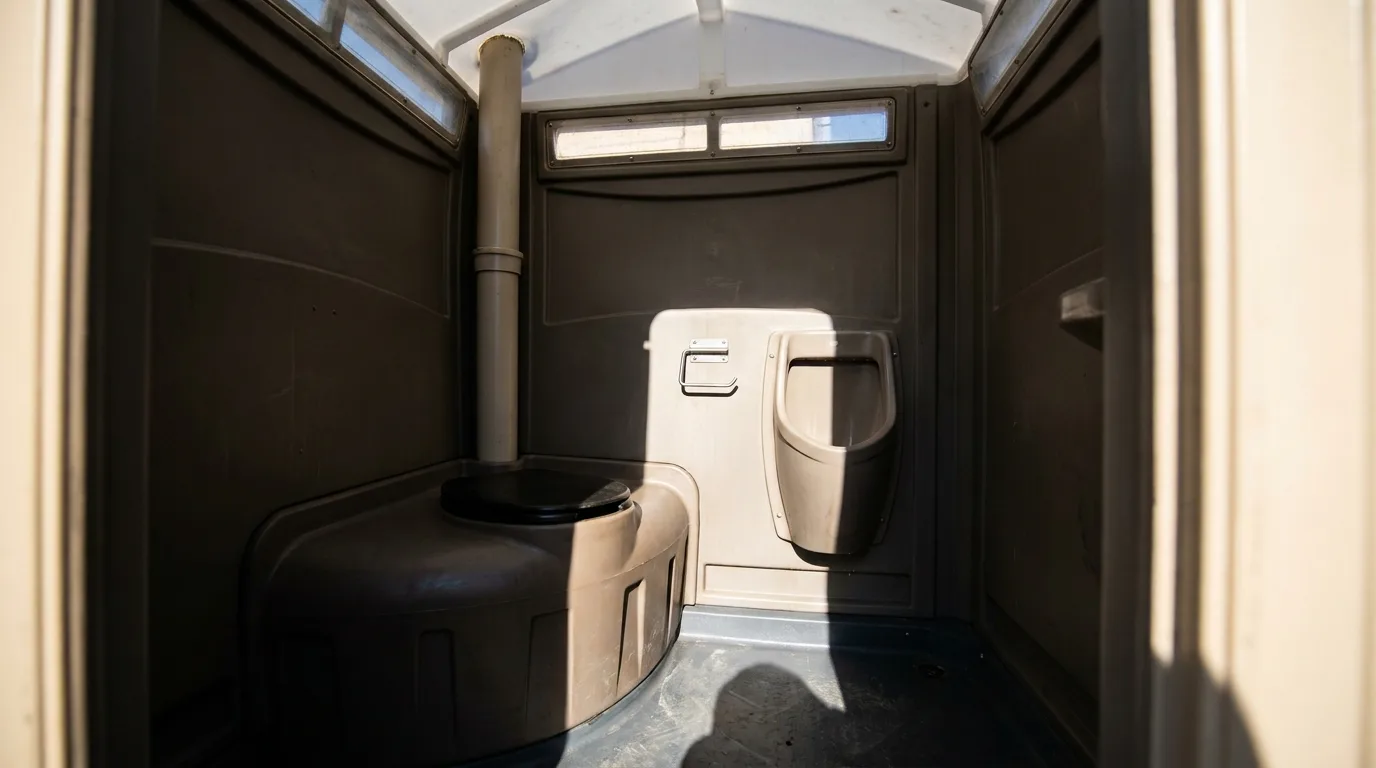
How does a porta potty work?
Waste falls straight into a holding tank under the seat. The tank already contains 3 to 5 gallons of fresh water and a measured dose of deodorizer, which is what keeps solids covered and slows the bacterial activity that produces odour. A vent stack running from the tank to the roof draws warm air up and out, so gases leave through the pipe rather than through the seat.
That is the whole mechanism. There is no plumbing, no power, no drain and no water supply. It is why a unit can stand on the eighteenth floor of a tower in Long Island City or on a barge at Randalls Island with no site services at all, and it is the reason the trade uses them instead of temporary plumbing.
What are the parts of a standard unit?
Seven components, and each one fails in a recognisable way:
- Holding tank. Moulded into the base. Manufacturer specifications from the major suppliers put
standard units at roughly 60 to 70 gallons.
- Seat and bowl assembly. Sits directly over the tank opening, usually with a hinged lid.
- Urinal. Drains into the same tank, and is what stops the seat being the bottleneck on a
jobsite.
- Vent stack. A vertical pipe from tank to roof. Blocked stack, smelly unit.
- Translucent roof panel. No lighting is fitted, so the roof is the only light source. This is
why a unit under a sidewalk shed feels like a cave.
- Door with occupancy indicator and inward latch. The vacant and occupied slide is a real safety
feature, not a nicety.
- Paper holder and sanitizer dispenser. Restocked at every service visit.
Dimensions are consistent enough to plan around. A standard unit runs roughly 43 to 48 inches square and about 90 to 92 inches tall depending on model, and weighs somewhere near 150 to 200 pounds empty. Two people can carry one. Full, it weighs several hundred pounds more and nobody moves it. The standard unit page lists what we run.
What chemicals go in a porta potty?
The blue liquid is a blended deodorizer, and it is doing three jobs at once. A biocide slows the sulfate-reducing bacteria that produce hydrogen sulfide, the rotten-egg smell. A surfactant breaks down solids and paper so the tank pumps cleanly. A dye and a fragrance mask what is left, and the dye doubles as a load indicator, because when the blue is gone the chemistry is spent.
Older formulations were formaldehyde-based. Most modern products in general use are not, largely because septage has to be accepted at a treatment works and biocide load matters there. New York City's Department of Environmental Protection treats roughly 1.3 billion gallons of wastewater a day across 14 water resource recovery facilities, and licensed septage goes to approved receiving points rather than anywhere else.
This is a different product from a septic tank additive, which is the thing people confuse. A septic tank is a live biological system that you generally do not want to dose with biocide, which is why septic tank cleaning is a pump-out and inspection rather than a chemical treatment. Interval guidance is on how often a septic tank needs pumping.
How does the service visit work?
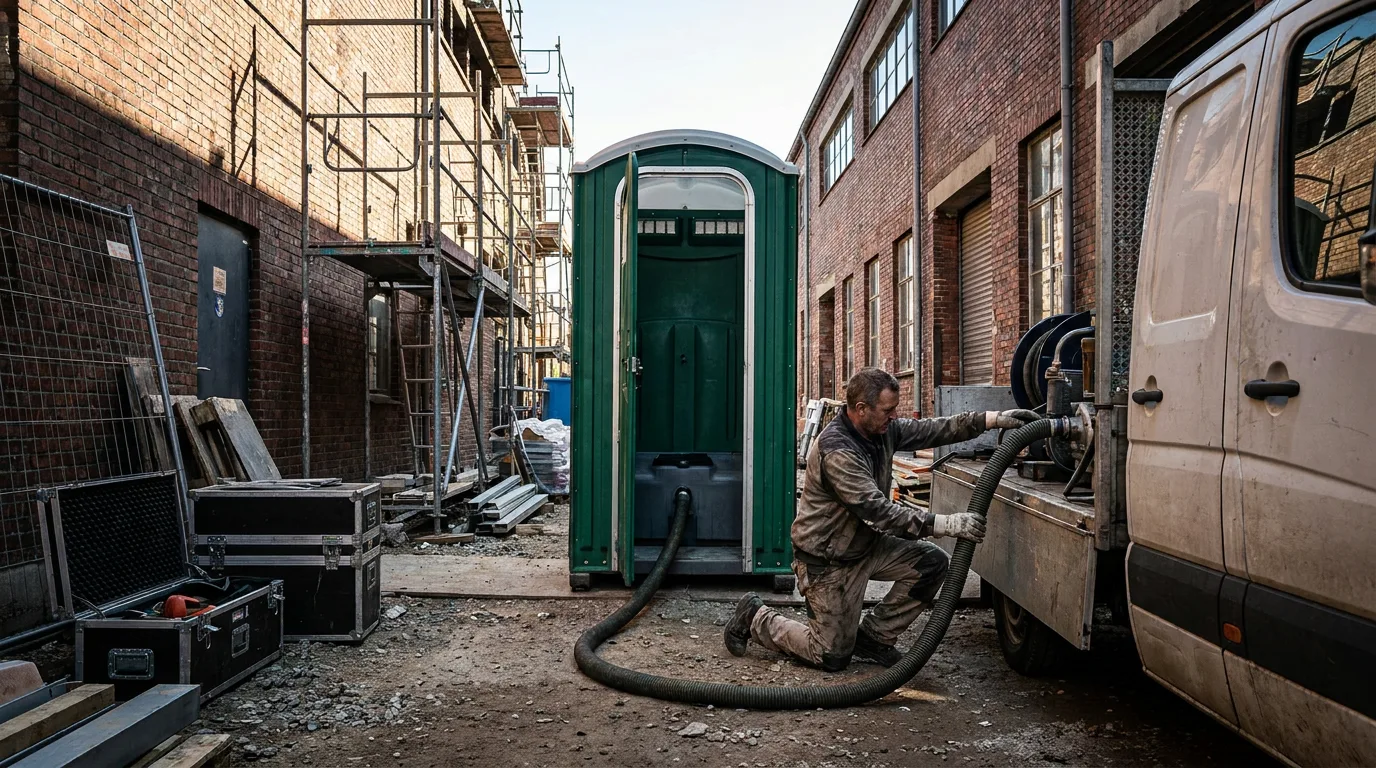
A vacuum truck carrying a waste tank, typically in the 800 to 1,500 gallon range, pulls up and runs a hose to the unit. The tank is pumped dry, the interior is washed down with a pressure wand and disinfectant, the wash water is vacuumed out as well, then the tank is recharged with fresh water and deodorizer and the paper is restocked.
ANSI/PSAI Z4.3, the American National Standard for nonsewered waste disposal systems, sets weekly servicing as the baseline for a standard unit in normal use. Heavier traffic needs more, which the cleaning frequency guide breaks down by job type. OSHA
1926.51(c) requires toilet facilities on a construction site to be maintained in a sanitary condition, so the schedule is a compliance item as well as a comfort one.
How do flushable porta potties work?
A flushable unit adds a separate freshwater reservoir and a foot-operated bellows pump. Pressing the pedal draws clean water from the reservoir and rinses the bowl, so solids stay covered between uses and the bowl is not on show to the next person. The waste still lands in the same sealed holding tank underneath.
The trade-off is capacity. Every flush uses freshwater and adds liquid volume to the tank, so a flushable unit fills faster than a standard one at the same headcount. Most also carry a hand pump sink and a mirror, which is why they show up at weddings and client-facing events rather than on a framing crew. See the deluxe flushable unit for specifications, or a restroom trailer where real plumbing is wanted.
How does a portable sink work?
A freestanding portable sink carries two tanks: one of fresh water feeding the tap, one below catching the greywater. A foot pump moves water from the first to the spout, so nothing needs electricity or a supply line. Capacity is usually enough for a few hundred handwashes before the tanks are swapped or refilled.
OSHA 1926.51(f)(1) requires washing facilities where employees are engaged in operations involving harmful substances, and on food-adjacent events the practical bar is higher again. The portable sink page, the handwash station page and the handwashing requirements guide cover which one a given job needs.
How do camping porta potties work?
Differently, and at a much smaller scale. A camping toilet is a self-contained cassette unit with a freshwater flush reservoir of a few gallons on top and a detachable waste holding tank below, usually around 5 gallons, that the user carries to a dump point and empties themselves. There is no truck and no service contract.
That is fine for two people at a campsite. It is not a substitute for a rental unit on a job or an event, because the emptying burden lands on whoever is running the site. Details on the camping porta potty page.
What makes this work differently in New York City?
The mechanism is the same everywhere. Getting the unit to where it needs to stand is not.
On tower work in the boroughs, units routinely go up rather than along. A unit hoisted to a working deck or a setback roof needs anchoring against wind at height, and it needs planning into the crane or hoist schedule rather than being an afterthought on delivery day. Because the unit needs no services, it can go almost anywhere structurally sound. Because it weighs several hundred pounds full, the pick has to be planned when it is empty.
At street level the constraint flips. A unit standing on a New York City street or sidewalk needs a permit from the Department of Transportation, run through borough offices by the Bureau of Permit Management and Construction Control at 55 Water Street, with turnaround from about a day to several weeks depending on borough and work type. Call 311 for a specific block. Pedestrian clearance decides the rest: never a curb ramp, a building entrance, an emergency path or a work-zone route. The placement guide and the permit requirements page cover both sides.
Getting the right unit on your job
If nobody will see it but the crew, a standard unit is the answer, sized with the OSHA ratios and hired by the month. If the public will use it, look at a flushable unit, an accessible unit under the ADA requirements, or a trailer.
How does portable sink work without plumbing?
A foot pump lifts fresh water up from a tank and drains it into a second tank below.
What is in the blue liquid?
Dye, fragrance and a biocide. Portable toilet chemicals near me searches turn up the same formulations.
Rates are on the cost page, short jobs at day rates, and urgent work through emergency rental. Winter changes the tank chemistry, which the winter guide explains, and odour questions are answered on do porta potties smell. Coverage is listed on the service areas page, the overview at porta potty rental in New York City, and quotes through the quote form or the contact page.
Next step
Get a delivery date
Tell us the address, the dates and the headcount. We size the order and confirm the route.