
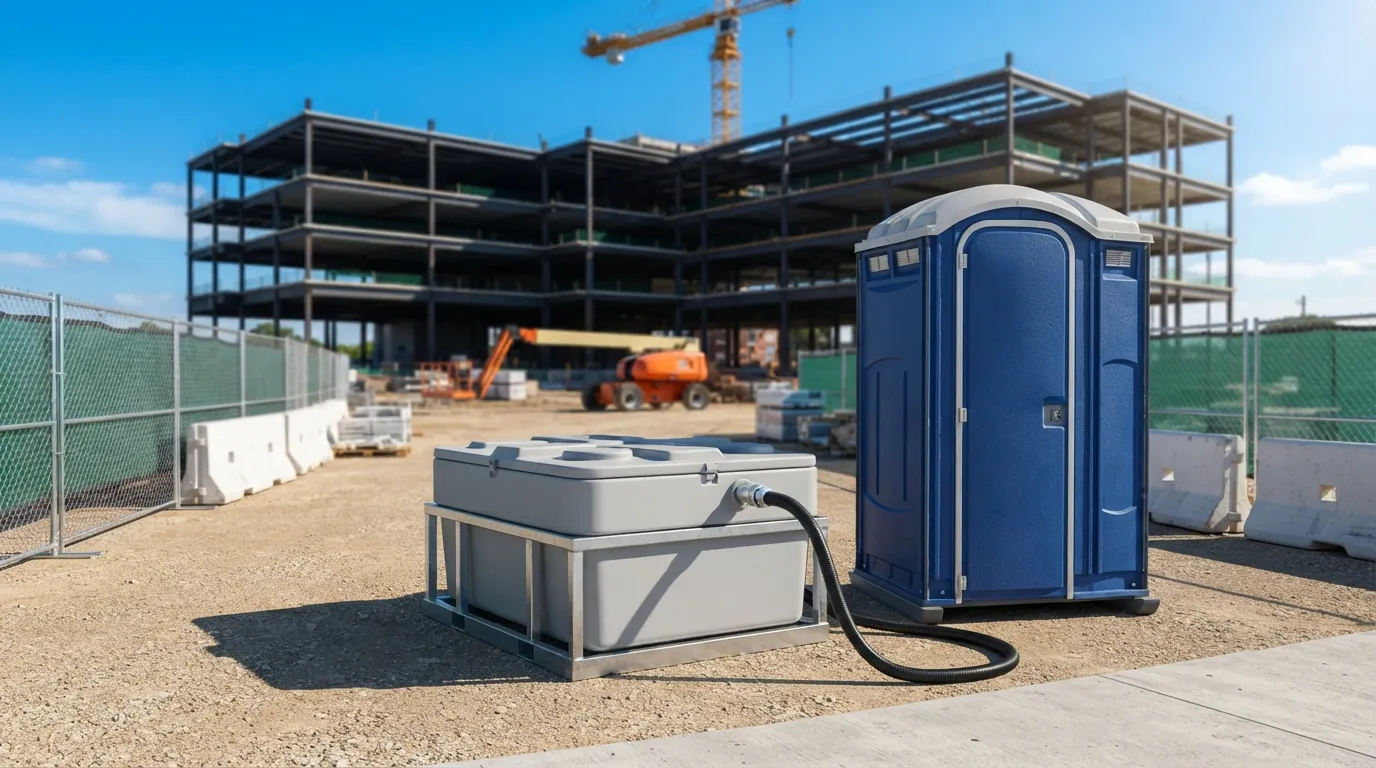
What is a holding tank, and when do you need one?
A holding tank is a sealed vessel with an inlet and no outlet, so everything that goes in stays there until a vacuum truck removes it. That is the whole difference between a holding tank and a septic tank. A septic tank separates and discharges. A holding tank only stores.
You need one when there is no sewer connection and no ground to discharge into. That covers a surprising amount of work in this city: film base camps on a closed block, event setups in the middle of a park, trailers and site offices without plumbing, temporary kitchens, and buildings where the sewer connection is out during a repair. It is also the answer when a property's septic system has failed and a replacement is going through permitting under New York State Department of Health Appendix 75-A of 10 NYCRR, which is not a fast process.
Holding tank sizes and how long each one lasts
Tanks are quoted by gallons, and the number that matters is how many uses you get before a truck has to come back.
| Tank size | Approximate flushes at 1.28 gpf | Typical use |
|---|---|---|
| 250 gallon | about 195 | Small trailer, short job, single unit |
| 500 gallon | about 390 | Site office, small base camp, weekend event |
| 1,000 gallon | about 780 | Multi-unit setup, week-long production |
| Paired 1,000 gallon tanks | about 1,560 | Large event or a block-long base camp |
The federal maximum for a new toilet is 1.6 gallons per flush and EPA WaterSense labels fixtures at
1.28 gallons or less, which is where those figures come from. Real usage runs higher once you add hand washing and cleaning water, so size up rather than down. For comparison, a standard porta potty carries a 60 to 70 gallon tank under the seat per manufacturer spec, and a restroom trailer typically carries 200 to 500 gallons of waste capacity.
Weight is the other planning number. Water runs 8.34 pounds per gallon, so a full 1,000 gallon tank is over four tons sitting on whatever surface you put it on. That rules out some rooftops, some decks and some older sidewalk vaults, and it is worth checking before delivery day rather than after.
How often does a holding tank need pumping?
On volume, not on a calendar. A tank with no outlet fills at exactly the rate people use it, so the schedule comes from the usage estimate and then gets corrected after the first real week.
- Film and television base camps. Usually daily service, timed to the production's own window.
- Multi-day events. Overnight service between operating days.
- Site offices and trailers. Weekly is typical, more if the crew grows.
- A house on a failed septic system. Depends entirely on household size. Expect weekly or better.
Fit a level gauge or an alarm if the tank does not have one. Running a sealed tank to overflow is worse than running a septic tank full, because there is nowhere for it to go but back up the line. The emergency septic service page covers what happens when it does.
Where holding tanks get used in New York City
This city generates more holding tank work than most, and it is not really about septic systems.
Film and television production is the biggest driver. A base camp parked on a Brooklyn or Queens block for a week has honey wagons and support trailers with no sewer to connect to, and the block has to be handed back clean when the permit expires. That work runs alongside film set restroom rental and is scheduled to the production's day, not to ours.
Park and venue events are the second. Setups at Flushing Meadows Corona Park, Prospect Park, Randalls Island, Citi Field and Yankee Stadium routinely put units where no sewer line reaches, and the venue sets the service vehicle access rules before you do. Ask the venue first. That applies to festival restrooms, concert restrooms and marathon and race events equally.
Third is construction, where a tank supports site trailers and washrooms until the permanent connection exists. Those jobs usually take the whole construction site services package.
What does holding tank rental cost?
We quote holding tanks per job rather than publishing a rate, because tank size, rental length, service frequency and where the truck can stop move the number more than any single figure could survive. What we can publish is the service side: a standard pump-out sits in the $150 to $300 market band, the same band set out on the septic tank pumping cost page. Prices reviewed July 2026, and these are typical ranges rather than a quote.
Send the location, the dates, the expected number of users and the access, and the number comes back accurate the first time. The quote form asks for exactly that.
Fresh water tanks are a separate line
Not every tank we deliver holds waste. Fresh water tanks feed trailers, temporary kitchens and washing setups where there is no potable connection, and they are kept entirely separate from waste equipment in handling and in storage. If you need both, say so up front, because they arrive as two tanks and two schedules. A portable sink or a handwash station is often the simpler answer for a small crew.
Placement and permits in the five boroughs
A tank on private property is a delivery question. A tank on a street or sidewalk is a permit question.
Anything in the public right of way needs a New York City Department of Transportation permit. Approvals run through borough offices and turnaround ranges from about a day to several weeks depending on the borough and the type of work, handled by the DOT Bureau of Permit Management and Construction Control at 55 Water Street. Call 311 for guidance on your block, and start the filing before you book the equipment. The permit requirements page has the walkthrough.
Pedestrian clearance decides the rest. Nothing blocks a curb ramp, a building entrance, an emergency path or a work-zone route, and the 2010 ADA Standards require a minimum 36 inch clear width on a pedestrian access route in section 403.5.1. Commercial vehicles are also banned from New York City parkways, so a delivery truck routes on the expressways and the NYC DOT truck route network, which affects your delivery window more than it affects your price.
Questions people ask about holding tank rental
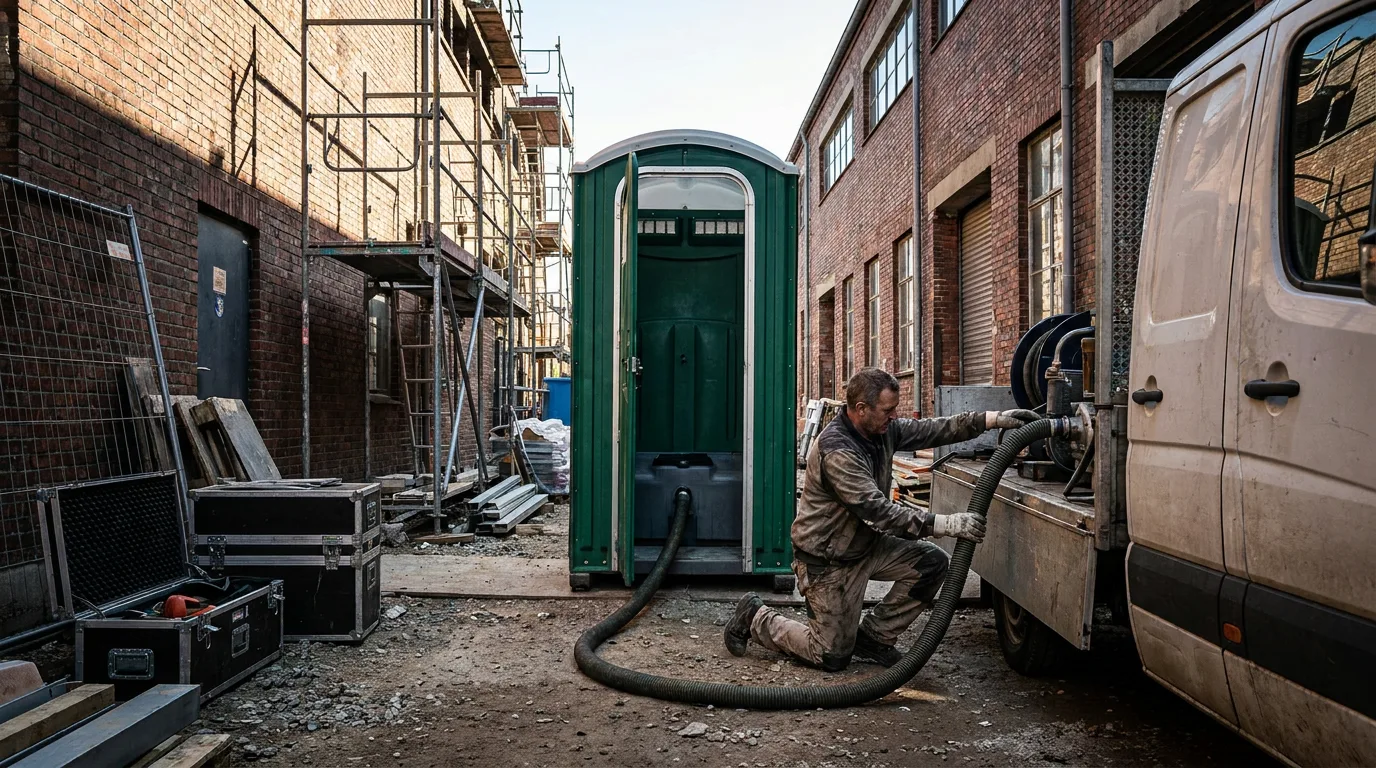
Do you rent RV and black water holding tanks? We handle waste tanks for trailers and vehicles on site. Tell us the connection type and we will bring the right fittings.
Can a tank sit on a sidewalk outside my building? Only with a DOT permit and only if it clears the pedestrian path. Many narrow frontages cannot take one legally at all. The placement guide explains what a driver checks.
How fast can you deliver? Same-day and next-day are realistic on private property. Right of way placements move at the permit's pace. Short-notice restroom work is on the emergency porta potty page.
Do you cover outside the five boroughs? Yes. Jersey City, Hoboken, Newark and Freeport are inside our range. The service areas page has the full list, the home page has everything else we run, and the contact page has the direct line.
What does holding tank rental cost?
Term plus pump-outs. Septic holding tank pumping cost is billed per visit, not per gallon, here.
Is holding tank rental near me available for an RV?
Yes. RV holding tank rental near me is a common New York City request at fairgrounds and long stays.
Next step
Get a delivery date
Tell us the address, the dates and the headcount. We size the order and confirm the route.