
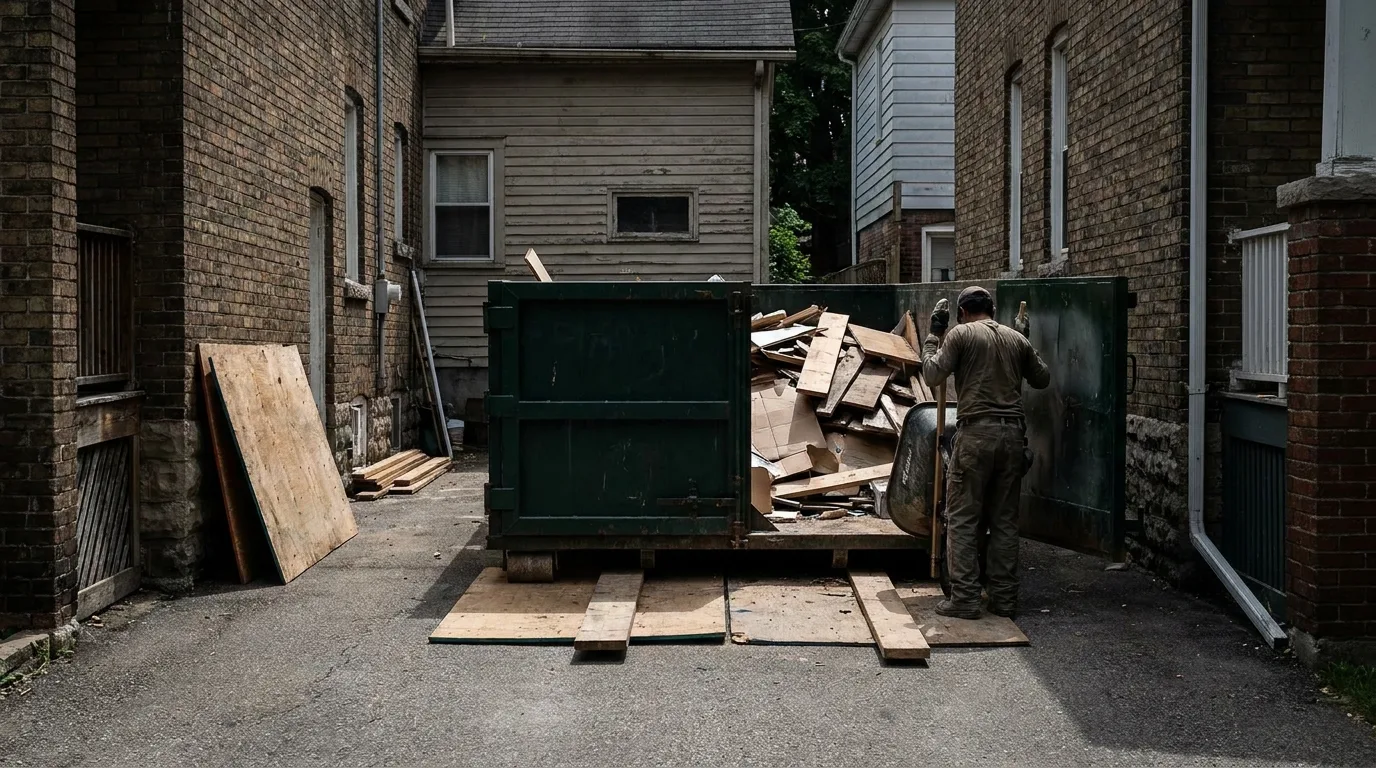
What cannot go in a dumpster in New York City?
A prohibited item is anything the transfer station is not licensed to accept, which is a narrower list than most people assume. Some of it is federal, some is New York State, and some is specific to this city. The table below covers what actually turns up on New York jobs.
| Material | Why it's restricted | Where it goes instead |
|---|---|---|
| Asbestos | Federal and NYC air rules | Licensed abatement contractor |
| Televisions, monitors, computers | NY State landfill ban since 2015 | Manufacturer takeback or DSNY e-waste |
| Fridges, freezers, window AC units | Refrigerant recovery required | Certified appliance recycler |
| Paint, stain, solvents | Household hazardous waste | NY paint collection program or a SAFE event |
| Motor oil, fuel, antifreeze | Hazardous liquid | Auto parts retailer or hazardous drop-off |
| Tires | NY State waste tire rules | Tire retailer or tire recycler |
| Batteries, propane tanks | Fire and hazard risk | Retail takeback or hazardous drop-off |
| Medical and sharps waste | Regulated medical waste | Licensed medical waste handler |
| Pesticides, pool chemicals | Hazardous waste | Hazardous waste event |
| Wet paint, joint compound, any liquid | Leaks and load weight | Dry it out or dispose separately |
| Contaminated soil | Requires testing and manifest | Specialist disposal |
The single most common reason a load gets flagged in this market isn't asbestos. It's half a bucket of joint compound nobody thought about.
Why does asbestos need its own process here?
Because New York City runs its own asbestos control programme on top of the federal rules. The NYC Department of Environmental Protection administers the Asbestos Control Program, and an ACP-5 filing is required before the Department of Buildings will sign off on many renovation and demolition permits. Federally, asbestos demolition and renovation work falls under the EPA's NESHAP rules at 40 CFR Part 61 Subpart M.
Practically, this matters more here than in newer cities. Pipe insulation, floor tile mastic, boiler lagging and old plaster systems in pre-war buildings across Manhattan, the Bronx and Brooklyn are all places asbestos turns up. If you're not certain, stop and get it tested. An abatement contractor handles removal and disposal under a separate manifest, and none of it goes in a container. The same building stock raises a lead question: New York City's Local Law 1 of 2004 governs lead paint hazards in residential buildings, which is worth checking before painted-surface demolition in an older apartment. See home renovation restroom rental for the rest of what a long interior job needs.
Where do electronics go in New York City?
Not in the container. New York State's Electronic Equipment Recycling and Reuse Act has banned televisions, computer monitors, computers, printers and similar equipment from landfill disposal since January 2015, and the ban applies to businesses and households alike.
Manufacturer takeback programmes cover most of it at no charge, and the Department of Sanitation runs residential electronics collection across the five boroughs. On a commercial gut-out, the electronics usually need to be separated before demolition starts rather than picked out of a pile afterwards. Plan for it in the sequence. Construction dumpster rental covers how a phased strip-out gets scheduled.
What about refrigerators and air conditioners?
They need certified refrigerant recovery before disposal. Section 608 of the federal Clean Air Act requires that refrigerant be recovered by a certified technician before an appliance containing it is scrapped, and no transfer station will take a unit that hasn't been evacuated and tagged.
Window air conditioners are the New York version of this problem. A single apartment building turnover can produce dozens of them, and every one needs handling before it can be hauled. Get them processed by an appliance recycler, then the empty shells can go with the rest of the metal. The dumpster rental cost page explains how a rejected load gets billed.
Can you put paint or liquids in a dumpster?
No, and this is where most homeowners get caught. Liquids leak, they add weight you'll pay for, and they contaminate the rest of the load.
Leftover architectural paint goes through New York's postconsumer paint collection programme, which takes it back at participating retailers. Solvents, thinners, pesticides and pool chemicals go to a household hazardous waste drop-off, and the Department of Sanitation runs collection events for exactly this. Latex paint that has been fully dried out, with the lid off and the can empty, is generally acceptable, but dried means dried, not tacky.
Water is the other liquid that costs money. An open container of drywall or soil that sits through a wet weekend gains real tonnage, and that weight lands on your invoice. Tarp it. Dumpster weight limits shows what a ton of extra water actually costs.
What happens if a prohibited item ends up in the load?
The load gets rejected at the scale, comes back to the site, and the return trip plus the sorting time gets billed. On a bad day, the container sits full and unhauled while somebody digs the offender out.
Two things reduce the risk. First, tell the person taking your booking what's in the debris, honestly and in detail. Second, use a licensed hauler. Private trade waste in New York City is regulated by the Business Integrity Commission under Title 16-A of the Administrative Code, and a licensed carter knows which transfer stations accept which streams. That knowledge is most of what you're paying for.
Things you can throw away that change the price
These are allowed, but they get quoted differently because they weigh differently or go to a different facility:
- Concrete, brick and block. A cubic yard runs about 4,000 pounds, so it goes as a clean load in a 10 yard container with its own tonnage rate.
- Soil and fill. Same treatment, and it must be uncontaminated.
- Roofing shingles. Roughly 230 to 400 pounds per 100 square foot square, which is why a 20 yard tear-off hits the weight limit before it fills.
- Mattresses. New York City requires mattresses and box springs to be fully sealed in plastic before disposal, a bed bug measure, and many facilities charge per piece.
- Appliances without refrigerant. Fine once the compressor unit is confirmed clear.
- Treated lumber and pressure-treated decking. Accepted at most facilities, sometimes with a surcharge, and often booked alongside temporary fencing when a yard is being cleared.
- Set and staging materials from a shoot, which are bulky and light and suit a 40 yard container. See film set restroom rental for the rest of a production order.
Federal rules cap a loaded truck at 80,000 pounds gross vehicle weight under 23 CFR 658, so heavy material is always a small-container conversation. The sizes and dimensions page shows which container suits which debris, and roll-off dumpster rental covers the rest.
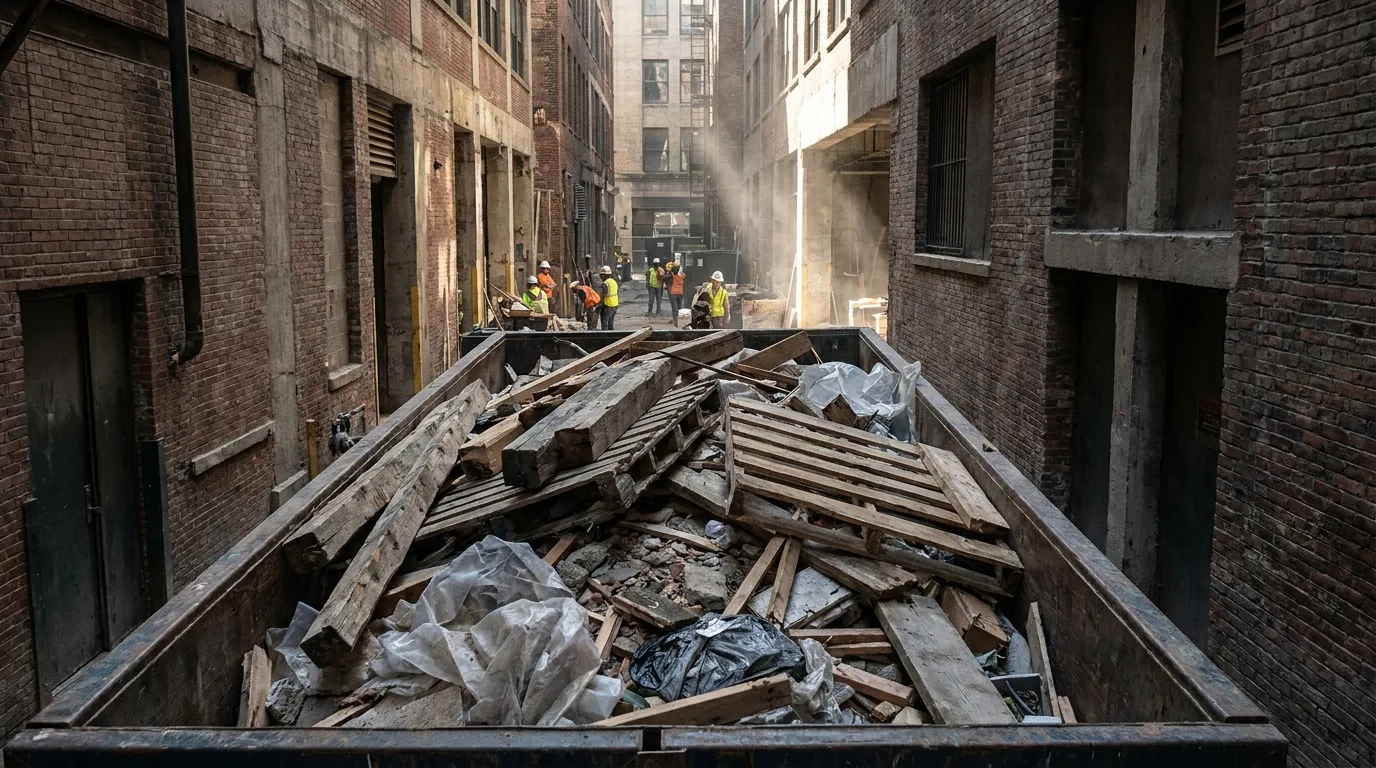
Questions people ask about prohibited items
Can I put a couch in a dumpster? Yes. Furniture and mattresses are fine, though mattresses have to be bagged and sealed in New York City and often carry a per-piece charge.
Can I throw away a water heater? Yes, once it's fully drained. Empty means empty.
What about septic or holding tank waste? Never. Liquid waste is pumped and hauled under a different licence entirely. See septic pumping service, septic tank cleaning or holding tank rental if that's what you're dealing with.
Does the crew need washing facilities if they're handling this stuff? Often yes. OSHA 1926.51(f)(1) requires washing facilities where workers handle harmful substances, which is why a portable sink shows up on most real jobsite quotes.
What about drywall and plaster? Both are accepted. Plaster and lath from a pre-war building weighs considerably more than modern drywall, so a 30 yard container full of it can beat its tonnage allowance.
Can I mix concrete with regular debris? You can, but it gets priced as a heavy mixed load, which costs more than booking a clean concrete load separately.
Does the container need a permit if it's holding restricted material? The permit question is about location, not contents. A container on a street or sidewalk needs a Department of Transportation permit through the Bureau of Permit Management and Construction Control at 55 Water Street, with borough turnaround running from about a day to several weeks. Details on dumpster permit requirements.
What if I'm not sure about something? Ask before it goes in. One phone call is cheaper than a rejected load. Use the quote form or the contact page, and check the FAQ. If the job also needs sanitation, see porta potty rental in New York City, what it costs or construction site services. Coverage across the boroughs and into Jersey City is on the service areas page, and everything we run is on the home page.
Next step
Get a delivery date
Tell us the address, the dates and the headcount. We size the order and confirm the route.