
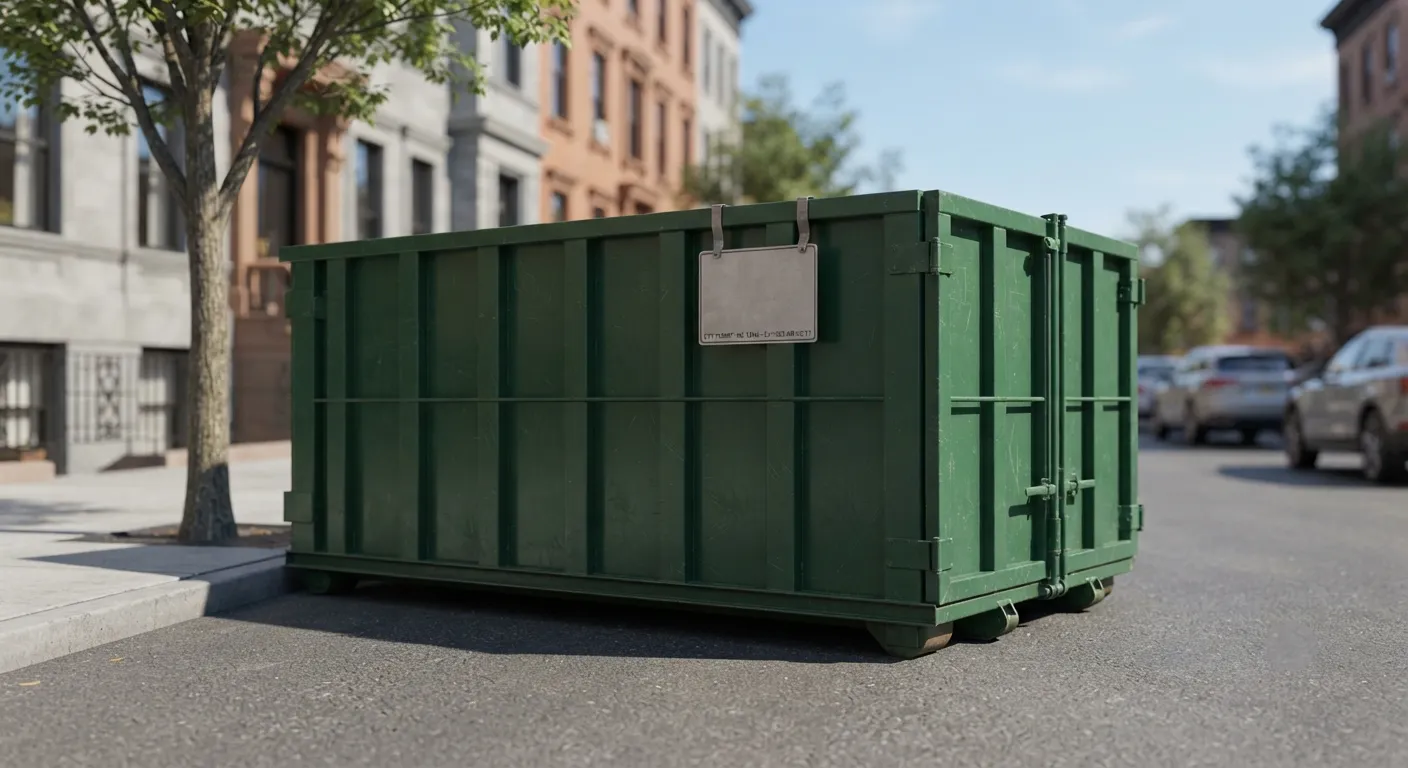
Do you need a permit for a dumpster in New York City?
Yes, if any part of the container sits in the public right of way. That means the roadway, a parking lane, a sidewalk, a crosswalk or a pedestrian plaza. The permit comes from the New York City Department of Transportation, handled through its Bureau of Permit Management and Construction Control at 55 Water Street, with borough offices doing the actual approvals. Calling 311 is the fastest way to get a straight answer for a specific address.
New York is stricter about this than almost any other US market, and the reason is density. With 8.8 million people across five boroughs, a container in the wrong place doesn't inconvenience a driver, it pushes pedestrians into traffic. That is the lens every application gets read through.
When do you not need a permit?
If the container sits entirely on private property, no DOT permit is required and delivery can usually happen the next business day. That covers:
- A driveway on a single or two-family home in Staten Island, eastern Queens or the north Bronx
- A private parking lot or loading dock apron
- A fenced construction site behind the property line
- An interior courtyard or private drive with truck access
Private property still comes with gatekeepers. Co-op and condo boards, building management and managing agents typically want the placement, the dates and a certificate of insurance before the truck is booked, and that approval routinely takes longer than the DOT would. Start it early.
What the DOT permit actually covers
The permit authorises a specific container, at a specific location, for a specific period. It is not a blanket permission to keep a dumpster on your block. Three things follow from that:
- The location on the permit is the location. Moving the container 30 feet down the street
because the first spot was occupied is not covered.
- The end date is a hard stop. When the permit expires the container comes back whether the job
is finished or not, so build extension time into the original filing rather than scrambling later.
- Conditions attached to the permit are enforceable. Restricted hours, reflective markings and
specific setbacks all show up on real approvals.
If the job runs long, plan a swap rather than an extension. The roll-off dumpster rental page explains how swap scheduling works on long jobs, and construction dumpster rental covers multi-container sites.
Who applies for the permit, you or the hauler?
In practice, whoever holds registered permittee status with DOT. That is normally the contractor or the carting company rather than a homeowner, because the permit process is built around registered entities carrying insurance on file. If you are a homeowner running your own renovation, ask your contractor or your hauler to file, and get confirmation in writing before you commit to a start date.
Worth checking at the same time: private trade waste hauling in New York City is regulated by the Business Integrity Commission under Title 16-A of the Administrative Code, and any legitimate carter holds a BIC license. A company that can't produce one also can't reliably get a street permit.
Placement rules that decide the answer before the permit does
Plenty of New York placements fail on geometry rather than paperwork. Check these before you apply, because no permit overrides them:
- Pedestrian clearance. The 2010 ADA Standards require a minimum 36 inch clear width on a pedestrian access route in section 403.5.1. On narrow blocks in the Financial District or Downtown Brooklyn there simply isn't the room.
- Curb ramps, building entrances and emergency paths must stay clear at all times.
- Hydrants, standpipes and building siamese connections.
- Protected bike lanes. A container cannot occupy one, and on avenues with parking-protected lanes the curb lane you were counting on is the buffer.
- Bus lanes, which run on more corridors than out-of-town contractors expect and are camera enforced.
- Overhead clearance. A roll-off truck needs roughly 22 feet to raise its hoist, and the city's Facade Inspection Safety Program keeps thousands of sidewalk sheds in place across Manhattan and the Bronx. Under a shed, the placement is dead regardless of the permit.
- Alternate side parking, which can strand a container mid-rental if nobody planned around it.
Container length matters here too. A 10 yard container at 12 to 14 feet is a far easier approval than a 20 yard at 22 feet per manufacturer spec, and 30 and 40 yard containers are rarely placed on city streets at all. The sizes and dimensions page has the measurements, and the placement guide covers what a driver assesses on arrival.
How long does a NYC dumpster permit take?
From about a day to several weeks, depending on the borough office and the type of work. A straightforward residential placement in an outer borough moves fast. Anything tied to a lane closure, a major corridor or a coordinated construction project takes considerably longer.
Sequence that works, in order: confirm the placement is physically and legally viable, file the permit, then book the container. Doing it the other way round is how jobs end up paying for a container sitting on a truck.
What happens if you skip the permit?
An unpermitted container in the right of way is an enforcement matter, and the container is also liable to be moved without much notice. The practical damage is usually worse than the citation: a crew stood down, a haul rescheduled, and a container that has to be collected and redelivered. It is not a corner worth cutting in this city.
Other permits the same job may need
A dumpster is rarely the only thing on the sidewalk. If the crew needs a restroom on the public right of way, that runs through a separate track covered on porta potty permit requirements. Fencing around a work zone has its own conditions, set out on the temporary fence rental page. Film and television work in New York is permitted through the Mayor's Office of Media and Entertainment, and street fairs run through the city's street activity permitting process, so film set support and festival planning both start with the event permit rather than with us.
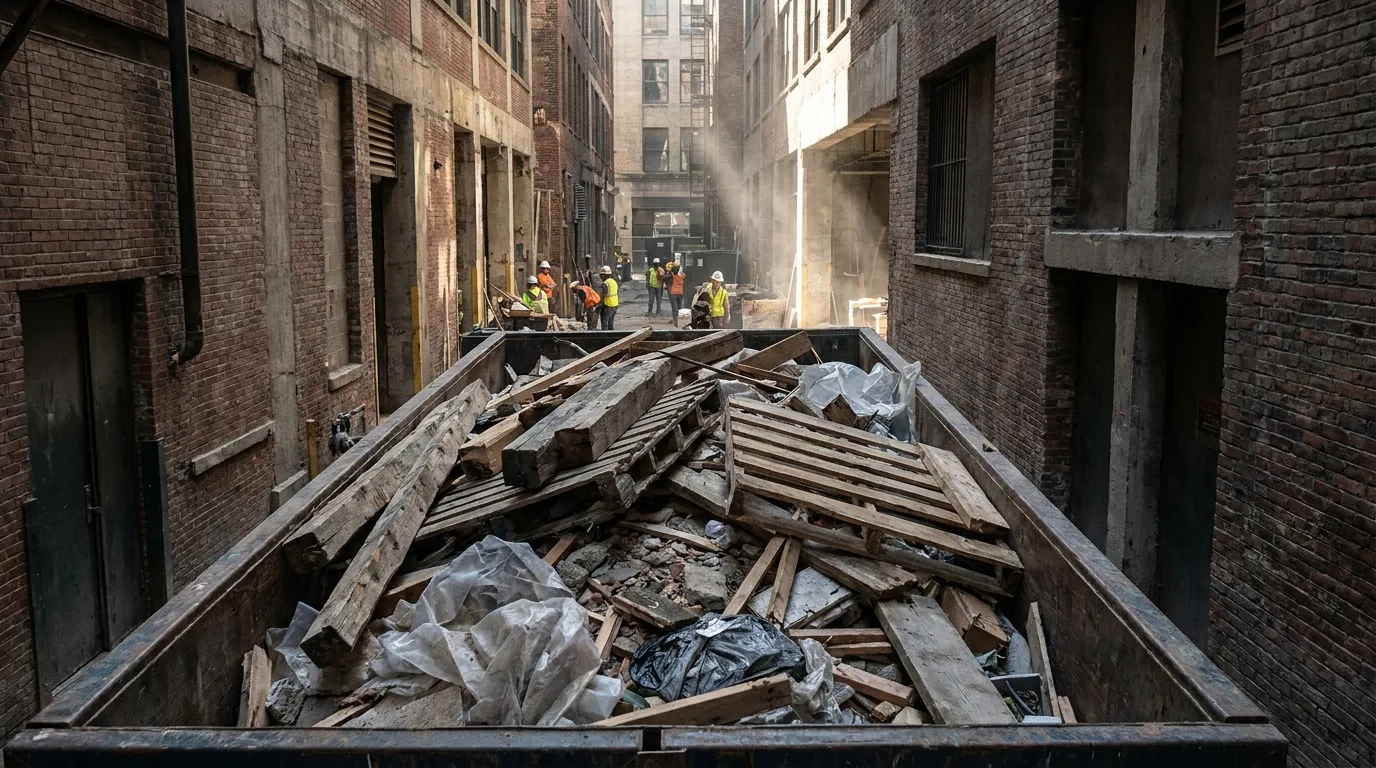
Questions people ask about dumpster permits
Can I put a dumpster in front of my house in Brooklyn? Only with a DOT permit, and only if the sidewalk and curb lane can spare the space. Many brownstone blocks can take a 10 yard container and nothing larger.
Does the permit cost much? The permit itself is a city charge. The expensive part is the delay if you file late, not the fee. Full pricing for the container is on the dumpster rental cost page.
Does the truck route matter to the permit? It matters to the delivery. Section 385 of the New York State Vehicle and Traffic Law sets vehicle weight and dimension limits, commercial vehicles are banned from the parkway network, and a loaded roll-off has to run the DOT truck route network. That shapes delivery windows more than the permit does. Dumpster weight limits has the numbers.
Do jobsite crews need anything else permitted? Often. OSHA 1926.51(c)(1) requires one toilet per 20 workers on a construction site working a 40-hour week, and if that unit sits on the sidewalk it needs its own approval. See construction site services.
Do I need a permit for a dumpster in a parking lot I own? No. Private property placements need no DOT permit at all.
Can the permit be extended? Extensions exist, but plan the duration correctly at filing. It's far easier than amending an approval mid-job.
What if my building sits on a bus route? Expect a harder approval and possibly restricted delivery hours. Ask 311 about your specific block before you commit to dates.
What can't go in the container once it's there? Asbestos, electronics, refrigerants, liquids and hazardous material, all covered on what cannot go in a dumpster. Weight rules are separate again and sit on dumpster weight limits.
Do I need a permit to rent a dumpster?
Only if it touches public ground. On a driveway, no permit at all.
What about a permit for dumpster on street placement?
That one you need. Start it before you book the box, because approval is the long pole.
Where does the dumpster permit application go?
To the city office that controls the right-of-way in New York City. The page above names it.
If the crew also needs sanitation, see porta potty rental in New York City, what it costs or the bundled construction site services. Coverage across the boroughs and into Jersey City and Newark is on the service areas page. Send your address through the quote form, call the number on the contact page, read the FAQ, or start from the home page.
Next step
Get a delivery date
Tell us the address, the dates and the headcount. We size the order and confirm the route.