
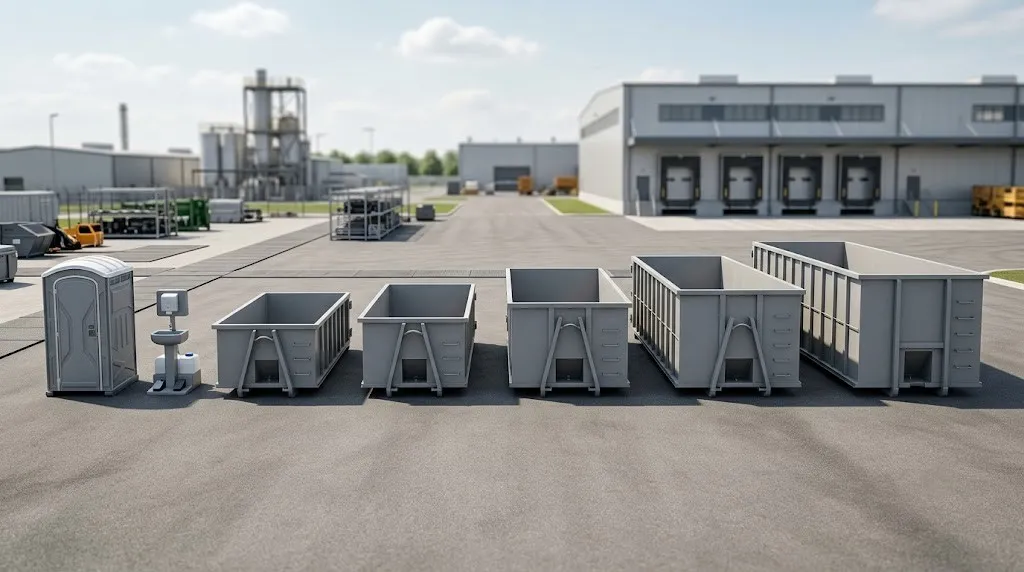
What are the standard roll-off dumpster sizes?
A roll-off dumpster is an open-top steel container delivered on a hooklift or cable truck, loaded on site, then winched back on and hauled to a transfer station. Yardage refers to cubic yards of volume, never weight. The four sizes below cover essentially every job in the five boroughs. Dimensions are typical manufacturer specifications and vary by a few inches between builders.
| Size | Length | Width | Wall height | Volume | Typical tonnage | Empty weight |
|---|---|---|---|---|---|---|
| 10 yard | 12 to 14 ft | 8 ft | 3.5 to 4 ft | 10 cu yd | 1 to 2 tons | 2,000 to 3,000 lb |
| 20 yard | 22 ft | 8 ft | 4 to 4.5 ft | 20 cu yd | 2 to 3 tons | about 4,000 lb |
| 30 yard | 22 ft | 8 ft | 6 ft | 30 cu yd | 3 to 4 tons | 5,000 to 6,000 lb |
| 40 yard | 22 ft | 8 ft | 8 ft | 40 cu yd | 4 to 6 tons | 7,000 to 8,000 lb |
Read that table left to right and one thing stands out. Three of the four sizes are the same length and width. Only the walls grow.
10 yard dumpster dimensions
A 10 yard container is roughly 12 to 14 feet long, 8 feet wide and 3.5 to 4 feet tall, weighing 2,000 to 3,000 pounds empty per manufacturer spec. It holds about 3 to 4 pickup truck loads.
The low walls are the point. You can pitch material in over the side without a ramp, and the loaded profile stays under fire escapes, awnings and low utility lines. It's also the container used for heavy clean loads, because a cubic yard of broken concrete runs about 4,000 pounds and the weight ceiling arrives long before the volume does. On brownstone blocks in Park Slope, Bed-Stuy and Astoria this is frequently the only size that will physically fit, which is why so many home renovation jobs here run on one small container and more frequent hauls.
20 yard dumpster dimensions
A 20 yard container measures about 22 feet long, 8 feet wide and 4 to 4.5 feet tall, around 4,000 pounds empty. It holds roughly 6 to 8 pickup loads and it's the size most New York renovation jobs book.
Twenty-two feet is close to two full parked cars of curb, and the truck needs another 55 to 60 feet of straight approach to set the container down and pick it up. Those two numbers together are what make a placement work or fail. A kitchen and bath renovation, a two-family roof tear-off or a mid-size commercial strip-out all land in this size.
30 yard dumpster dimensions
A 30 yard container is about 22 feet long, 8 feet wide and 6 feet tall, roughly 5,000 to 6,000 pounds empty. It takes 9 to 12 pickup loads.
Since the footprint matches the 20 yard exactly, the upgrade is nearly free in terms of space and buys 50 percent more volume. What it costs you is headroom. A roll-off truck needs about 22 feet of vertical clearance to raise its hoist, and the city's Facade Inspection Safety Program keeps thousands of sidewalk sheds standing across Manhattan and the Bronx, every one of which rules out a placement underneath. Most 30 yard containers here go on private lots and permitted construction sites.
40 yard dumpster dimensions
A 40 yard container runs about 22 feet long, 8 feet wide and 8 feet tall, weighing 7,000 to 8,000 pounds empty. It handles 12 to 16 pickup loads of bulky, light debris.
Eight foot walls mean nothing goes in over the side. Order a rear swing door and plan a walk-in path or a ramp. This size is built for warehouse cleanouts, commercial demolition of light material and film production strikes, and it is very rarely placed on a New York City street. Sites running one usually have temporary fencing and a storage container on the same lot.
Why do the 20, 30 and 40 yard containers share a footprint?
Because they share a truck and a set of rails. The hooklift and cable systems that carry roll-off containers are built around a standard rail spacing and a standard length, so builders change wall height rather than the base to create different volumes. The 10 yard is the odd one out, built shorter so it can be dropped into tight spaces and carry dense material without exceeding axle limits.
The practical consequence in New York is worth stating plainly. If your placement fits a 20 yard container, it fits a 30 and a 40 too, as long as nothing is overhead. Sizing up is usually cheaper than a second haul. The only real constraint on going bigger is vertical clearance and weight, not ground space. See roll-off dumpster rental for how swaps and multiple containers get scheduled.
How much space does a dumpster need in New York City?
Three measurements, and all three have to work:
- Container length plus clearance. Add 5 feet at each end so the driver can position the rails.
A 20 yard container therefore wants about 32 feet of curb or driveway.
- Straight approach. Roughly 55 to 60 feet of unobstructed line for the truck to back in and
winch the container off.
- Overhead. About 22 feet of vertical clearance for the hoist.
That third number is the one out-of-town contractors miss here. Sidewalk sheds, scaffolding cross-bracing, fire escapes, awnings, low-hanging utility lines in Queens and Staten Island, and mature street trees all sit inside it.
On top of the physical measurements, a street or sidewalk placement needs a permit from the New York City Department of Transportation, handled through the Bureau of Permit Management and Construction Control at 55 Water Street with borough offices doing approvals, and turnaround running from about a day to several weeks depending on the borough and the type of work. Pedestrian clearance is the first test any placement has to pass: the 2010 ADA Standards require a minimum 36 inch clear width on a pedestrian access route in section 403.5.1, and no container can block a curb ramp, a building entrance or an emergency path. Protected bike lanes, bus lanes and alternate side parking take out a lot of the rest. The dumpster permit requirements page walks the filing through, and the placement guide covers what a driver looks at on arrival.
What size dumpster do I need for my job?
Match the size to the debris, then check the block will take it.
- Single bathroom, small cleanout, any concrete or dirt. 10 yard.
- Kitchen and bath, roof tear-off, deck removal, garage plus basement. 20 yard.
- Full apartment gut, whole-house cleanout, commercial fit-out, siding job. 30 yard.
- Warehouse clearance, light commercial demolition, set strike, retail gut. 40 yard.
- Long construction job. Two or three containers on a swap schedule rather than one big one. See construction dumpster rental.
If you're between sizes and the placement can take the bigger one, take the bigger one. A second haul costs far more than the difference in rental rate. Full pricing sits on the dumpster rental cost page.
Weight, not volume, is what usually decides the size
The dimensions above tell you what fits. Tonnage tells you what can legally leave. Federal rules cap a loaded truck at 80,000 pounds gross vehicle weight under 23 CFR 658, and after the tractor and an empty container are subtracted, the payload allowance is what you see in the table.
Rough densities to plan against: mixed construction debris runs about 500 to 800 pounds per cubic yard, drywall about 500 pounds, asphalt shingles roughly 230 to 400 pounds per 100 square foot square, and broken concrete around 4,000 pounds per cubic yard. Forty cubic yards of genuinely mixed debris is 10 to 16 tons, which no roll-off truck in the country can carry. That is why heavy material goes in small containers and light material goes in big ones. Dumpster weight limits has the full breakdown and how overage is billed.
Questions people ask about dumpster dimensions
How big is a 20 yard dumpster in feet? About 22 feet long, 8 feet wide and 4 to 4.5 feet tall per manufacturer spec. Add roughly 10 feet of total clearance for the driver to work.
Does the size affect what the truck can legally carry? Yes. Section 385 of the New York State Vehicle and Traffic Law sets vehicle weight and dimension limits, and federal rules cap a loaded truck at 80,000 pounds under 23 CFR 658, which is what sets the tonnage allowance on each container.
Who is allowed to haul it in New York City? A carter licensed by the Business Integrity Commission, which regulates private trade waste under Title 16-A of the Administrative Code. Ask for the license number.
Which dumpster fits in a single parking space? None of them fully. A 10 yard container is the closest, taking roughly one and a half spaces of curb before clearance.
Do all dumpsters have a door? Most 20, 30 and 40 yard containers have a rear swing door. Ask for it at booking if the crew will walk material in rather than lift it over the side.
Can a container sit on grass or dirt? Yes with planking under the rails, though soft ground after rain is a genuine problem. Plywood is cheap insurance on a driveway too. In freezing weather the same ground behaves differently again, and winter site planning covers what changes.
How fast can one be delivered? Next business day on private property across the five boroughs and out to Jersey City and Hoboken. Short-notice work runs through emergency rental.
What can't go in any of them? Asbestos, electronics, refrigerants, liquids, tires and hazardous material. The specifics for New York, including the NYC DEP asbestos filing, are on what cannot go in a dumpster.
Do I need a restroom on site as well? Most multi-day jobs do. See porta potty rental in New York City, what it costs, or construction site services for the bundled version. Everything we run is listed on the home page, coverage is on the service areas page, and you can send measurements through the quote form or the contact page. The FAQ covers the rest.
What are the 10 yard dumpster measurements?
Roughly 12 to 14 by 8 by 3.5 to 4 feet. Those 10-yard dumpster dimensions suit tight streets.
What are the 20 yard dumpster measurements?
About 22 by 8 by 4.5 feet. Dumpster dimensions 20 yard boxes carry vary by inches between makers.
How many 10 yard dumpster sizes are there?
One. The 10 yard dumpster size is a single container, with slight wall differences by manufacturer.
Next step
Get a delivery date
Tell us the address, the dates and the headcount. We size the order and confirm the route.