
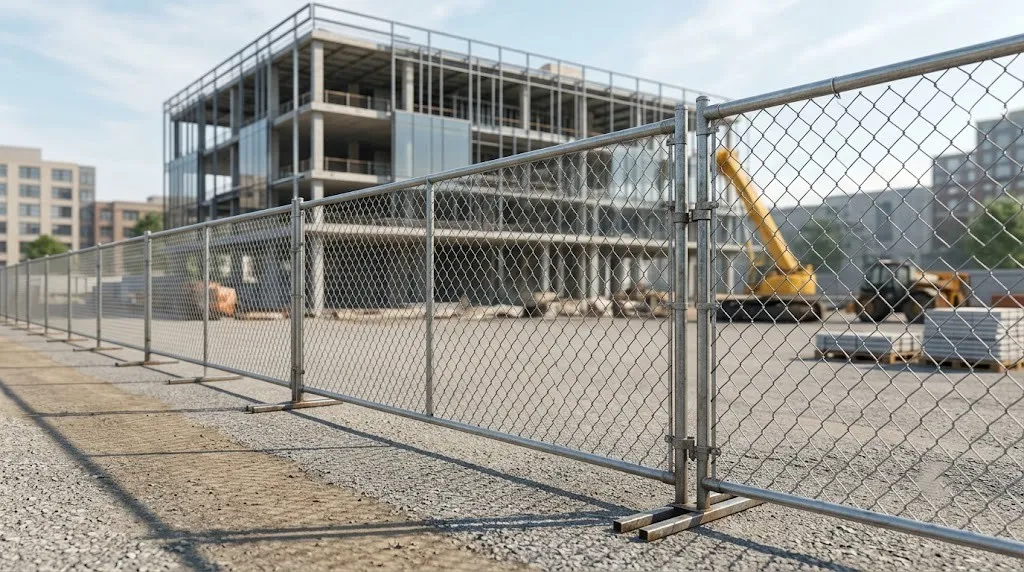
What is a chain link temporary fence?
A chain link temporary fence is a run of free standing steel panels, each one a welded tube frame filled with galvanised chain link mesh, dropped into weighted bases and clamped together at every joint. Nothing is driven into the ground and nothing is concreted.
That is the whole reason it dominates New York sites. A panel run goes up on a sidewalk, a slab, a parking deck or a vault cover without touching what's underneath, and it comes out the same way. Some older contractors here still call them cyclone chain link temporary fence panels, which is the same product under an older name for the mesh.
Panel sizes and specs
| Item | Typical spec |
|---|---|
| Standard panel | 6 feet by 12 feet |
| Short panel | 6 x 10 chain link temporary fence panel |
| NYC construction height | 8 feet, per Building Code Chapter 33 |
| Frame tube | 1 3/8 inch outside diameter |
| Mesh | 2 inch diamond, 11.5 or 9 gauge |
| Panel weight | 60 to 90 pounds |
| Base block | 32 to 40 pounds, concrete or moulded rubber |
| Coverage per 100 feet | About 8 panels at 12 foot width |
The 6 by 10 panel earns its place on tight New York runs. Twelve foot sections leave you cutting a gap at the end of a 46 foot frontage; ten foot sections land closer, and they're easier to carry through a building when the truck cannot reach the line.
How the panels connect and stay up
Each panel sits with one leg in a base and the next panel's leg in the same base, then a clamp bolts the two frames together at the top rail. Repeat down the line. That clamped joint is what turns individual panels into a continuous run that resists being pushed over.
The failure points are always the same three. A run of more than about eight panels with no return or brace acts like a hinge in wind. Corners need an extra base. And any gate opening needs bracing back into the site, because a hinged panel carries a load the clamps were never meant to take.
Windscreen and what it does to ballast
Bare mesh is mostly air, so wind passes through and a standard base holds it. Cover a 6 by 12 panel in privacy screen and you have created a 72 square foot sail.
In this city that matters more than in most. Wind funnels between Midtown towers, waterfront sites in Red Hook and the Rockaways take the full load, and a January nor'easter is not a hypothetical. Screened runs need heavier ballast, closer base spacing and bracing back into the site, and on exposed or rooftop work they need an engineered ballast design rather than standard blocks. If you add screen after installation, tell us, because that's the change that causes failures.
Why New York runs 8 foot panels
New York City Building Code Chapter 33, safeguards during construction, governs site protection, and an 8 foot construction fence along a public way is the standard requirement here. Most of the country fences a site at 6 feet.
Two feet sounds trivial and it isn't. Eight foot panels are heavier, they catch more wind, they need more ballast per foot, and they cost more per linear foot to install. Budget for the New York height rather than a national average. Where the work involves a tall building over an occupied sidewalk, Chapter 33 moves you past a fence into sidewalk shed territory, which is a filed structure rather than something that arrives on a truck.
Temporary chain link fence rental cost in NYC
Published market data puts temporary fence at $30 to $75 per day with around $50 typical. Prices reviewed July 2026, and those are market ranges rather than a quote. Longer New York jobs are usually quoted monthly against a linear foot run instead, since installation and removal labour is the real cost and it happens twice regardless of term.
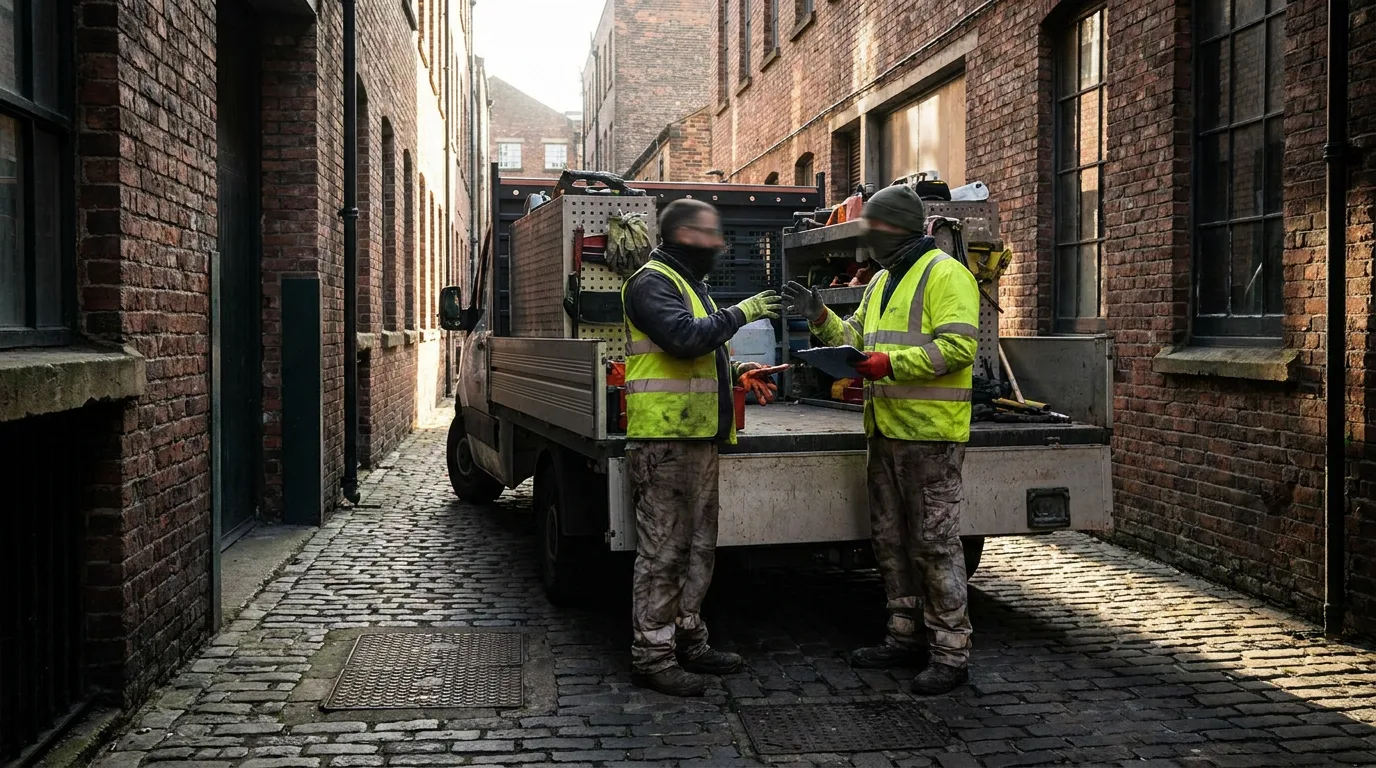
Temporary chain link fence rental prices move on run length, gate count, screen, whether the line sits on a permitted sidewalk, and how the panels reach the line. Carrying 25 panels through a building because the truck cannot get to the frontage is a labour line, and it is a real one in Manhattan. Temporary fence cost breaks every fee out, and temporary fence rental covers the wider product including post driven fence.
Do you need a permit for a temporary chain link fence rental?
On private property, no. On a New York City street or sidewalk, yes, and it comes from the Department of Transportation through its Bureau of Permit Management and Construction Control at 55 Water Street. Borough offices handle approvals and turnaround runs from about a day to several weeks depending on the borough and the type of work. 311 answers address specific questions fastest.
Pedestrian clearance is settled before the permit. The 2010 ADA Standards require a 36 inch minimum clear width on a pedestrian access route in section 403.5.1, and the fence line cannot block a curb ramp, a hydrant, a building entrance, a subway stair or an emergency egress path. On a narrow sidewalk that usually forces the line back onto the property. Porta potty permit requirements has the same DOT sequence for sanitation, and the placement guide covers clearance on site.
Questions people ask about chain link panels
How many panels for a 300 foot perimeter? About 25 at 12 foot width, plus extras for corners and gates. That's roughly 3,000 pounds of steel and ballast on your site.
Can you build a gate from panels? Yes. Two 12 foot panels on hinges give a 24 foot vehicle opening, which handles a tilt bed truck placing a 20ft storage container or a hooklift collecting a roll-off dumpster.
Do you use these for events? For back of house, yes. Queue lines and race routes want crowd control barrier rental instead, since barricades interlock and move by hand. Festival restroom rental and film set restroom rental cover the rest of a temporary compound.
What else lands on the same order? Restrooms through porta potty rental in New York City at these prices, handwashing station rental, a light tower for night shifts, a temporary power pole for the supply and a mobile office trailer for the site team. Construction site services bundles it.
Do you deliver outside the five boroughs? Yes, including Jersey City, Newark and Hempstead. The service areas page has the map.
Send the run length and the gate positions through the quote form, or call the number on the contact page. The FAQ answers the rest and everything we run is on the home page.
Next step
Get a delivery date
Tell us the address, the dates and the headcount. We size the order and confirm the route.