
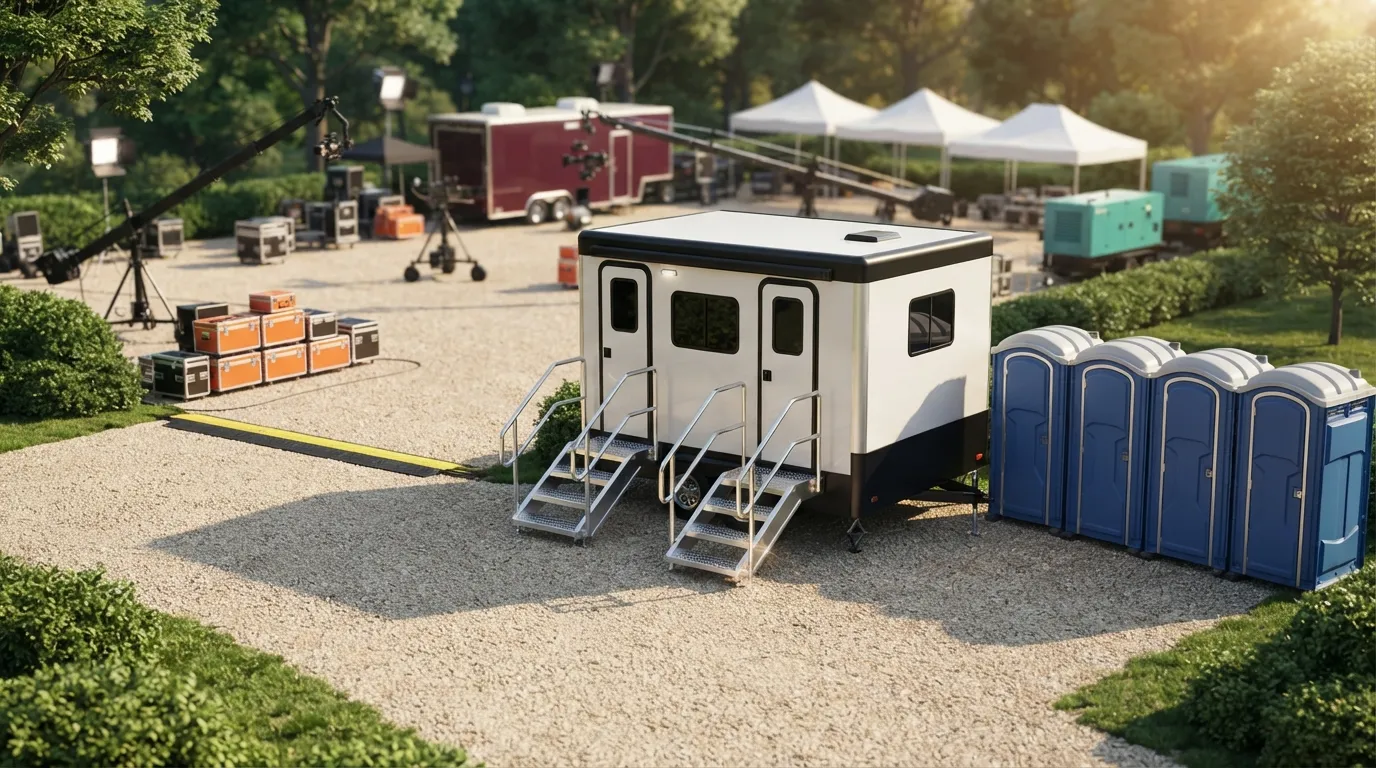
What film sets actually order, and why it is not the standard blue unit
Film set restroom rental is short-notice supply of portable toilets, handwashing and restroom trailers to a production base camp, a location set or a stage support area, serviced daily rather than weekly. The unit type is different from a jobsite order. Sets run deluxe flushable units as the default, because talent, background and department heads all use the same facilities and a standard unit does not survive a 14 hour day with 120 people on it.
A typical New York order looks like this:
- Four to eight deluxe units at base camp, split between crew and background holding
- A 2 stall trailer or 4 stall trailer where the location has room and power
- One ADA accessible unit, which is a requirement rather than a courtesy once the public is involved
- Handwashing stations beside craft services and catering
- A shower trailer on stunt, effects or multi-day location work
Why New York productions book at 48 hours notice
This city's production calendar runs year round and moves constantly. Locations fall through, weather cover kicks in, a permit shifts a block, and the restroom order moves with it. We plan for that rather than complaining about it, which mostly means holding fleet through the working week and keeping the paperwork simple.
Film permits in New York are issued by the Mayor's Office of Media and Entertainment through its Office of Film, Theatre and Broadcasting, at no charge, and the permit requires a certificate of insurance carrying at least $1 million in general liability naming the City of New York. That permit is also what gets production vehicles their parking privileges on the block, which in practice is what determines where our truck can stop. Send us the permit block and the parking plan, not just the address.
Do film set porta potties need a DOT permit?
If the unit stands on a New York City street or sidewalk, yes. It needs a permit from the Department of Transportation, filed through borough offices, with turnaround running from about a day to several weeks depending on the borough and the type of work. The NYC DOT Bureau of Permit Management and Construction Control at 55 Water Street administers it, and 311 will confirm what a given block requires. That is separate from the film permit itself.
Pedestrian clearance governs the placement whatever the shoot needs. Nothing blocks a curb ramp, a building entrance, an emergency path or a work-zone route, and the 2010 ADA Standards set a 36 inch minimum clear width on a pedestrian access route in section 403.5.1 against a unit about 44 inches wide per manufacturer spec. Inside a stage, a lot or a private courtyard, none of that applies. Full sequence on porta potty permit requirements.
Base camp placement in a city with no spare curb
Base camp in Manhattan is usually a permitted stretch of side street, and the restroom units compete for it with the honeywagon, the trucks, catering and the trailers. What we need is simple and non-negotiable: a spot the delivery truck can reach legally, and the same spot reachable again for the service visit.
- Keep units at the far end of camp from catering, and downwind
- Leave a legal stop within roughly 30 feet for the service truck
- On a park location, NYC Parks keeps loaded vehicles on the service road, so plan a walk-in
- Rooftop and setback placements need a lift and written building sign-off, because a full unit is near 700 pounds
- Light the approach for night shoots. A light tower sorts it
The placement guide covers measuring, and where a location genuinely has no room, the answer is more frequent servicing on fewer units rather than a placement that blocks the sidewalk.
How often does a film set need servicing?
ANSI/PSAI Z4.3 sets weekly servicing as the floor for a unit in normal use, and a film set is not normal use. A standard unit holds 60 to 70 gallons per manufacturer spec, and a crew of 120 working a 14 hour day will move through that. Sets get serviced daily, usually before call or after wrap, and that schedule needs an access window written into the order rather than agreed on the morning.
New York State licenses the haulers moving that waste under 6 NYCRR Part 364, which is worth confirming with any vendor before a production books. See how often porta potties are cleaned for what a visit involves.
What does film set restroom rental cost in New York City?
Typical five-borough ranges, reviewed July 2026. Market bands, not a quote. Short-notice bookings and restricted-window deliveries sit at the top of every band, and multi-week location holds sit at the bottom.
| Item | Typical range |
|---|---|
| Deluxe flushable, per shoot day | $300 to $500 |
| Standard unit, per shoot day | $250 to $450 |
| ADA unit, per shoot day | $300 to $600 |
| 2 stall trailer, weekend | $1,000 to $2,500 |
| 4 stall trailer, weekend | $1,400 to $3,000 |
| Handwash station | $75 to $150 |
| Extra or daily service visit | $75 to $125 |
Multi-week shows are better priced monthly. See the monthly rental page and the porta potty rental cost page, with trailers broken out on restroom trailer rental cost.
Trailers on location, and what they need
A restroom trailer is a towable unit with flushing toilets, running water, lighting and climate control, and on a location shoot it is the difference between a comfortable holding area and a complaint. Trailers need a 110-volt 20-amp circuit and a hose connection per manufacturer spec, with fresh water tanks typically 100 to 300 gallons. On most sets the electric department already has a generator that can carry it, which is worth confirming before the trailer arrives rather than after.
Where a trailer will not fit, deluxe units screened with camera-friendly fabric are the working substitute. Trailer specifications sit on restroom trailer rental, with the higher-end fit-out on luxury restroom trailer.
Questions locations managers ask
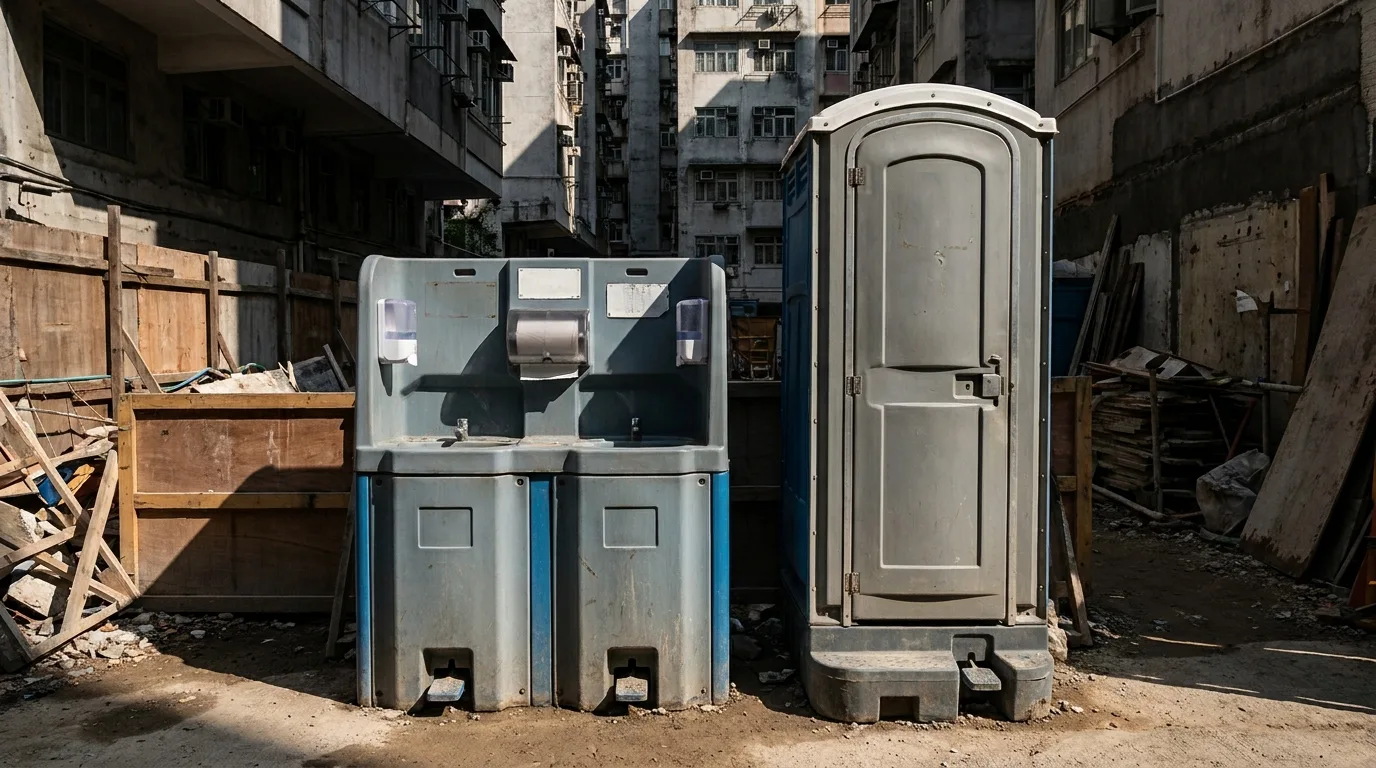
How late can we change the order? Later than most suppliers will tell you. Call rather than email if it is inside 24 hours, and see emergency porta potty rental if it is inside a few hours.
Can you deliver before call time? Yes, subject to the New York City Noise Code, which treats 10pm to 7am as the night period on residential blocks.
Do you work stage and warehouse locations too? Yes, and those are easier. A storage container or mobile office trailer often goes on the same order.
What about a shoot in New Jersey? Jersey City, Hoboken and Newark are all in normal range, with the rest on the service areas page.
Do you handle power for a night shoot?
We can arrange the portable generator rental film crews expect, and light towers with it.
Send the permit block, the dates and the crew count through the quote form, or call from the contact page. Related work sits on event restroom rental and construction site services, the market overview on porta potty rental in New York City, and everything else on the home page and in the FAQ.
Next step
Get a delivery date
Tell us the address, the dates and the headcount. We size the order and confirm the route.