
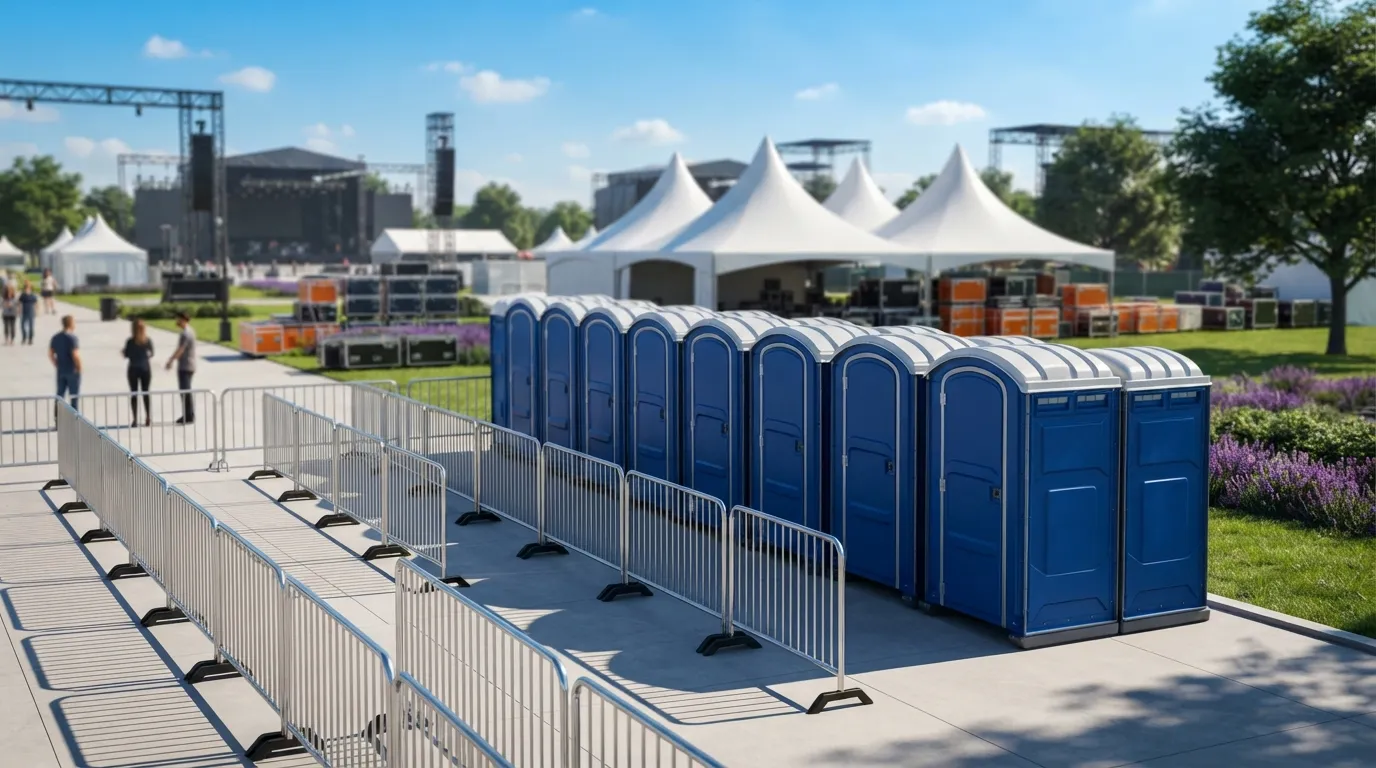
What event restroom rental means in New York
Event restroom rental is the short-term supply of portable toilets, handwashing and restroom trailers for a gathering that has no plumbing of its own, or not enough of it. The unit is the easy part. In this city the job is really about permission and access: who controls the ground, what the truck can reach, and how long the approval takes.
Three different bodies control most event ground here, and they do not run on the same clock:
- NYC Parks, for Prospect Park, Flushing Meadows Corona Park and the rest of the park system, through its special events permit process
- The Street Activity Permit Office in the Mayor's Office of Citywide Event Coordination and Management, for block parties, street fairs and anything closing a roadway
- The venue itself, for Citi Field, Yankee Stadium and Randalls Island, each of which sets its own service vehicle rules and lead times
Ask that question first. We have quoted plenty of events where the restrooms were sorted a month before the ground was.
How many portable toilets does an event need?
The working rule across the portable sanitation trade is one unit per 50 guests for a four hour event, then 15 to 20 percent more where alcohol is served, because alcohol raises both frequency and dwell time. Longer events need more, not the same units for longer. An eight hour street festival at the same headcount needs roughly double a four hour one.
| Guests | 4 hours, no alcohol | 4 hours, with alcohol | 8 hours, with alcohol |
|---|---|---|---|
| 100 | 2 units | 2 to 3 units | 4 units |
| 250 | 5 units | 6 units | 10 units |
| 500 | 10 units | 12 units | 20 units |
| 1,000 | 20 units | 23 to 24 units | 40 units |
| 2,000 | 40 units | 46 to 48 units | 80 units |
Where units are clustered at one location, the 2010 ADA Standards section 213.2 exception 4 puts the accessible share at 5 percent of the cluster, so a bank of 20 needs at least one ADA accessible unit and a bank of 40 needs two. Run your own numbers on how many porta potties you need and check the ADA restroom requirements before you sign off a layout.
What does event restroom rental cost in New York City?
Typical five-borough ranges, reviewed July 2026. These are market bands rather than a quote, and delivery access moves them more than anything else on the list.
| Unit | Typical event range | Notes |
|---|---|---|
| Standard unit | $250 to $450 | The blue box, one day, delivered and collected |
| Deluxe flushable | $300 to $500 | Foot flush and an interior hand sink |
| ADA accessible | $300 to $600 | Ground-level entry, wider footprint |
| 2 stall trailer | $1,000 to $2,500 weekend | Needs power and water |
| 4 stall trailer | $1,400 to $3,000 weekend | Common for 150 to 300 guests |
| Handwash station | $75 to $150 | Two stations per bank of 10 units |
Full pricing across every duration is on the porta potty rental cost page, and restroom trailer rental cost breaks the trailers out by stall count. A one-day rental always costs the most per day, because delivery and collection are the same work whether the unit stays six hours or six weeks.
Do you need a permit for event porta potties in NYC?
Only when the unit sits on public right of way. A unit on a New York City street or sidewalk needs a permit from the Department of Transportation, filed through borough offices, with turnaround ranging from about a day to several weeks depending on the borough and the type of work. The NYC DOT Bureau of Permit Management and Construction Control at 55 Water Street runs it, and 311 will point you at the right office for your block.
Park events go through NYC Parks instead, and street closures through the Street Activity Permit Office, and both of those want an application well before the date rather than the week of it. Pedestrian clearance still governs the layout in every case: no curb ramp, building entrance, emergency path or work-zone route blocked, and the 2010 ADA Standards require a 36 inch minimum clear width on a pedestrian access route in section 403.5.1. On a private rooftop, courtyard or lot, none of the permit process applies. See porta potty permit requirements for the full walkthrough.
Where the units go, and why the layout matters more here
Pick placements before you pick quantities. In a park, that means a spot the service truck can reach without crossing turf. On a street, it means a stretch of curb that clears the pedestrian path with the doors open. On a rooftop or in a courtyard, it means a freight elevator or a lift and a written confirmation from the building.
- Keep banks 50 to 150 feet from food service, downwind if the site has a prevailing wind
- Light the approach, because most complaints about event restrooms are really about the walk to them
- Split a large bank into two smaller ones rather than one long row, which halves the queue
- Leave the service truck a legal stop within roughly 30 feet of the units
- Put the ADA unit at the end of the row on level ground, not in the middle
The placement guide covers measuring a spot, and the rental checklist is the list we ask clients to work through before the site visit.
Trailers, deluxe units, or plain standard units
A restroom trailer is a towable unit with flushing toilets, running water, lighting and climate control, and it replaces roughly four to eight standard units depending on stall count. Trailers need a 110-volt 20-amp circuit and a hose connection per manufacturer spec, with fresh water tanks typically 100 to 300 gallons, so a park or rooftop site without utilities needs a generator in the plan too.
The honest split: hard hats and back-of-house get standard units, guests in good clothes get a trailer or at least a deluxe flushable. Weddings almost always want the luxury trailer. Long shoot days and multi-day builds sometimes want a shower trailer as well.
Servicing during a multi-day event
ANSI/PSAI Z4.3 sets weekly servicing as the floor for a unit in normal use, and an event is not normal use. A standard unit carries a 60 to 70 gallon holding tank per manufacturer spec, and a busy bank at a street fair can work through that in a single afternoon. Multi-day events get serviced overnight or between sessions, which has to be written into the plan because the truck needs a route in while the site is closed.
By event type, the detail sits on festival restrooms, concerts, marathons and races, golf tournaments, county fairs and weddings. Film and television work runs on its own rules again, covered on film set restroom rental.
Questions event planners in New York ask
How far ahead should I book? For May through October weekends, as early as you can. Street fair season concentrates demand into a handful of dates across all five boroughs and availability tightens fast.
Can you deliver the night before? Usually, and often that is the only workable option in Manhattan. Overnight placement needs a secure spot or a permitted one.
What if the site has no power or water? Standard and deluxe units need neither. Trailers need both, or a generator and a water tank.
Do you supply barriers and fencing too? Yes. Crowd control barrier and temporary fencing go out on the same trucks, and a light tower if the site runs after dark.
Do you cover events outside the city? Yes. Jersey City, Hoboken and Freeport are all in range, with the rest on the service areas page.
Is an event porta potty different from a standard unit?
Cleaner and serviced more often. Event portable toilet rental is priced on hours, not weeks.
What does portable toilet rental for events include?
Drop, one service and collection. Porta potty rental for events over 500 guests usually needs a mid-event service.
What is a special event porta potty?
A deluxe unit with a flush and a sink, used where guests are dressed up.
Send the date, the headcount and the exact location through the quote form, or call from the contact page. The wider market picture is on porta potty rental in New York City, the FAQ answers the rest, how we work is on the about page, and everything else we rent is listed on the home page.
Next step
Get a delivery date
Tell us the address, the dates and the headcount. We size the order and confirm the route.