
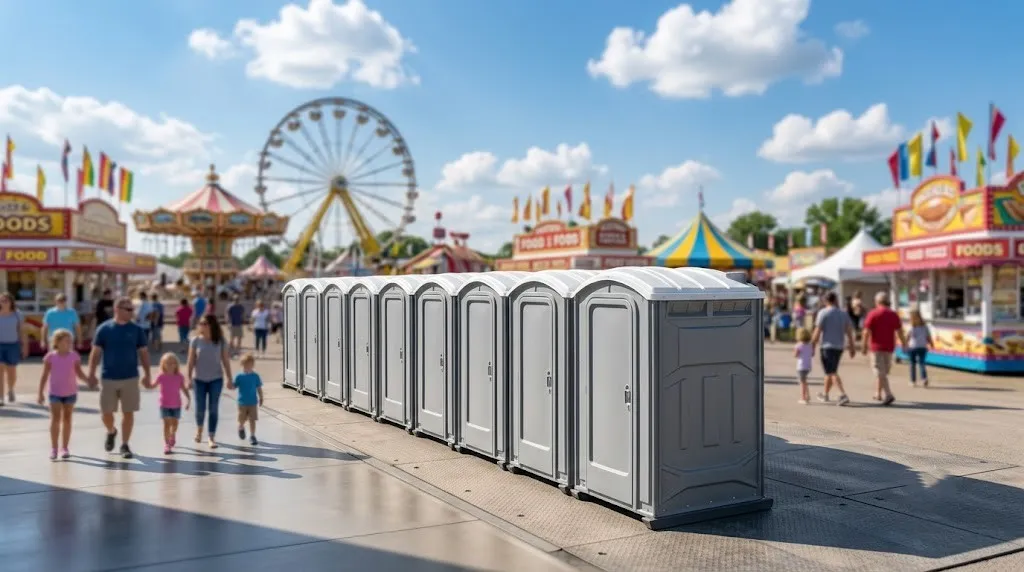
New York City has five counties, and two real county fairs
The five boroughs are five counties: New York, Kings, Queens, Bronx and Richmond. Two of them still hold a genuine county fair. The Queens County Farm Museum in Floral Park, a working farm on roughly 47 acres and the longest continuously farmed site in New York State, hosts the Queens County Fair. The Richmond County Fair has run at Historic Richmond Town on Staten Island. Everything else the city calls a fair is really a street fair, which is a different animal and is covered on festival restroom rental.
Most of the true county fairs our trucks reach sit past the city line, in Nassau, Suffolk and northern New Jersey. Those sites are easier in one way, because there is room to work, and harder in another, because they are field placements with no hardstand and no utilities.
How many portable toilets does a county fair need?
Fairs are multi-day and attendance is a daily figure, so size against peak simultaneous attendance rather than the total gate across the run. Start from one unit per 50 people for a four hour session, scale with the hours the gates are open, and add 15 to 20 percent where beer is sold.
| Peak daily attendance | 8 hour day | 12 hour day | ADA minimum |
|---|---|---|---|
| 1,000 | 20 units | 26 to 30 units | 1 to 2 units |
| 3,000 | 40 to 60 units | 78 to 90 units | 3 to 5 units |
| 5,000 | 100 units | 130 to 150 units | 5 to 8 units |
Where units are clustered at one location, the 2010 ADA Standards section 213.2 exception 4 puts the accessible share at 5 percent of the cluster, so a bank of 20 needs at least one ADA accessible unit on level ground with its own approach. Fairs draw a wide age range and a lot of strollers, so the accessible units get used far more than the ratio implies. Method on how many porta potties you need and ADA restroom requirements.
Handwashing at animal exhibits and food rows
This is the part of a fair plan that regulators look at first. New York tightened fair sanitation practice after the 2005 E. coli outbreak at the Rensselaer County Fair, and handwashing at animal contact areas is now standard at fairs across the state. Inside the city, the New York City Department of Health and Mental Hygiene requires handwashing facilities as part of the temporary food service permit vendors operate under.
- A handwashing station at every exit from an animal contact area, not just at the food row
- Two sink stations per bank of about 10 toilets as a baseline
- Hand sanitizer stands as a supplement, never as a replacement where animals are involved
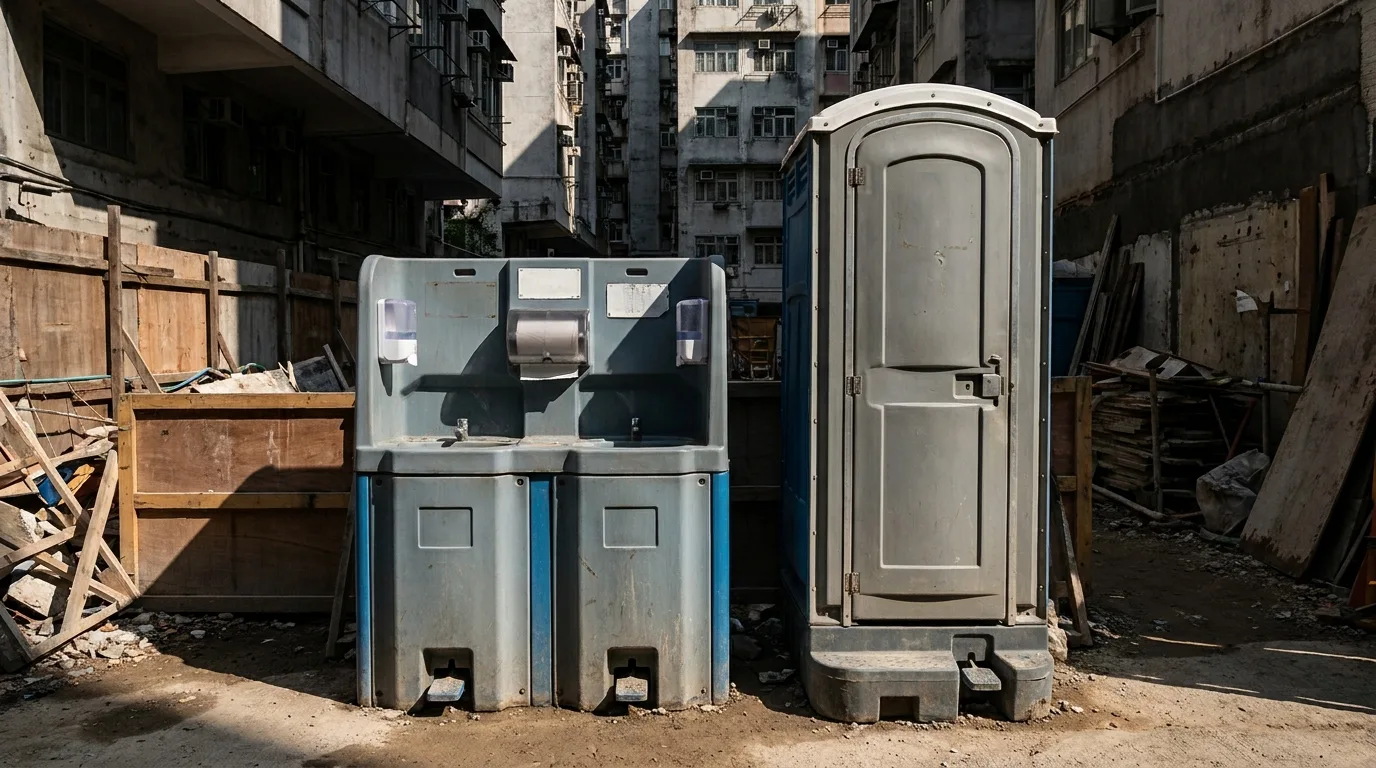
- A portable sink for vendors who need a dedicated one
- Handwashing requirements sets out what applies where
Servicing a fair that runs for several days
A standard unit carries a 60 to 70 gallon holding tank per manufacturer spec, and a fair bank in August will fill that in a day. ANSI/PSAI Z4.3 sets weekly servicing as the floor for a unit in normal use, so a multi-day fair needs a written service plan on top: an overnight pump-out between days, a mid-day restock on the busiest ones, and a truck route that does not cross the midway.
Agree the access point with the fair operator before the layout is locked. On a farm site that usually means a field gate. At a city location it means whichever street the permit allows a truck to stand on. New York State licenses the haulers moving that waste under 6 NYCRR Part 364, so the truck carries its own permit. More detail on how often porta potties are cleaned, and do porta potties smell is the honest answer to the question fair committees always ask.
Do fair restrooms need a permit in New York City?
Only if a unit stands on public right of way. A unit on a New York City street or sidewalk needs a permit from the Department of Transportation, filed through borough offices, with turnaround running from about a day to several weeks depending on the borough and the type of work. The NYC DOT Bureau of Permit Management and Construction Control at 55 Water Street runs the process, and 311 will confirm what applies.
An event on city parkland goes through the NYC Parks special events permit process instead, and a street closure through the Street Activity Permit Office. On private farm ground, whether that is in Queens or out on Long Island, no city permit applies to the unit at all. Pedestrian clearance still governs any placement touching a public path, and the 2010 ADA Standards require a 36 inch minimum clear width on a pedestrian access route in section 403.5.1. See porta potty permit requirements.
Placement on a field site with no hardstand
Fair ground is usually grass or packed dirt, which changes what we do and what we bring.
- Units go on plywood or matting, because a loaded unit weighs near 700 pounds and soft ground moves
- Banks split into several small ones across the site, so nobody walks past the livestock tent to queue
- Lighting matters more than at a daytime event, and a light tower over a restroom bank prevents most of the complaints
- Keep banks upwind and 50 to 150 feet from food rows
- Vehicle access to each bank, with a legal stop within roughly 30 feet for the service truck
The placement guide covers the measuring, and temporary fencing or crowd control barrier usually goes in on the same delivery.
What county fair restrooms cost
Typical market ranges for our service area, reviewed July 2026. Multi-day orders are priced per job because the servicing schedule is a bigger line than the units.
| Item | Typical range |
|---|---|
| Standard unit, event use | $250 to $450 |
| ADA unit, event use | $300 to $600 |
| Handwash station | $75 to $150 |
| Extra service visit | $75 to $125 |
| 20 yard dumpster, weekly | $475 to $700 |
| Delivery | $75 to $200 |
Volume moves those numbers down noticeably once the truck is already committed to the site. Full detail on the porta potty rental cost page and dumpster rental cost.
Questions fair committees ask
How far ahead should we book? For late-summer dates, months. August and September concentrate most fair activity in this region into a handful of weekends.
Can you pump out overnight? Yes, and on any fair running more than one day that is the plan rather than an option.
Do you cover fairgrounds outside the city? Yes. Hempstead, Levittown and Freeport are all in normal range, with the full list on the service areas page.
What about the livestock side of a farm site? Farm and agricultural restrooms covers the working-farm rules, which are a different set again.
Send the dates, the daily attendance estimate and the site plan through the quote form, or call from the contact page. Related work sits on event restroom rental and golf tournament restrooms, the market overview on porta potty rental in New York City, and everything else on the home page and in the FAQ.
Next step
Get a delivery date
Tell us the address, the dates and the headcount. We size the order and confirm the route.