
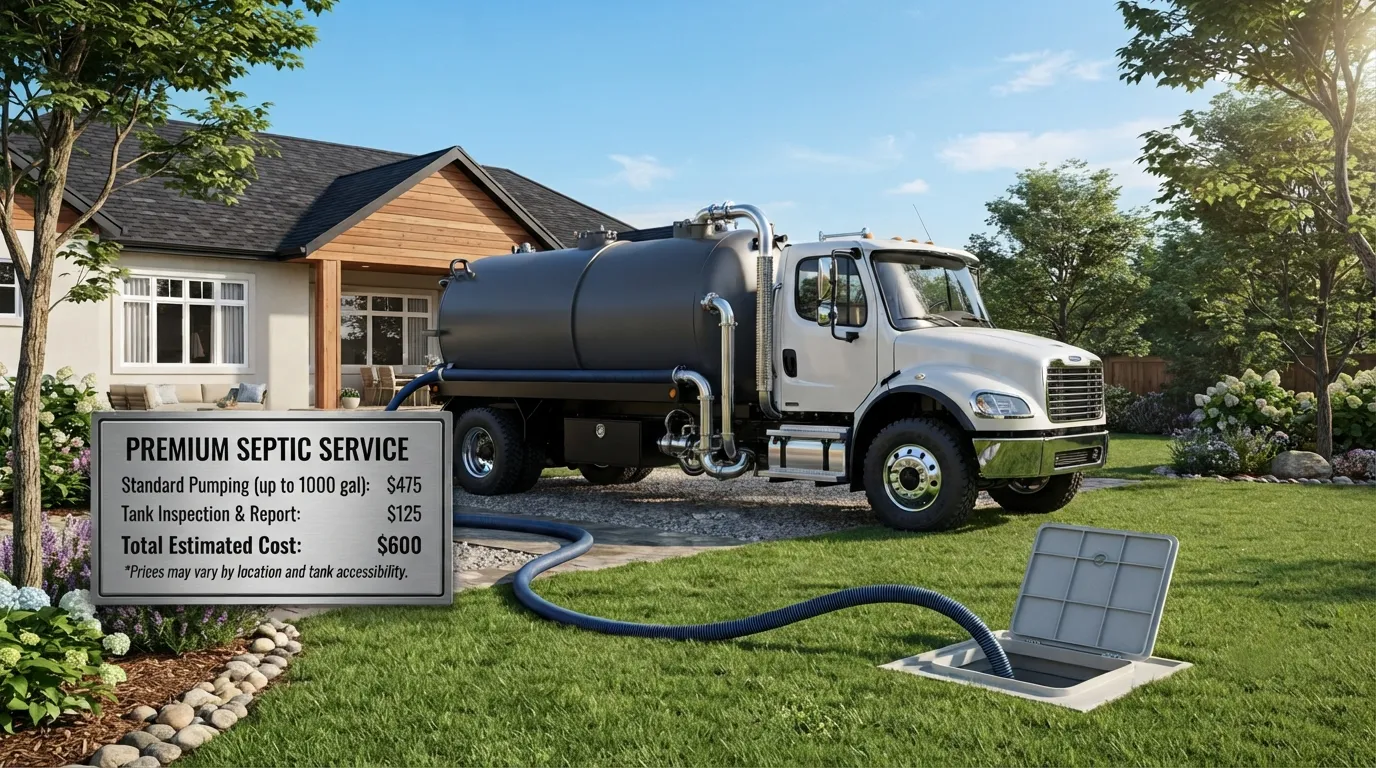
How much does septic tank pumping cost?
Septic tank pumping is billed per job, not per hour and not per gallon, and the published market band for a straightforward residential visit is $150 to $300. Prices reviewed July 2026. These are typical market ranges rather than a quote, and our price data on septic work is thinner than our data on portable toilets, so treat the edges as soft rather than fixed.
Two things about that band are worth understanding before you compare quotes. It assumes the tank can be found and opened without excavation, and it assumes the truck can stop within hose reach. In New York City the second assumption fails more often than the first.
Septic pumping prices by tank size
New York State Department of Health Appendix 75-A of 10 NYCRR sets minimum residential tank volumes at 1,000 gallons for a one to three bedroom house, 1,250 gallons for four bedrooms and 1,500 gallons for five. Most of what gets pumped on Staten Island sits at or near that 1,000 gallon floor.
Above the 1,000 gallon line, the figures below are the market band scaled by volume rather than separately published price data. Use them for planning, then get the job quoted.
| Tank size | Typical range per pump-out | Notes |
|---|---|---|
| 750 gallon | $150 to $275 | Older or undersized tanks, usually pre-Appendix 75-A |
| 1,000 gallon | $150 to $300 | The standard residential job and the best-supported figure here |
| 1,250 gallon | $200 to $350 | Four bedroom minimum under Appendix 75-A |
| 1,500 gallon | $225 to $400 | Five bedroom minimum |
| 2,000 gallon and up | quote only | Usually commercial, often two-compartment |
| Cesspool | quote only | Pumped on volume, generally more often |
| Sealed holding tank | quote only | Priced on volume and visit frequency |
Volume is not the only reason a bigger tank costs more. Water weighs 8.34 pounds per gallon, so 1,500 gallons of septage is more than six tons of payload, and a vacuum tanker carrying between 1,500 and 5,000 gallons per manufacturer spec fills up faster on large tanks. Fewer stops per load means more trips to the disposal point, and that time is in the price.
What is in the price, and what is billed separately
Ask for these as named lines. A quote that gives one number and no breakdown is not comparable to one that does.
| Line item | How it is usually handled |
|---|---|
| Pump-out labour and truck time | In the base price |
| Disposal at a permitted facility | Normally in the base price. Get it confirmed |
| Effluent filter clean | Should be included, not an add-on |
| Baffle and tee inspection | Should be included |
| Locating an unmarked lid | Often a separate charge |
| Excavating a buried lid | Separate labour, and the most common surprise |
| Riser fitted so the next visit is easy | Quoted separately, pays for itself in two visits |
| Hose run beyond about 150 feet | Extra time, sometimes an extra charge |
| Same-day or after-hours callout | Above the band. See emergency septic service |
| Written condition report | Ask for it. Costs nothing to provide |
The single biggest avoidable cost on this list is the buried lid. If yours is 18 inches down, you are paying for that dig every three to five years forever, and a riser ends it. The septic tank cleaning page explains what the visit itself involves.
What makes a New York City septic job cost more?
Access, and almost nothing else. The tank is the same tank it would be in Dutchess County.
Commercial vehicles are banned from New York City parkways, so a tanker heading to a Staten Island South Shore address runs the Staten Island Expressway and the West Shore Expressway instead of the Belt, and it has to stay on the NYC DOT designated truck route network for the through leg. That is real drive time on a job priced per visit.
Then there is the kerb. Alternate side rules, hydrant zones, bus lanes and loading restrictions all take stopping options away, and a tanker cannot sit double parked the way a service van can. If the work has to occupy the street or sidewalk beyond ordinary standing, it becomes a New York City Department of Transportation permit matter, handled through borough offices by the Bureau of Permit Management and Construction Control at 55 Water Street, with turnaround from about a day to several weeks depending on the borough and the type of work. Call 311 for your specific block. The same rule drives porta potty permit requirements and dumpster permits.
Where the hose crosses matters too. The 2010 ADA Standards require a minimum 36 inch clear width on a pedestrian access route in section 403.5.1, so a hose run across a narrow sidewalk has to leave a walkable path the whole time the crew is working. Our placement guide covers the same clearance rules from the delivery side, and jobs that need tank service alongside units and skips are bundled through construction site services.
How much does it cost to pump a 1,000 gallon septic tank?
Budget $150 to $300 for a 1,000 gallon tank in normal condition with an accessible lid. That is the best-supported number on this page and the one most New York City households will pay.
Three things push a 1,000 gallon job above $300 rather than below it: a lid that has to be excavated, a truck that cannot get within about 150 feet, and a tank that has not been touched in a decade so the sludge cake needs breaking up rather than sucking out. None of those are surcharges invented at the door. They are extra hours, and an honest quote names them before the truck rolls.
What does emergency septic pumping cost?
Same-day, overnight and weekend work is priced above the standard band, because it means pulling a truck off a planned route. Sewage backing into a fixture, effluent surfacing in the yard or an alarm on a pump tank are all genuine emergencies. Slow drains and a faint odour outside are not, and paying the premium for them is money wasted.
Response, what counts as urgent and how the call gets priced sit on the emergency septic service page, and the warning signs page sorts the urgent symptoms from the ones that can wait for a scheduled visit.
How septic pumping compares with our other site service prices
Useful context if you are budgeting a whole property or a whole job rather than one line. All figures are typical New York City market ranges, reviewed July 2026.
| Service | Typical range |
|---|---|
| Septic pump-out, standard residential | $150 to $300 per visit |
| Standard porta potty, weekend | $175 to $300 |
| Porta potty, per day | $125 to $350 |
| Porta potty, monthly with weekly service | $150 to $350 |
| Deluxe flushable unit, weekend | $250 to $400 |
| ADA accessible unit, weekend | $225 to $350 |
| Two stall restroom trailer, weekend | $1,000 to $2,500 |
| Handwash station, per event | $75 to $150 |
| Roll-off dumpster, per week | $425 to $775 |
| Storage container, per month | $100 to $250 |
| Temporary fence, per day | $30 to $75 |
Full breakdowns live on the dumpster rental cost page, the restroom trailer cost page, the storage container cost page and the temporary fence cost page.
Septic pumping is the cheapest recurring line on that table and the one with the highest cost of neglect, which is the whole argument for keeping to a schedule.
Keeping the ten year cost down
The pump-out price is not really the number that matters. The drain field is.
- Pump on schedule. The US EPA recommends inspection at least every 3 years and pumping every 3 to
5, and a field blinded off by solids does not recover.
- Fit a riser once. It removes the excavation charge from every future visit.
- Keep wipes out. New York City DEP's Trash It, Don't Flush It campaign names wipes, paper towels
and grease as the main causes of clogs, and all three behave the same way in a septic tank.
- Skip additives. The EPA states plainly that they do not remove the need to pump.
- Watch the disposal. Daily use raises the solids load reaching the tank by up to 50 percent
according to the EPA, which takes roughly a year off the interval.
- Get a written condition note each visit so you see a baffle failing before it becomes a backup.
The pumping frequency guide turns points 1 and 5 into an actual schedule for your tank size and household. On a commercial property the equivalent line is the grease interceptor, which runs on a much shorter clock and is the other recurring cost most owners underestimate.
Is a very cheap septic quote a warning sign?
Sometimes, and the tell is disposal. Anyone hauling septage in New York State needs a New York State Department of Environmental Conservation Part 364 waste transporter permit and has to deliver the load to a facility permitted to receive it, which in this city generally means one of DEP's 14 wastewater resource recovery facilities. That disposal step has a real cost, and a price far under the market band sometimes means it is being skipped.
Ask for the manifest. A hauler who hands you paperwork naming where the load went is doing the job properly. The other common shortcut is pumping the liquid off the top and leaving the sludge, which looks identical on the invoice and costs you a drain field a few years later. The cleaning page sets out the nine steps a full visit should include, so you can check an invoice against them.
What a fair septic quote names
Tank size, whether the lid is at grade, how far the truck will be from it, whether the filter clean and baffle check are included, where the septage goes, and whether disposal is inside the number or outside it. A quote missing those is a number, not a quote.
What is the average cost of septic tank pumping?
It tracks tank size and access. 1000 gallon septic tank pumping cost is the usual benchmark.
Is septic tank pumping cost near me higher out of hours?
Yes. Weekend and night dispatch carries a premium in New York City.
Our request a quote form asks all of it up front. If you would rather talk it through, the contact page has the direct line and the FAQ covers the common ones. Everything else we run across the five boroughs sits on the septic pumping service page, grease trap pumping, portable toilet rental, restroom trailers and the home page, with the full service area listed on the areas we cover page. Local jobs in Jersey City, Bayonne, Elizabeth and Freeport are priced the same way, and there is more on how we quote on the about page and the New York City rental page.
Next step
Get a delivery date
Tell us the address, the dates and the headcount. We size the order and confirm the route.